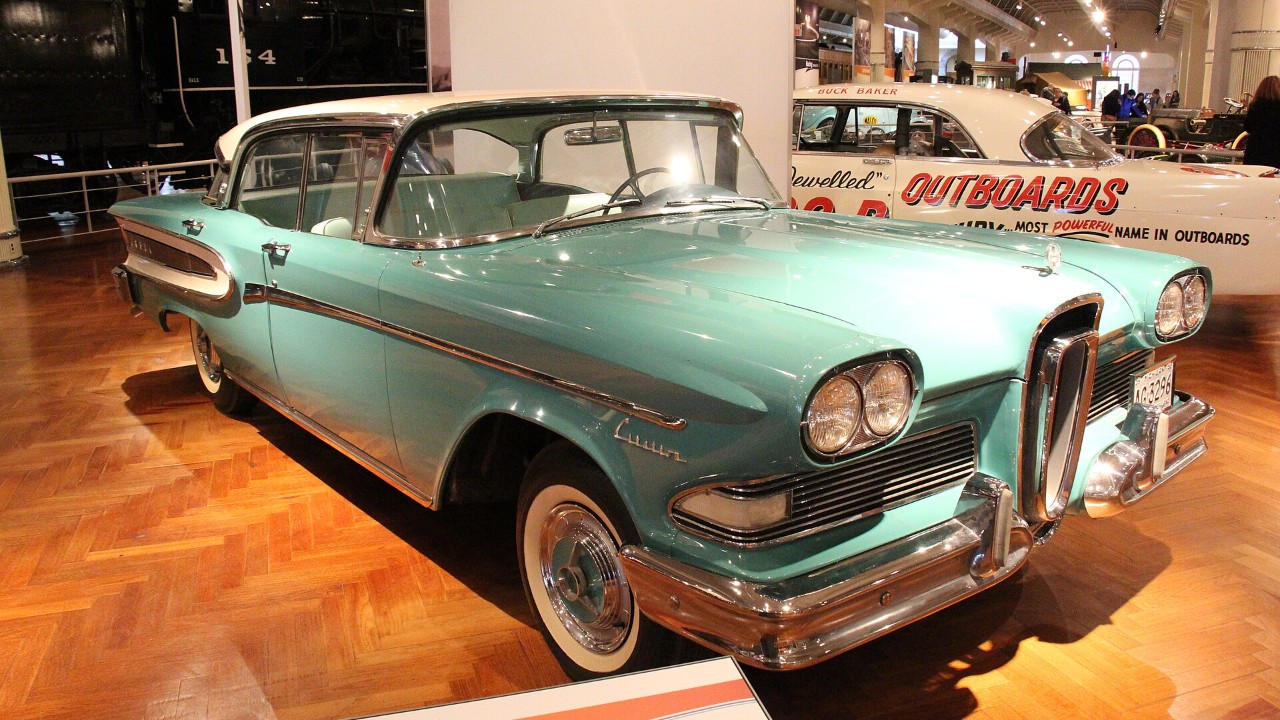
Most automatics of the late 1950s shifted with a lever on the column. The 1958 Edsel did it differently. Its Edsel Teletouch system put five push buttons in the center of the steering wheel, the spot where drivers were used to reaching for the horn.
Ford launched the Edsel as a whole new make, and Teletouch was one of its signature tricks. It looked like the future in a showroom. On the road, however, it brought a set of problems that ended its life after a single model year.
So here is how the buttons worked, what they cost, why they caused trouble and what a Teletouch Edsel brings today.
How the Edsel Teletouch buttons worked

The Edsel Teletouch pod sat in the hub of the wheel, but it did not turn with the wheel. According to the Edsel Owners Club’s 1958 model history, planetary gears in the steering column kept the buttons still while the rim turned around them. As a result, the labels always read the right way up.
The buttons ran P, R, N, D and L, with “Dr” for Drive and “Lo” for Low, as The Truth About Cars explains in its history of Ford’s automatics. Neutral sat at the top. Electrical current reached the pod through slip rings and brush contacts, Motorious notes.
Pressing a button did not move anything mechanical in the column. Instead, it sent a signal to a servo motor mounted down at the transmission. That motor then moved the shift controls on the Cruise-O-Matic gearbox for the driver.
Ford also built in a safeguard. An inhibitor switch, worked by transmission fluid pressure, was meant to block a careless stab at Reverse or Park while the car was moving.
Standard on the big Edsels, $231.40 on the rest
The Edsel line split into two families for 1958. The senior Citation and Corsair rode on a large Mercury-based frame. Meanwhile, the junior Ranger, Pacer and the Bermuda, Villager and Roundup wagons used a smaller Ford-based frame.
The Citation and Corsair offered only the Teletouch automatic, according to the Edsel Owners Club. On the Ranger, Pacer and wagons, it was an option that retailed for $231.40. Buyers took it in large numbers, because about 95 percent of 1958 Edsels had automatic transmissions.
There was briefly a fancier version, too. Edsel offered a six-button Dual-Range Teletouch, but it deleted that option on February 4, 1958.
Under the hood, the junior cars used the E-400 V8. It displaced 361 cubic inches and made 303 horsepower. By comparison, the Citation and Corsair got the E-475, a 410-cubic-inch V8 rated at 345 horsepower, the club records.
Why the buttons caused trouble
The idea was clever, but the hardware lived in a bad place. The servo motor, its relays, switches and wiring sat between the bell housing and the exhaust, close to the road. That spot was hot, wet and dirty, both The Truth About Cars and Motorious point out. In fact, TTAC blames the unreliable operation on those parts rather than on the buttons themselves.
The hub location created a human problem as well. Drivers who were used to finding the horn in the middle of the wheel sometimes hit the pod with a hand or fist in an emergency. That rarely changed gears, TTAC says, but it occasionally damaged the button panel.
The safety switch had a gap, too. Pressing Neutral first took away the hydraulic pressure that held the inhibitor. A driver could then select Reverse or Park at speed, which could break the parking pawl. Also, the buttons demanded a glance down at a very close point, which made them hard to read on the move, Curbside Classic notes.
Edsel was not alone with push buttons at the time. Chrysler had already put mechanical buttons to the left of the wheel in 1956, and Packard offered an electric Touch Button Ultramatic the same year.
One year and done
Ford did not hold back on the launch. The official first day of Edsel production was July 15, 1957, according to the club. Before that, Ford signed more than 1,000 dealers and built a new factory in Kentucky, RM Sotheby’s notes. It also ran Edsel ads on all four major TV networks at the same time.
The Edsel itself still had a hard start. Ford held E-Day on September 4, 1957, and some 2.5 million Americans visited Edsel dealers that day, the club says. Even so, the launch ran into a recession, and buyers were already moving toward smaller cars.
Ford had projected first-year sales of 200,000. Instead, 1958 US production came to 63,110 cars, including 192 knock-down kits for export assembly. Total 1958 Edsel production reached 68,045.
Teletouch did not see a second season. Edsel dropped the system for 1959, and the brand itself was gone by the end of that year, Motorious notes. Across three model years, Ford built 110,847 Edsels, and the club estimates fewer than 6,000 survive.
What a Teletouch Edsel brings today
A good Teletouch car is now a conversation piece at any show, since passengers rarely guess how it shifts. At RM Sotheby’s Auburn Fall sale in 2018, a 1958 Edsel Pacer convertible with Teletouch push buttons in the steering-wheel hub sold for $42,900. It had the 303-horsepower E-400 V8, and the auction house listed it as one of just 1,876 Pacer convertibles built.
More from Fast Lane Only