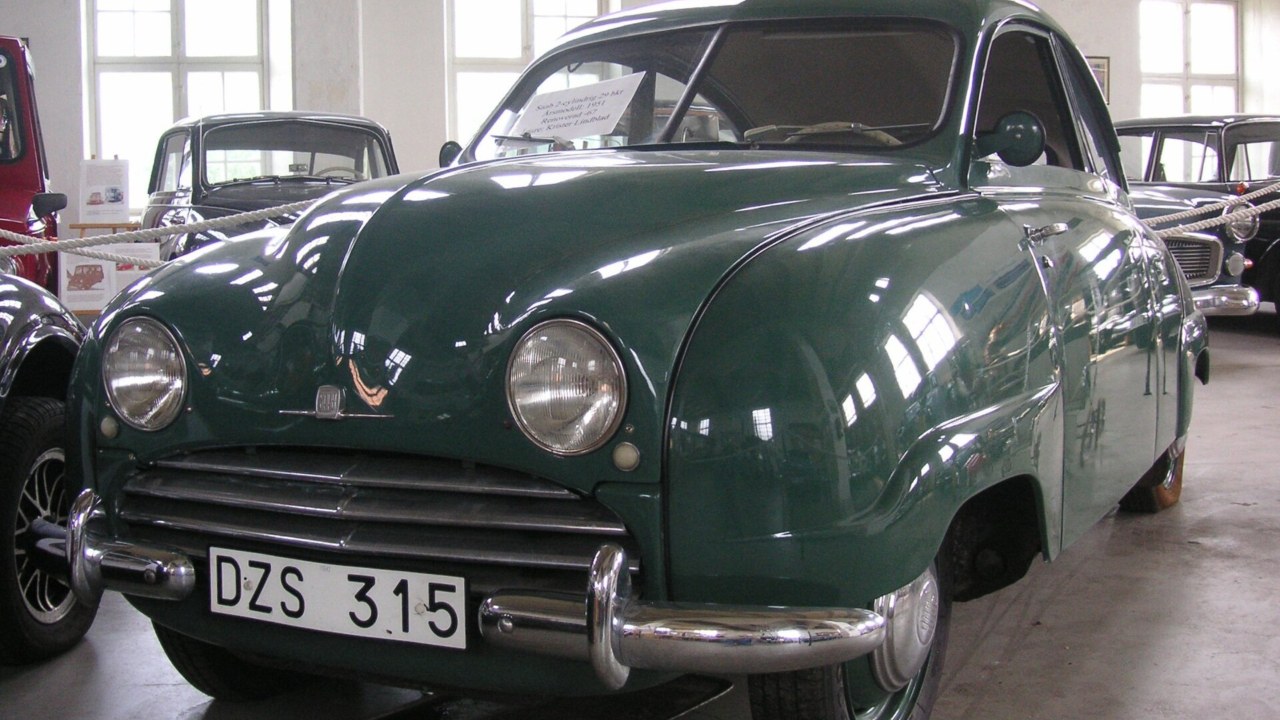
Saab built airplanes before it built a single car. Its first production model, the Saab 92, carried that background in its shape. It slipped through the air with a 0.30 drag coefficient, and the early cars all left the factory in the same shade of green.
That mix of aircraft thinking and wartime thrift makes the little two-door one of the more interesting starts any carmaker has had. It also shows, in one small car, how an aircraft maker thought about the road.
Here is where the car came from, what was under its rounded nose, why the green paint mattered and how many were built.
An aircraft company builds a Saab 92
Saab began in 1937 as Svenska Aeroplan Aktiebolaget, the Swedish Aeroplane Corporation. During World War II it built aircraft for Sweden’s air force, and as the war ended it turned to a car, the Lane Motor Museum records.
The body came from Sixten Sason. He had joined the Swedish Air Force as a pilot until a crash ended that career, Hagerty explains. Later, during the war, he worked on the Saab 17 fighter and the Saab 18 bomber. Sason finished his first sketches for the Saab 92 in 1946, for an in-house design competition.
Engineer Gunnar Ljungström led the work on the first car. The prototype that came first, known as the Ursaab, carried the designation X9248. Hagerty dates it to 1945, and the production car closely followed Sason’s early drawings.
Interestingly, the Ursaab borrowed a DKW-derived drivetrain that the team reverse-engineered, Curbside Classic reports. Today, that first prototype is a star exhibit at the Saab Bilmuseum.
Why the shape mattered
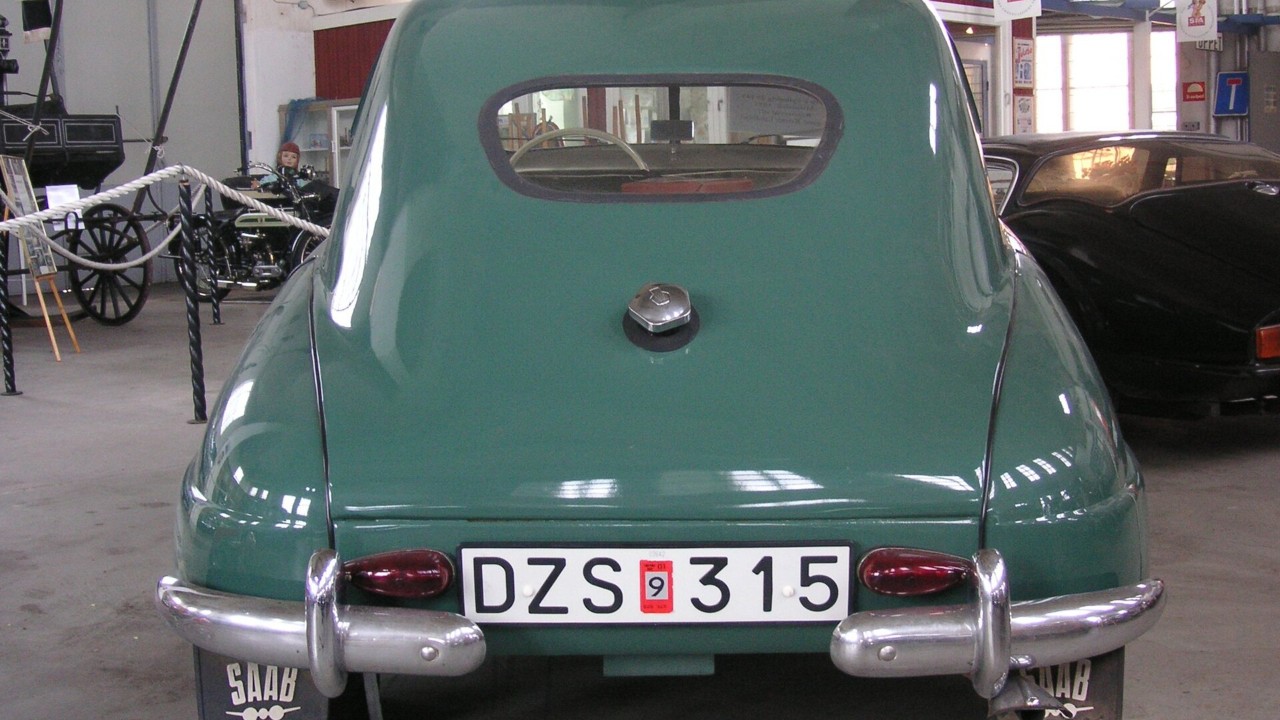
The Saab 92 had a bull-nosed front and a body that tapered toward the rear. For that reason, Hagerty compares it to Paul Jaray’s teardrop concept. The wheels sat faired into the bodywork, much like the “spats” on aircraft tires, and the drag coefficient came to 0.30.
Underneath, the car used a unibody rather than a separate frame. That, too, came from Sason’s aircraft background. In addition, the suspension used torsion bars instead of coil springs.
The Lane Motor Museum adds that the shell had reinforced structural members for safety, years before crash protection became a legal requirement. Front-wheel drive, meanwhile, gave good traction in Scandinavian snow.
There was a practical side as well. The rear seat came out, and a kit could turn the cabin into a double bed, both the Lane Motor Museum and Auto123 note.
A small two-stroke up front
Power came from a transversely mounted, water-cooled two-stroke twin. It displaced 764 cc and made 25 horsepower, according to Hagerty, which says the engine was based on a DKW design. As a result, top speed was a modest 65 mph.
Meanwhile, a three-speed gearbox with a column shifter drove the front wheels. It included a freewheel device, because a two-stroke can starve itself of oil under engine braking. Drivers also had to add oil to the gasoline by hand.
First gear had no synchromesh, the Saabmuseum.com history notes. Still, the car was frugal by design. Only 17 percent of its cost came from imported materials, that history says.
Every early Saab 92 wore green
The color is the detail most people remember. All 1950 cars were green, according to Saabmuseum.com. Curbside Classic describes the early cars as a specific dark green, and Auto123 says every unit from 1949 to late 1952 came in green.
Why green? The usual story says Saab had surplus paint left over from wartime aircraft production. However, Saabmuseum.com calls that tale unconfirmed, and the Lane Motor Museum offers it only as a suggestion. It makes a good explanation, but nobody has proved it.
Production and sales
Full-scale production began on December 12, 1949, with the model-year 1950 car, Saabmuseum.com records. Saab made about 700 in that first run. After that, it built 1,246 cars in 1950. Then the 1951 model year arrived, identical except for one change: German VDO instruments replaced the American Stewart-Warner gauges.
Demand was strong at home. Philipsons, Sweden’s largest car distributor, reportedly had a waiting list of 15,000 to 35,000 people, Saabmuseum.com says. The distributor held exclusive rights after guaranteeing to take 8,000 units in four years. In fact, its advance payment helped Saab start production, and sales beat that target by 1,000 cars.
For 1953, the 92B replaced the original 92. Later, the car reached America, selling about 250 units in its first US year, which Hagerty places in 1956. Early Saabs also started winning rallies with Erik Carlsson at the wheel, which helped people take the brand seriously.
Production ended in 1956, and Saab built 20,128 cars in total, according to Auto123. The Lane Motor Museum, which keeps a green 1950 Saab 92 in its collection, rounds that figure to 20,000.
More from Fast Lane Only