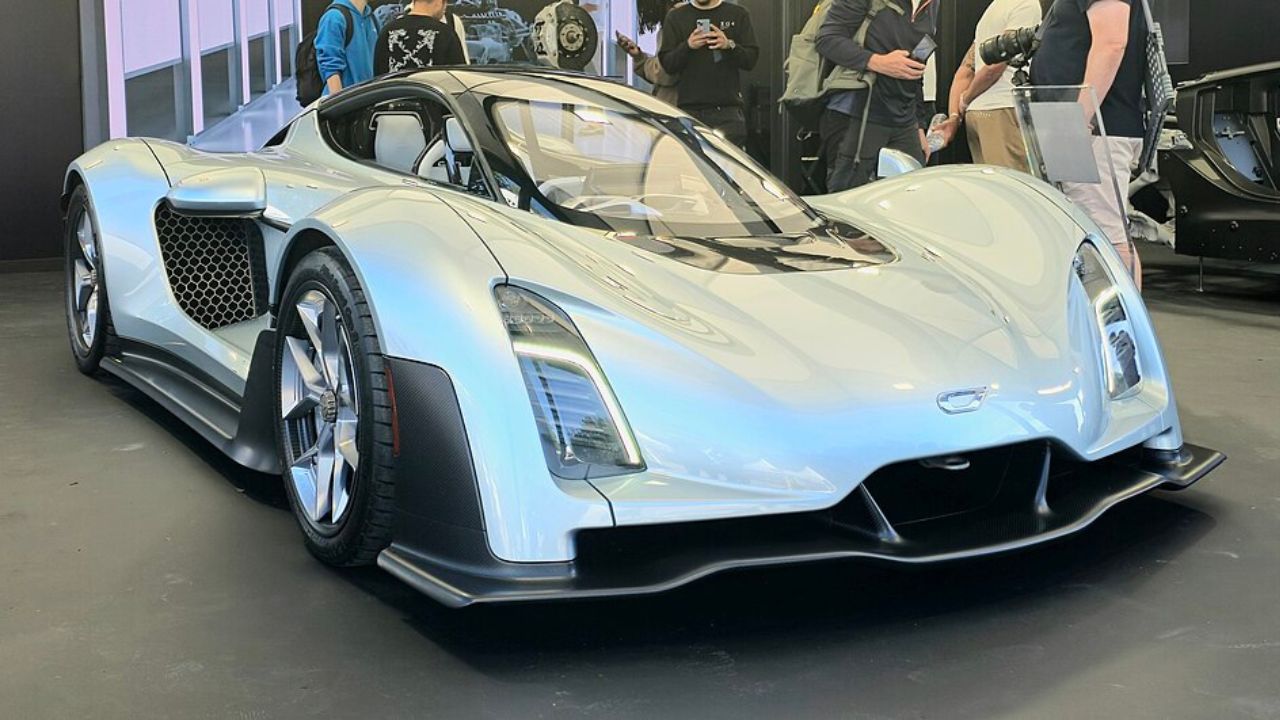
The Czinger 21C does not try to mimic a traditional supercar. It feels like a machine built around a single seat, a single driver, and a single purpose: to deliver the kind of focus and violence usually reserved for fighter pilots. From its tandem cockpit to its 3D-printed structure and hybrid powertrain, the 21C treats the road more like a runway than a street.
That impression is not just marketing. The first drive reveals a car that pairs extreme numbers with equally extreme intent, turning every straight into a launch and every braking zone into a test of nerve and aero grip.
What happened
The Czinger 21C is the first production model from Czinger Vehicles, a Los Angeles-based company founded by Kevin Czinger with the goal of rethinking how cars are designed and built. This low-volume hypercar, limited to 80 units globally, uses a hybrid powertrain and an advanced, largely 3D-printed structure to chase lap records and top-speed runs rather than boulevard posing.
At the heart of the 21C sits a compact 2.88-liter twin-turbo V8 that revs to 11,000 rpm. On its own it produces a figure that would embarrass many larger engines, but in the 21C it works with two electric motors on the front axle. System output is quoted at around 1,250 horsepower in standard form, with an optional upgrade that pushes the total to roughly 1,350 horsepower. Power goes to all four wheels through a seven-speed automated manual gearbox, with the electric motors providing torque vectoring at the front.
The car’s layout is as distinctive as its numbers. Instead of a conventional two-seat, side-by-side cabin, the 21C uses a tandem arrangement, with the driver sitting centrally and the passenger directly behind. This configuration narrows the frontal area, improves aero efficiency, and gives the driver a commanding, aircraft-like view down the center of the car. It also defines the experience from the moment the dihedral door swings up and the driver drops into the carbon shell seat.
The chassis and body structure are built using a mix of carbon fiber and 3D-printed aluminum nodes connected by composite sections. Czinger’s parent company, Divergent, developed a digital manufacturing process that allows engineers to optimize each component for strength, stiffness, and weight, then print it rather than stamp or cast it. The result is a web of organic-looking junctions and spars that resemble something grown more than assembled. That approach extends to subframes and suspension components, where topology-optimized shapes replace traditional straight arms and brackets.
On track, the 21C translates those choices into vivid sensations. The hybrid system’s electric assist fills in any lag from the small-displacement V8, so throttle response feels immediate even at low rpm. Once the turbos are fully spooled, acceleration becomes ferocious, with the car surging forward in a continuous wave rather than a stepped rush. Czinger claims a 0 to 62 mph time well under 2 seconds and a top speed beyond 250 mph, and the first drive impressions suggest those numbers are not theoretical. In its low-drag configuration, the 21C has already set production car lap records at circuits such as Circuit of the Americas and Laguna Seca, using its power and aero to rewrite what a road-legal car can do.
The brakes and aero package play as large a role as the powertrain. Massive carbon-ceramic discs sit behind center-lock wheels, clamped by multi-piston calipers that can haul the car down from triple-digit speeds with repeated consistency. Active aerodynamic elements, including a large rear wing and complex front splitter and underbody, adjust to balance drag and downforce. In high-downforce trim, Czinger quotes figures that rival GT3 race cars, giving the 21C the ability to carry astonishing speed through medium- and high-speed corners.
Inside, the cabin strips away most of the plushness associated with modern exotics. The driver faces a yoke-style steering wheel with integrated controls and a central display that shows speed, gear, and key telemetry. Secondary screens handle cameras and vehicle settings. The tandem passenger seat is narrower and more enclosed, accessed by the same door but with a more confined footwell. Materials are high-quality carbon, metal, and Alcantara, but the overall impression is more cockpit than lounge. Visibility forward is excellent thanks to the central seating position, though the view rearward relies heavily on camera feeds.
On the road portions of the drive, the 21C proves that it can operate outside a circuit, but there is no attempt to disguise its primary focus. Ride quality is firm even in softer modes, road noise is pronounced, and the powertrain remains ever-present. The hybrid system can perform low-speed maneuvers quietly on electric power in limited situations, yet most of the time the V8 is awake and vocal. The car’s width and low ride height demand attention on imperfect pavement and in traffic. It is possible to commute in a 21C, but the experience is closer to ferrying a race car between stages than cruising in a grand tourer.
The first drive report from a dedicated test at a private circuit describes how the 21C’s combination of power, aero, and braking gives it an almost surreal ability to compress straights and shorten braking zones. The driver builds trust in the front end as the electric motors help pull the car into apexes, while the rear remains planted under power thanks to the aero balance and all-wheel drive. According to that first drive review, the car feels more like a track prototype with plates than a conventional hypercar, with the tandem seating and central driving position amplifying that impression.
Why it matters
The Czinger 21C matters for more than lap times and top-speed claims. It represents a different way of thinking about how performance cars are conceived and built, and it arrives at a moment when the definition of a supercar is under pressure from electrification, regulation, and shifting buyer expectations.
The manufacturing story is as significant as the performance. Traditional supercar makers rely on a mix of carbon tubs, aluminum subframes, and hand-finished bodywork. Czinger’s approach uses algorithm-driven design and 3D printing to create structures that are lighter and more efficient, with less tooling investment and potentially shorter development cycles. If the 21C’s underlying Divergent Adaptive Production System proves scalable, it could give Czinger and its partners the ability to iterate more quickly on future models, or even supply structural components to other manufacturers looking to reduce weight and cost without building new factories.
The 21C also shows how a hybrid powertrain can be used for outright performance rather than as a compliance tool. Many recent supercars add electric assistance primarily to lower emissions or satisfy regulations, which can result in heavy, complex systems that blunt feedback. By contrast, the 21C’s compact V8 and front axle motors work together to enhance response and balance. Electric torque fills gaps in the powerband and sharpens turn-in via torque vectoring, while the small engine keeps mass low and centralized. The car still emits plenty of noise and CO2, but it points toward a performance future where electric assistance is integrated from the start rather than layered on late in the program.
The car’s design also challenges expectations about what a road car cabin should be. The tandem layout is not practical for frequent family use, and it complicates casual conversation between driver and passenger. Yet it brings clear benefits in aerodynamics and driver focus. By narrowing the body and putting the driver on the centerline, Czinger reduces drag and frontal area, which in turn allows for higher speed and better efficiency at a given power level. It also gives the driver a symmetrical view of the road and curbs, similar to what McLaren achieved with the F1’s central seat but taken further by placing the passenger behind rather than beside.
That tradeoff speaks to a broader trend in hypercars. As prices climb and volumes shrink, buyers are increasingly willing to accept compromises in comfort and practicality if the result is a more intense, unique experience. The 21C leans into that logic. It is not trying to be a daily driver that also happens to be fast. It is trying to be the most engaging, track-capable road car possible, even if that limits its appeal to a subset of enthusiasts who value lap times and engineering novelty over luggage space and cupholders.
The 21C also enters a competitive set that includes cars like the Rimac Nevera, Bugatti Chiron Super Sport, and track-focused specials from Ferrari, McLaren, and Lamborghini. Many of those rivals chase records with larger engines or full battery-electric powertrains. Czinger’s choice of a small-displacement V8 hybrid positions the 21C as a bridge between pure combustion monsters and silent electric missiles. It keeps the visceral drama of an internal combustion engine while using electric power strategically, which may resonate with drivers who are not ready to give up noise and mechanical character in exchange for instant torque alone.
From a brand perspective, the 21C is Czinger’s calling card. As a first product, it sets the tone for what the company stands for: aggressive engineering, unconventional design, and a willingness to prioritize performance over convention. If the car delivers on its reliability and quality targets, it could help Czinger establish credibility in a space dominated by legacy names. If it stumbles, the perception of 3D-printed structures and radical layouts could suffer by association.
Pricing and exclusivity also matter. With only 80 units planned and a price deep into seven figures, the 21C is not about volume. It is about influence. The owners who buy it are likely to have large collections and strong connections in the enthusiast world. Their feedback and social presence will shape how the wider community views Czinger and its technology. Strong track performance and a compelling story could turn those owners into evangelists, which would help the brand as it develops more accessible models.
Finally, the 21C highlights a tension in the performance car market. As regulations tighten and cities push back against noisy, high-emission vehicles, cars like this face an uncertain long-term future on public roads. Czinger has homologated the 21C for key markets, but the car’s natural environment is a private circuit. That reality raises questions about how long the traditional road-legal hypercar can survive in its current form, and whether future machines will need to lean even more heavily on electric running or track-only status.
What to watch next
The Czinger 21C’s first drive is only the beginning of its story. Several key areas will determine how significant the car ultimately becomes.
One is durability and real-world usability. Early drives focus on controlled environments with factory support. The real test will come when customer cars accumulate mileage on varied roads and tracks. Owners will reveal how the hybrid system copes with repeated heat cycles, how the 3D-printed structural components resist fatigue and corrosion, and how serviceable the complex powertrain and electronics prove over time. Any issues in those areas would not only affect Czinger’s reputation but also broader confidence in printed structural components for high-performance use.
More from Fast Lane Only