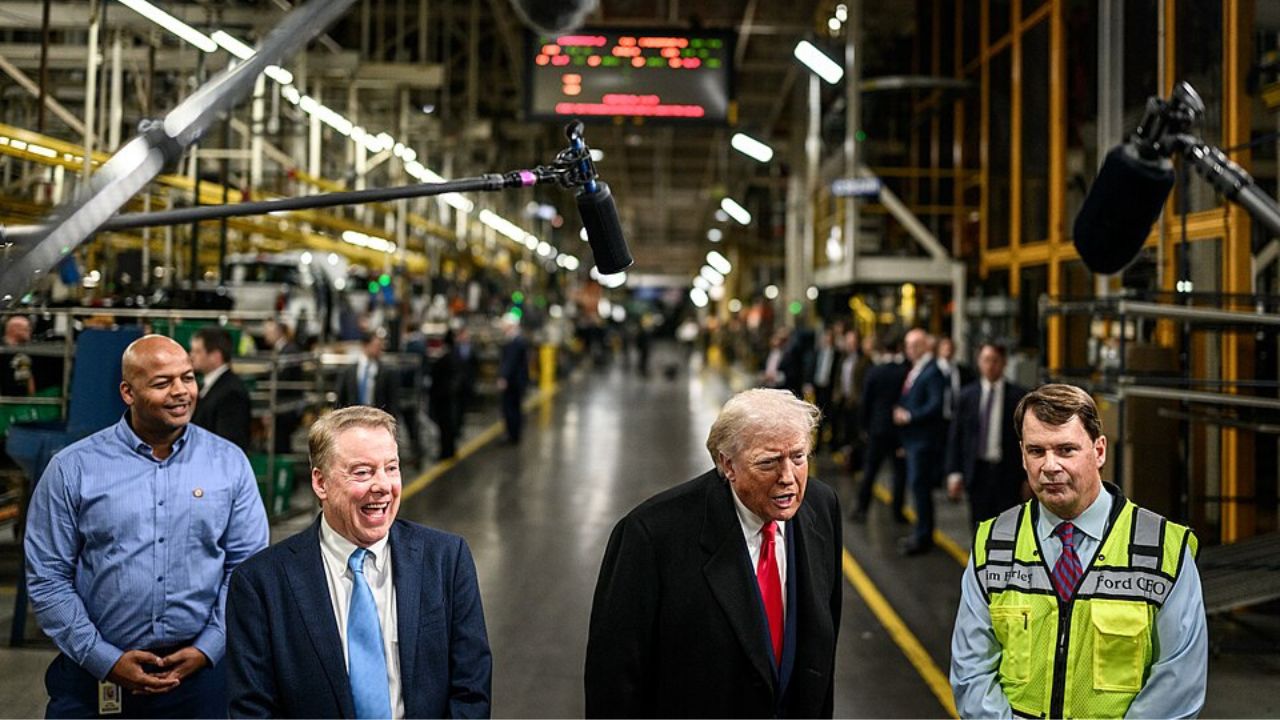
The head of Ford is sounding relieved about one thing in Washington and alarmed about another. Ford CEO Jim Farley says the White House under President Donald Trump will always pick up the phone and listen, but he is just as blunt that the administration has not yet done enough to stop a wave of Chinese electric vehicles from crashing into the American market. In his view, the political access is there, the urgency is not.
Farley’s praise for access, and his warning flare
When I look at how corporate leaders talk about Washington, I rarely hear the kind of open-door description Jim Farley is offering. The Ford CEO has said that the White House will “always answer the phone,” a sign that Jan conversations between Ford and senior officials are frequent and direct, and that Trump’s team is eager to be seen as a partner to Detroit. Farley has framed President Donald Trump as “great to work with,” stressing that the administration is willing to walk through complex decisions with Ford rather than dictate from afar, a level of access that many industries would envy and that reflects how closely the president ties his political fortunes to American manufacturing.
Yet Farley couples that praise with a sharp caveat that the same White House needs to do more to curb China’s auto threat before it is too late. In one vivid example, he has described a “car with ten cameras” packed with sensors and software as a symbol of how far Chinese electric vehicles have leapt ahead, and he wants tougher action soon to keep those models from overwhelming U.S. showrooms, a concern he has raised directly in Jan discussions with the administration, according to Farley.
China’s EV surge and the “car with ten cameras” problem
Farley’s anxiety is rooted in a simple reality: China has built a formidable electric vehicle machine that now threatens to roll straight into the United States. He has pointed to huge subsidies from the Chinese government that have helped local manufacturers flood their home market with advanced EVs, driving down costs and speeding up innovation in ways that American rivals struggle to match. In his telling, the “car with ten cameras” is not a sci‑fi prototype but a real product of that system, a connected vehicle bristling with hardware that can feed data back to Chinese companies and, potentially, to the state, a combination that raises both competitive and security alarms tied directly to the scale of China’s EV surge.
From Farley’s perspective, that surge is not just about cheaper batteries or slick touchscreens, it is about a Chinese industrial strategy that pairs state support with aggressive global expansion. He has warned that Chinese brands, backed by those subsidies and by a domestic market that has already normalized high-tech EVs, could undercut American automakers on price while offering more digital features, a one-two punch that would be hard for Ford or any U.S. rival to counter without policy help. That is why he keeps returning to the image of that camera-laden car, a shorthand for a Chinese EV sector that is not only catching up but, in some segments, already ahead of what American and European companies have on the road.
Trump’s record so far: friendly, but not yet fierce enough
Farley is careful to acknowledge that Trump has already taken steps that many in the auto industry welcome. He has praised the president’s decision to roll back fuel economy standards that had been tightening under previous administrations, arguing that looser rules give Ford more flexibility to balance internal combustion trucks with new EVs. He has also credited Trump with easing some auto tariffs that had complicated cross-border supply chains, saying that the White House has been “great to work with” as Ford navigates those shifts, a sentiment he has repeated while raising his broader concerns about China EV dominance.
At the same time, Farley argues that those moves are not enough to meet the scale of the Chinese challenge. He has said that while the administration has made an effort to address threats from Chinese rivals, the response still falls short of what is needed to protect American automakers from a wave of subsidized imports. In his view, Trump must go further on trade to bolster U.S. automakers, using targeted tariffs and other tools to slow the influx of Chinese EVs and to push back against the subsidies that he sees as distorting the global market, a message he has delivered while noting that the White House will always listen when Ford CEO Jim calls.
A “1980s on steroids” showdown with China
To understand the stakes, Farley often reaches back to history. He has compared the current U.S.–China EV confrontation to the American auto industry’s 1980s showdown with Japan, but “on steroids,” a phrase that captures how much bigger and faster this fight feels. In that earlier era, Japanese brands like Toyota and Honda upended Detroit with more efficient, reliable cars, forcing Ford and its peers to rethink quality and cost; now, Farley sees Chinese EV makers playing a similar role, only with the added accelerant of software, data and state-backed financing that make the competitive pressure even more intense, a dynamic he has described while discussing the broader US-China EV war.
Farley’s analogy is not just rhetorical flair, it is a warning that the old playbook of gradual adaptation will not work this time. In the 1980s, American automakers had years to respond to Japanese competition, and geography still offered some protection as imports ramped up slowly. Today, Farley argues, Chinese EVs can scale globally at digital speed, and American companies cannot rely on geography for protection, a point he has underscored by describing China as a “700‑pound gorilla” in the EV industry that could put every American carmaker out of business if policymakers and executives misjudge the moment, a scenario he has sketched while warning about the rise of new Chinese manufacturers.
What Farley wants from Washington, and what is at stake for Ford
When Farley talks about needing Trump to “do more,” he is not speaking in abstractions. As CEO of Ford Motor Co, he is responsible for a company that still depends heavily on profitable trucks and SUVs built in American plants, even as it pours billions into electric models like the F‑150 Lightning and Mustang Mach‑E. He has made clear that Ford Motor Co, listed on the NYSE as F, cannot win a race to the bottom on price against heavily subsidized Chinese EVs, and that without stronger trade defenses and industrial policy, the company’s transition to electric could be undercut before it fully takes hold, a concern he has voiced while describing his role as CEO Jim Farley.
Farley has also stressed that the Trump administration’s willingness to engage is only useful if it translates into concrete measures that match the scale of China’s rising dominance. He has warned that Chinese EV makers, buoyed by state support and rapid innovation, could quickly erode the market share of American brands if they gain a foothold in the United States, and he has urged the White House to pair its friendly phone manners with tougher policies that confront that threat head on. In his view, the choice for Trump is stark: either move decisively to counter China’s EV push, or risk presiding over an era in which the country’s most iconic automakers, including Ford, find themselves outflanked by a new generation of Chinese rivals whose “car with ten cameras” becomes the default on American roads, a future he has linked directly to China’s rising dominance.
More from Fast Lane Only