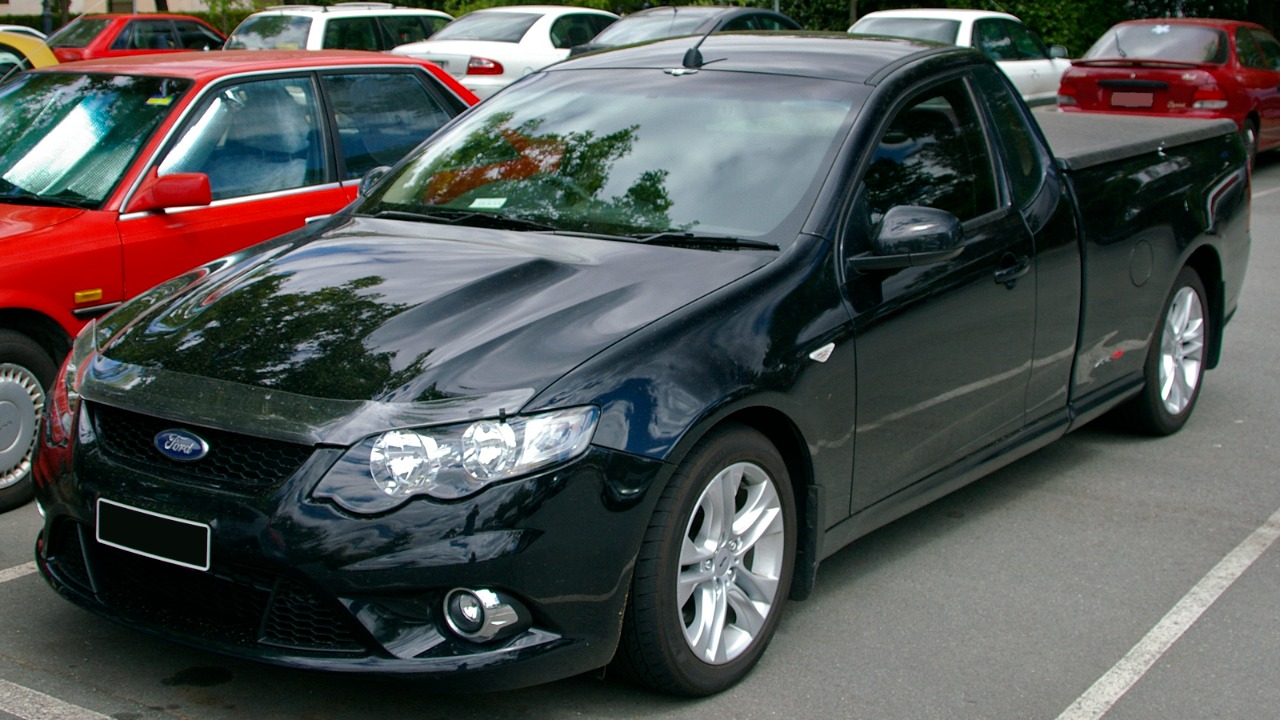
Ford is openly flirting with the idea of bringing back a distinctly Australian creation, the car-based ute, and giving it a modern twist. During a visit to Australia, Ford chief executive Jim Farley praised the country for inventing the format and suggested that a Falcon-style utility could return to the company’s global line-up. His comments signal that the ute, long written off as a relic of a bygone era, is suddenly back on the corporate agenda.
Farley framed the discussion as more than nostalgia, casting the ute as a potential bridge between traditional passenger cars and the increasingly large pickups that dominate markets such as the United States. For Australian buyers who grew up with Falcon and Commodore utes, the prospect carries a strong emotional pull, but it also raises practical questions about platform choice, powertrains and global positioning.
Farley’s Australian pitch
The renewed attention began as Jim Farley toured Australia and engaged directly with local enthusiasts and media. He described Australia as the country that “gave the globe the ute,” a clear nod to the 1930s Coupe Utility that blended sedan comfort with a usable tray. The remark went beyond flattery and positioned Australia as the natural test bed for any revival.
Farley also stressed that he did not want a simple global parts-bin solution forced onto local buyers. In comments reported from the trip, he said that to “do it right here” he would resist stamping out a generic product and instead shape a ute around Australian expectations, an approach that contrasts with the more standardized global strategies of recent decades.
From Falcon heritage to future product
For many Australians, the reference point is the Falcon ute, a vehicle that evolved from the Falcon sedan and became a cultural fixture on farms, work sites and racetracks. During his visit, Farley acknowledged that heritage and confirmed that a Falcon-inspired performance ute is under active study inside Ford. Reporting on internal discussions describes a possible revival under consideration by Ford CEO Jim, with explicit comparisons to earlier Falcon utilities.
Farley has linked the modern ute idea to Ford’s 1934 Coupe Utility, crediting that vehicle with inventing the format and giving Australia a unique place in company lore. By drawing a line from the Coupe Utility to the Falcon ute and then to a potential new model, he is effectively sketching a historical arc that justifies fresh investment in what had become a dormant category.
Local coverage has also highlighted that Farley spoke of a decision timeline tied to his Australian visit. He indicated that he wanted clarity on whether a new ute would proceed before leaving the country, a sign that the trip was not only ceremonial but also a fact-finding mission on customer appetite and dealer feedback in Australia.
Why a ute now, and how it might differ
The strategic logic for revisiting the ute concept rests on changing buyer tastes and gaps in Ford’s portfolio. In the United States, the compact Maverick has shown that there is strong demand for smaller, more car-like pickups, yet Australian tastes have historically skewed toward lower, more agile vehicles than the U.S. market Maverick. Farley has acknowledged that Australia took to traditional utes in a way that created a distinct segment, with buyers valuing the blend of sedan dynamics and open load space more than they embraced American-style trucks.
Reporting on his Australian comments notes that Farley contrasted the country’s ute legacy with the divergence between cars and trucks in North America, where the two categories grew further apart over time. In that context, an Australian-style ute could serve as a middle ground, offering everyday drivability closer to a car while still carrying tools, bikes or surfboards in the tray.
Any new model would also arrive in a different technological era. Farley has spoken about the possibility of combining gasoline and electric power in future utilities, and coverage of his trip states that he raised the prospect of a ute available with both internal combustion and electric drivetrains. That would align a revived ute with Ford’s broader electrification strategy rather than leaving it as a purely nostalgic exercise.
He has also been clear that a modern ute could not simply be a re-bodied Ranger. Comments captured in one report stress that he would not accept a generic global solution, and that an Australian-focused vehicle would need tuning and packaging that reflect local roads, loading habits and performance expectations. That stance hints at a product that leans more toward a unibody, car-derived architecture than a conventional ladder-frame truck.
Global implications and fan reaction
Farley’s remarks have quickly sparked speculation about how far a revived ute might travel beyond Australia. Some analysis points out that a Falcon-style utility could complement the Maverick in North America rather than replace it, offering a lower, sportier alternative for buyers who see traditional pickups as too large. The idea that Australia “gave the globe the ute” has been picked up in coverage that highlights how the segment once provided a template for car-based work vehicles in other markets before fading from showrooms.
More from Fast Lane Only