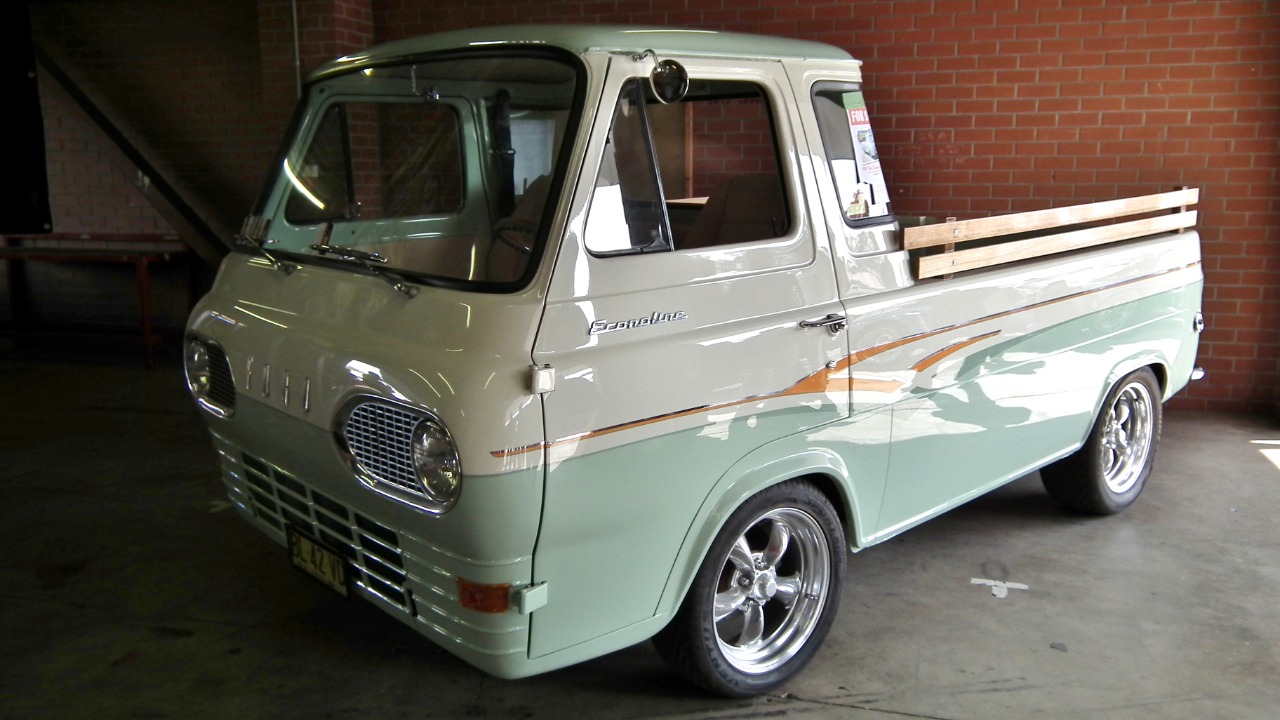
Ford’s 1961 Econoline pickup looked like a delivery van that someone had sliced in half. The Ford Econoline pickup put its cab right over the front wheels, and it hid a six-cylinder engine in a box between the two seats. That layout bought a long bed on a short truck. Still, buyers mostly walked past it and drove home in the van instead.
The Econoline family was Ford’s answer to a new kind of compact hauler. Volkswagen already sold its bus-based pickup, and Chevrolet launched rear-engine Corvair vans and pickups for the same 1961 season. Ford took a simpler path. It borrowed parts from its new compact car, the Falcon, and built a boxy truck around them.
Engineers call this layout forward control. In other words, the driver sits over the front axle instead of behind a long hood, much like a city bus or a step van. On a small pickup, that turned almost the whole length of the truck into cargo space.
How the Ford Econoline pickup was built
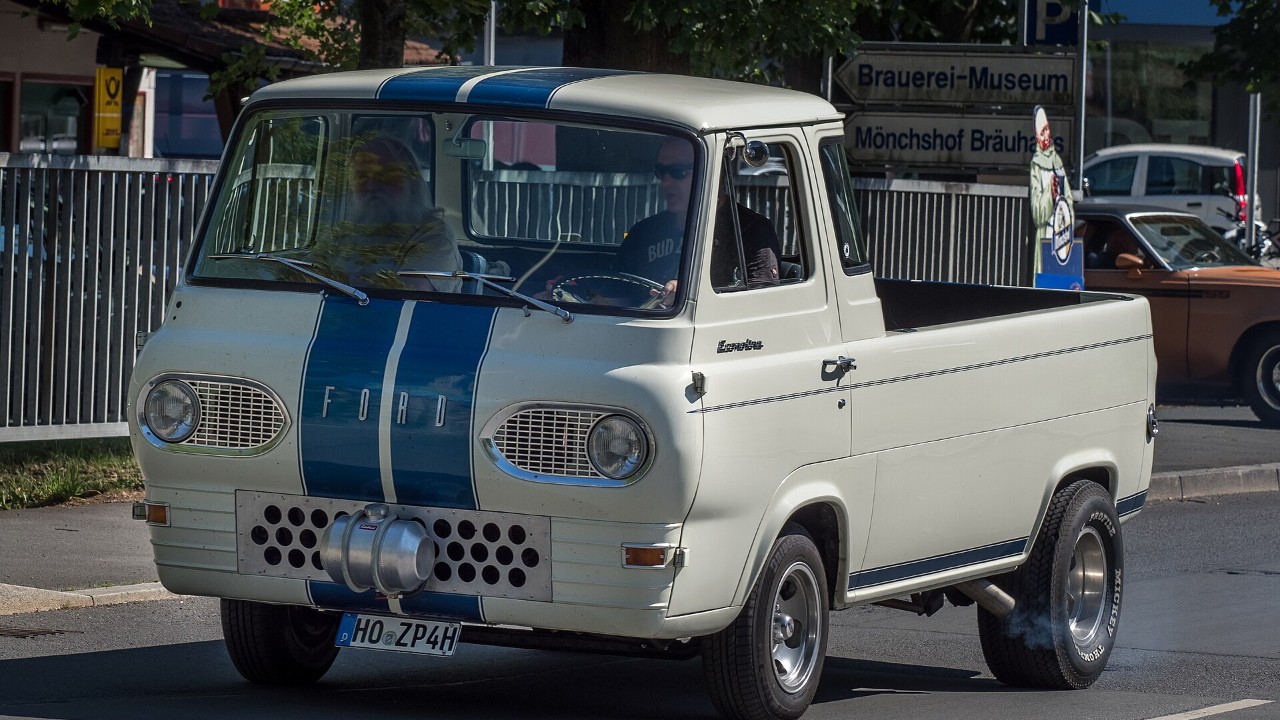
Mac’s Motor City Garage describes the first-generation Econoline as Falcon drivetrain parts on a simple unit-construction chassis. Leaf springs carried both ends, with a beam axle up front and a live axle at the rear. The truck was also stubby. Mac’s puts a 1961–67 Econoline at about 14 feet long, and just over six feet wide and tall.
The base engine was the Falcon’s 144-cubic-inch inline six. Mac’s rates it at 85 horsepower, while Hagerty lists 80 horsepower and 134 lb-ft of torque. Either way, that was a modest engine for a half-ton truck. A 170-cubic-inch six was optional, and Mac’s says a 240-cubic-inch “Big Six” joined the list from 1965.
A six-cylinder engine between the seats
Ford mounted that six right up front, between the driver and the passenger. As a result, the nose stayed flat and the bed stayed long. However, it also put a running engine within elbow reach of everyone on board.
Road testers noticed right away. The Autopian quotes CarLife magazine on the point: “We didn’t like having the engine alongside us, for, despite a fiberglass hood that somewhat reduced heat and noise, we got a piston-in-the-ribs feeling.” That same story also notes that Ford did not offer air conditioning at first.
The engine’s spot had another side effect. With the motor up front and nothing heavy behind the cab, an empty truck carried little weight over its rear wheels. That’s why Hagerty points to the 165-pound ballast weights Ford placed in the rear. The Autopian goes further and calls the truck, in effect, a mid-engine vehicle.
Seven feet of bed on a short truck
The payoff was cargo room. According to The Autopian, the Econoline pickup offered nearly seven feet of flat bed behind the cab. By comparison, conventional pickups with beds that long ran some three feet longer from bumper to bumper. Hagerty, for its part, puts the cargo area at 37 square feet.
The bed floor also sat level with the rear bumper, so loading took very little lift. For a tradesman hauling tools and supplies all day, that was a real selling point. In 1965, Ford even dressed the truck up. Mac’s says a spring promotion that year offered the Econoline Pickup Special with Poppy Red paint, Falcon wheel covers, chrome bumpers and Deluxe Club Wagon side trim.
Why buyers chose the van instead
Ford had high hopes for the open truck. In fact, The Autopian says Dearborn expected the pickup to become the best-selling version of the whole Econoline line. It never came close. Instead, Ford sold almost nine times as many vans as pickups.
The yearly numbers tell the story. The Autopian lists 14,893 pickups for 1961, then 8,140 for 1962. Sales recovered to 11,394 in 1963, but they fell to 5,184 in 1964. By 1966 and 1967, Ford sold fewer than 3,000 a year. Overall, Hagerty puts pickup production past 44,000 through the end of 1967.
Chevrolet struggled too. Its Corvair-based pickups managed only 13,600 units in 1961 and less than 4,500 a year after that, per The Autopian. Then, for 1964, Chevrolet gave up on the rear-engine layout for its new vans. It copied the Econoline’s engine placement instead.
The end of the cab-forward Econoline
Mac’s dates the first generation from 1961 through 1967. For 1968, Ford launched a new, larger Econoline. According to The Autopian, that redesign moved the engine forward and tucked the radiator under a short conventional hood. Hagerty’s pickup count, meanwhile, stops at the end of 1967.
Today the odd little truck has a following of its own. The low sales that disappointed Ford left fewer of them to go around. The Autopian pointed to a 1962 Econoline pickup that sold on Bring a Trailer for $18,000, which it called about the going rate for one in decent condition.
More from Fast Lane Only