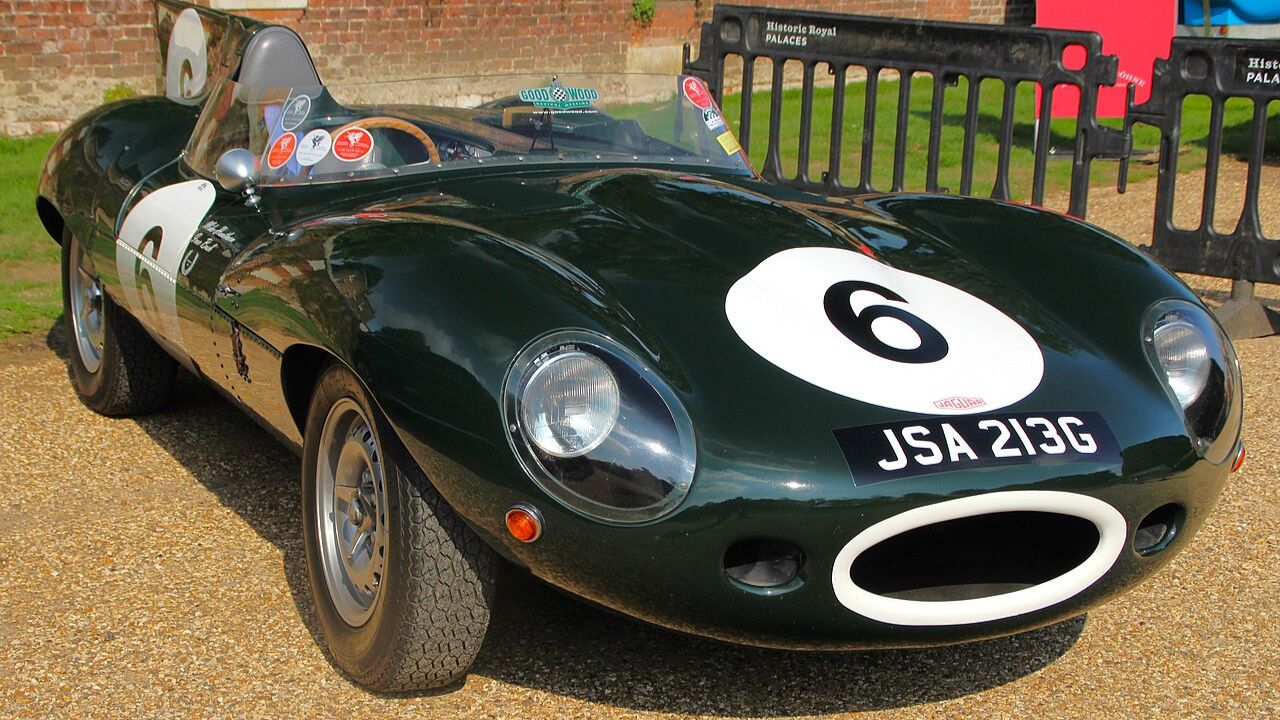
The Jaguar D-Type won the 24 Hours of Le Mans in 1955, 1956 and 1957. Then, in its final year on top, it did something even rarer. D-Types crossed the line first, second, third and fourth, and another one finished sixth.
That is a remarkable record, especially for a car that was not new by 1957. Even more striking, none of those finishers came from a Jaguar works team. Private teams ran them instead, and one small Scottish team won twice.
Here’s how a sports racer built in Coventry turned a French endurance race into its own stage for three straight summers.
What made the Jaguar D-Type different
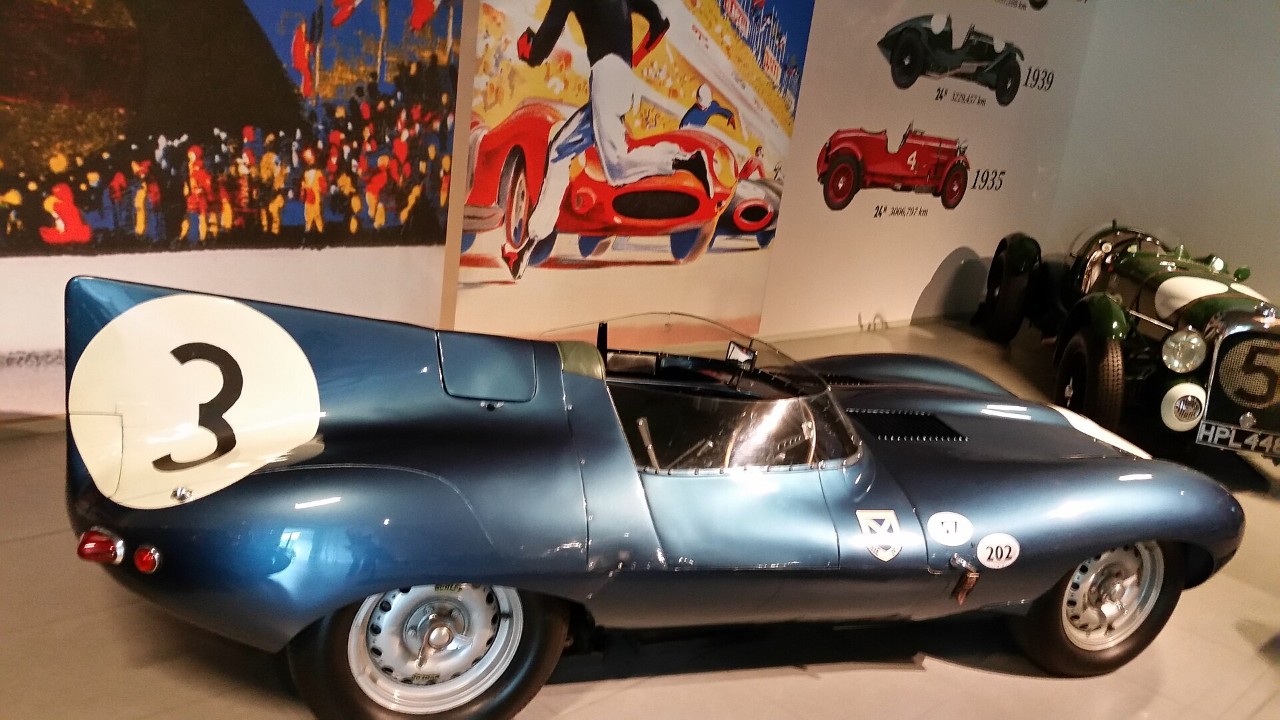
The D-Type’s body and frame worked together as one structure. RM Sotheby’s describes it as perhaps the first car to claim unitary monocoque construction. It also stopped on disc brakes at all four corners. Like the body, that was serious race-car hardware in a car private teams could buy.
Meanwhile, power came from Jaguar’s twin-cam inline six. In the 1955 car RM Sotheby’s sold, that engine displaced 3,442 cc and carried three Weber carburetors. The auction house lists it at 250 bhp. By comparison, Motor Authority’s report on the same car quotes about 245 hp, so the figures vary by source.
Jaguar built six team cars for 1954, according to the RM Sotheby’s catalog. Later, production cars for private buyers followed, starting with chassis XKD 501. That car would matter more than anyone could have guessed.
1955: the first Le Mans win
First, the breakthrough came in 1955 with Jaguar’s own team. Mike Hawthorn shared the winning car with Ivor Bueb. In fact, Goodwood’s Paul Fearnley notes that Bueb was a late replacement in the lineup. As RM Sotheby’s puts it, the D-Type had won its first Le Mans.
Meanwhile, that same year a private Scottish team took delivery of its first D-Type. XKD 501 left Jaguar on May 5, 1955, as the first production car for a private team. The buyer was Ecurie Ecosse, and RM Sotheby’s says the car sat out Le Mans that year. Instead, it raced elsewhere and took second in Goodwood’s nine-hour race.
1956: Ecurie Ecosse beats the factory
For 1956, new rules aimed for less power and better fuel use, or “fewer bhp, more mpg,” as Goodwood sums it up. Jaguar brought three fuel-injected, long-nose D-Types. However, all three were out of contention within four laps, according to Goodwood.
As a result, the job fell to Ecurie Ecosse and its year-old car. Ron Flockhart and Ninian Sanderson drove XKD 501 to the win, in the team’s first attempt at the race. The official Le Mans site says the pair held off Aston Martin, including the DB3S of Stirling Moss and Peter Collins. Goodwood adds that the Scots gained a lap when that Aston lost second gear early in the morning.
Yet Ecurie Ecosse was hardly a giant. Goodwood describes team boss David Murray as a wine merchant and publican. He ran the operation from lock-ups in an Edinburgh mews. His co-director, “Wilkie” Wilkinson, was a well-known tuner from London. Even the paint told you where the team came from. The official Le Mans site describes XKD 501’s Scottish Flag Metallic Blue, with a white St Andrew’s Cross on the front fenders.
1957: a Jaguar D-Type clean sweep of the top four
By 1957, Le Mans had let big prototypes back in. Maserati arrived with its 4.5-liter V8 450S, and Ferrari ran a 4.1-liter V12. In contrast, the D-Type was one of the few production cars entered. Goodwood notes that its engine and gearbox had changed little since Jaguar’s 1950 Le Mans appearance.
So Ecurie Ecosse bought two cars for the race. One, XKD 606, got a 3.8-liter six with Lucas fuel injection. The other, XKD 603, kept a 3.4-liter engine with Weber carburetors. Flockhart returned, this time paired with 1955 winner Bueb. Meanwhile, Sanderson moved to the second car with rookie Jock Lawrence.
The results from Racing Sports Cars show how complete the win was. Bueb and Flockhart won in the No. 3 Ecurie Ecosse car with 327 laps. Their teammates, Lawrence and Sanderson, finished second with 319. Then came the Los Amigos D-Type of Jean Lucas and “Mary” in third, on 317 laps. Finally, Paul Frère and Freddy Rousselle placed fourth for Equipe Nationale Belge, with 310.
In the end, only one Ferrari broke the run. Stuart Lewis-Evans and Martino Severi took fifth in a 315 Sport, 300 laps in. After that, Duncan Hamilton and Masten Gregory brought another D-Type home sixth. Ferrari still had the speed, though. Mike Hawthorn, the 1955 winner for Jaguar, set the fastest lap in a Ferrari 335 Sport. Of the 21 cars that finished, five were D-Types in the top six. That result also gave Flockhart back-to-back wins, and Bueb his second in three years. Jaguar would not return to the top step for decades, a story we tell in our look at the V12 Jaguar XJR-9 that won in 1988.
What the Jaguar D-Type is worth now
Meanwhile, the 1956 winner kept racing for Ecurie Ecosse after Le Mans. In 1957, it ran the Mille Miglia, where it retired, and a handful of other races. According to Motor Authority, it had just three private owners after the team sold it.
In August 2016, RM Sotheby’s offered XKD 501 at its Monterey sale. It sold for $21,780,000. Motor Authority reported that it was the highest price ever paid for a British car at the time.
More from Fast Lane Only