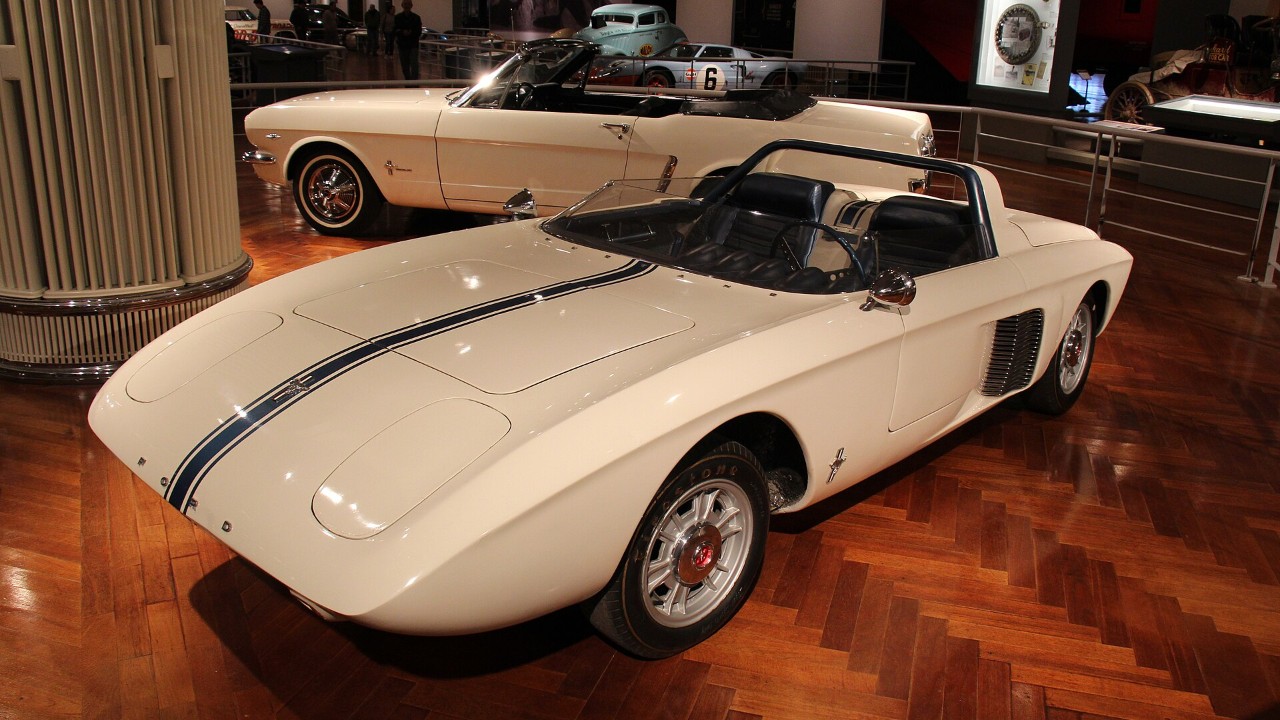
The first car to wear the Mustang name had two seats, an aluminum body and its engine behind the driver. Ford called it the Mustang I. Dan Gurney drove it in public for the first time at Watkins Glen in October 1962, on the weekend of the United States Grand Prix.
That makes the Ford Mustang I one of the odder chapters in the pony car’s family tree. It was a mid-engine roadster built by a company famous for family sedans. Ford never planned to sell it, either.
Instead, the car had one job: get people talking about Ford. It did that, and then it showed Ford what kind of Mustang it should not build.
A Ford Mustang I built in about 100 days
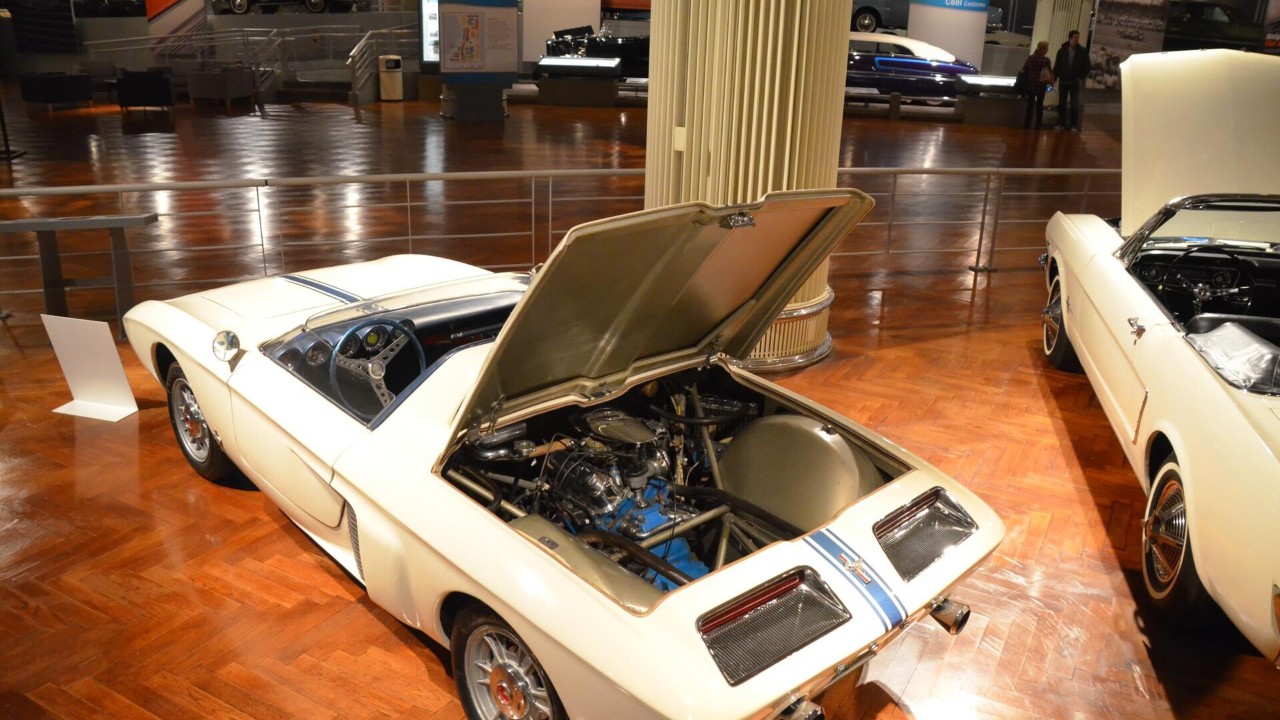
First, the car came together fast. According to an account of the project from Cars4Starters, it took about 100 days to go from idea to running car. Gurney had been involved since it was only a drawing, the same account says.
Several people shared the work. Cars4Starters credits stylists John Najjar and Jim Sipple with the shape, and it says Najjar took the name from the P-51 Mustang fighter plane. Engineer Roy Lunn, who later worked on the GT40, built the tube frame inside Ford. Then a California shop, Troutman and Barnes, formed the aluminum body.
Phil Clark drew the galloping horse badge, according to the same account. That detail matters, because the badge outlived the car. MustangSpecs notes that only the Mustang name and emblem from this prototype reached production.
What sat behind the seats
Meanwhile, the engine was small and came from Ford’s German operation. It was a 60-degree V4 of about 1.5 liters, mounted mid-car and driving the rear wheels through a four-speed transaxle. MustangSpecs lists 1,498 cc and 89 horsepower at 6,600 rpm, and says the transaxle came from the front-drive Taunus.
However, the museum that owns the car quotes a higher number. The Henry Ford’s catalog entry lists a 91-cubic-inch V4 making 109 horsepower at 6,400 rpm. Neither source explains the gap, so both figures are given here.
Weight is another split. The Henry Ford gives 1,544 pounds. By contrast, MustangSpecs and the Racing Archives both list 1,200 pounds. Whichever is right, it was a very light car for a Ford.
The shape and the hardware
The Henry Ford lists the roadster at 154 inches long and 61 inches wide on a 90-inch wheelbase. It stands only about 39.4 inches tall.
The Racing Archives adds the chassis details. It lists a tube frame, independent suspension, front disc brakes, a built-in roll bar and 13-inch cast magnesium wheels. The car wore white paint with blue stripes, and the running pony sat on the hood.
Dan Gurney’s laps at Watkins Glen
Ford had a reason to show the car at Watkins Glen. The Racing Archives says Ford began working with the Watkins Glen Grand Prix Corporation in 1961, the year the track first hosted a Formula One race. So the Grand Prix gave Ford an audience of serious enthusiasts.
Gurney, already a well-known racer, took the Mustang I around the road course in a demonstration. After all, it was not a race. Even so, both the Racing Archives and Cars4Starters put his speed at about 100 mph, and Conceptcarz says his lap times were only slightly off the pace of the Formula One cars.
The car also had a ceremonial role that day. According to the Racing Archives, it led a parade of Ford Galaxies carrying the Formula One drivers. Stirling Moss rode in the passenger seat as honorary starter, while course marshal Charles Lytle drove.
Still, the exact day varies by source. MustangSpecs gives October 7, 1962, the day of the race, while Cars4Starters places the first laps on Saturday, October 6. All agree that it was the Grand Prix weekend.
After the Glen
The Mustang I did not stop at one appearance. Less than two weeks later, Gurney drove it again at the Pacific Grand Prix at Laguna Seca in California. The Henry Ford holds a Dave Friedman photo of that run, dated October 19–20, 1962.
Later, the car toured auto shows. Cars4Starters says it also anchored Ford’s graduate recruiting talks at more than 20 American universities. Meanwhile, Lee Iacocca, Ford’s new general manager, saw little market for a two-seat mid-engine car, according to the same account.
Ford took the hint from the crowds. Conceptcarz says the company became convinced that a more practical four-passenger car would sell. The Racing Archives notes that a four-seat Mustang II concept appeared at the 1963 Grand Prix. Then, in April 1964, Ford launched the production Mustang at the New York World’s Fair.
Where the Ford Mustang I is now
Today, the original car survives. The Henry Ford lists the 1962 Mustang I Roadster as a gift of Ford Motor Company, and it is on display in the Driving America exhibit at the Henry Ford Museum in Dearborn, Michigan.
More from Fast Lane Only