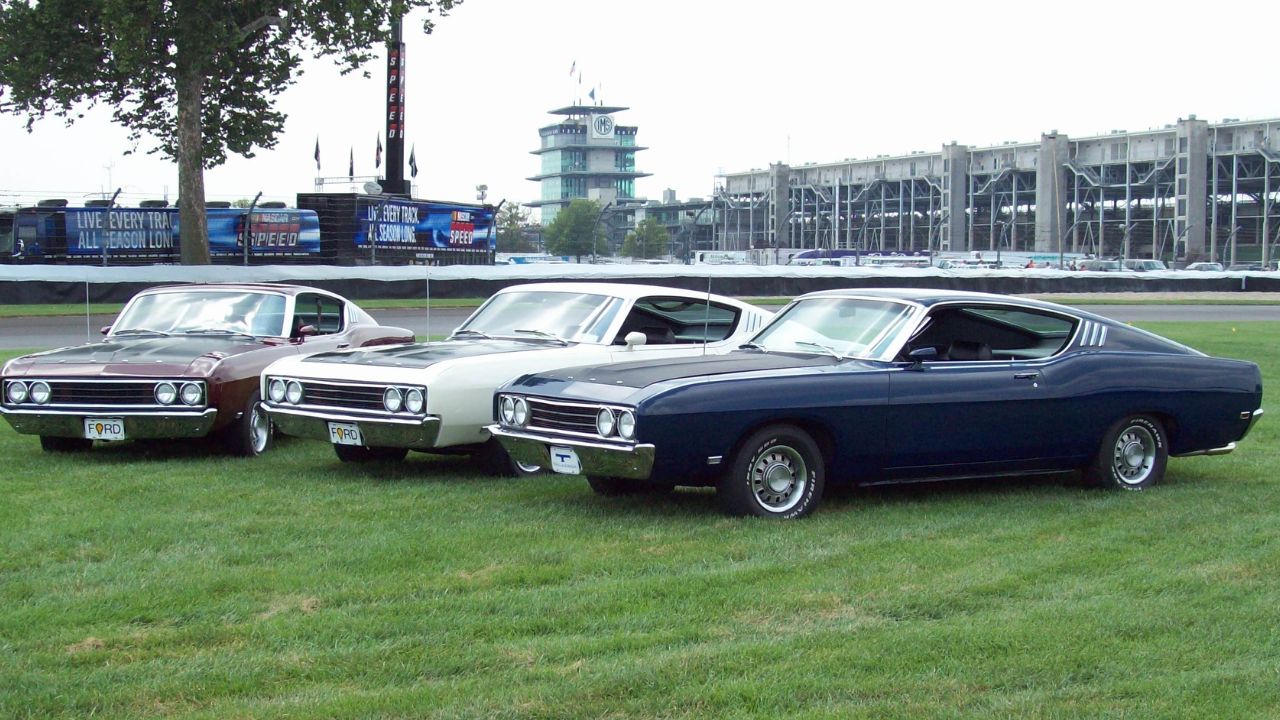
Ford did not just chase speed at the end of the 1960s. It reshaped the car itself around the new Talladega Superspeedway, then forced everyone in stock car racing to rethink how to win. The Ford Torino Talladega took a familiar midsize body, smoothed it for the wind, and turned aerodynamics into the deciding factor in strategy.
What began as a rulebook exercise in building a homologation special became a quiet revolution. By the time the Talladega hit the track, drafting tactics, pit calls, and even which drivers teams hired started to revolve around airflow as much as horsepower.
From superspeedway to street: why Talladega demanded a new Ford
When NASCAR added the massive Talladega Superspeedway to its schedule, the track’s length and speed exposed the limits of traditional “stock” bodies. Long straights and steep banking rewarded cars that could slice through the air with minimal drag, and the old bluff front ends became a liability. Ford responded by reshaping its Torino into what enthusiasts now know as the Ford Torino Talladega, a car explicitly named for the new venue and built to live in the draft.
The production version carried the name Ford Talladega in period coverage, and period profiles describe how the company took the standard fastback and refined it for smoother airflow. The Ford Talladega story highlights that the car was conceived around NASCAR’s newest superspeedway, not the other way around. The track dictated the car’s shape, and the car in turn reshaped the racing that unfolded there.
NASCAR’s homologation rules required manufacturers to sell a minimum batch of road cars if they wanted to race a new body. Because NASCAR enforced that requirement, Ford had to put at least 500 street-legal examples into showrooms. That figure turned a pure racing experiment into something a regular buyer could register, and it created a direct line between Talladega’s banking and suburban driveways.
Holman Moody and the six-inch solution
Ford knew that brute power alone would not be enough against the Mopar teams. The company turned to its competition partner Holman Moody, the outfit that had already built winning stock cars and endurance racers. At Holman Moody, engineers attacked the Torino’s nose, which created lift and turbulence at high speed.
Holman and Moody developed a new front section that extended the Torino’s nose by about six inches, then blended it into a rounded, flush grille opening. Reporting on the “first aero warrior,” notes that a panel was added in front of the original hood and that the bumper was reshaped and tucked in to act more like a fairing than a chrome battering ram. The aim was simple: reduce drag, cut front-end lift, and keep the car planted in the draft.
Those changes turned the Talladega into something very different from the showroom Torino. The front fenders were rolled, the rocker panels were modified to lower the body in race trim, and details that once served styling now served the stopwatch. The car still met the letter of NASCAR’s stock rules, but its form followed the wind tunnel more than the design studio.
“Aero Warrior” mentality and the birth of a new class
The Torino Talladega did not exist in a vacuum. It arrived as one of the early NASCAR “aero warrior” cars, a small group of body styles that treated the rulebook as an aerodynamic challenge. A widely shared description from Apr by Andr Daniel Silva under the banner AMERICAN MUSCLE CARS calls the 1969 Ford Torino Talladega one of the early purpose-built NASCAR specials, a limited-production muscle car built with the clear intention to dominate on the big ovals. That Andr Daniel Silva framing captures how radical the idea was at the time.
Another description from Aug spells out that the Ford Torino Talladega was a limited-production aerodynamic muscle car, named after the Talladega track and aimed squarely at NASCAR competition. These were not just dress-up packages with stripes. They were built in small numbers, tuned for high-speed stability, and engineered around the realities of pack racing.
By moving in this direction, Ford helped create a short-lived but influential class. The term “aero warrior” now covers the Torino Talladega, its Mercury cousin, and the winged Mopars that followed. Each car pushed the envelope a little further, but Ford’s decision to smooth the Torino and commit it to Talladega’s demands set the tone.
How the Talladega changed the race itself
The Talladega’s shape did more than add miles per hour. It changed how drivers and crew chiefs thought about racing on the superspeedways. With a cleaner nose and lower drag, the car could sit in another driver’s slipstream with less buffeting, then slingshot past with a smaller power advantage. Drafting had existed before, but the Talladega turned it into a central tactic.
Accounts of the car’s development stress that the slippery Torino fastback already worked well, but wind tunnel sessions showed where the airflow separated and where lift built up. The Ford Torino Talladega Aero Advantage package refined those areas so the car stayed stable at higher speeds. That stability allowed drivers to run closer together, hold the throttle open longer, and treat the draft as a tool rather than a white-knuckle risk.
Strategy followed. Crew chiefs began planning around track position in the draft instead of simply clean air. Pit calls were timed to keep Talladega drivers in fast packs, not isolated on track, where even a powerful engine could not overcome the drag penalty. Teams also started to value drivers who could read the air and manage the pack, because the car’s potential was unlocked only when it lived in traffic.
Aero Wars and the response from Dodge and the winged cars
Rivals noticed quickly. When the Ford Torino Talladega and its Mercury counterpart appeared, they exposed weaknesses in other brands’ bodies. An analysis of NASCAR’s Aero Wars explains that it did not take Dodge long to realize that its Charger 500 was outclassed by FoMoCo’s ringers. Engineers at Dodge Charger headquarters embarked on a crash program that produced the Charger Daytona and set off a full-blown aerodynamic arms race.
That same coverage repeats the homologation figure of 500, this time attached to the winged Mopars. Just as Ford had built at least 500 Talladega-based road cars to qualify its shape, Dodge and Plymouth followed with their own batches. The number became a shorthand for how far manufacturers were willing to go to chase a few extra miles per hour at Talladega and Daytona.
On track, the Aero Wars turned strategy into a chess match. Ford’s smoother nose and lower stance gave it an edge in the early battles, especially on the longer tracks, and that forced Mopar teams to use drafting alliances and pit timing to blunt the advantage until their own aero specials arrived. Once the Charger Daytona and its stablemates joined the fight, pack dynamics changed again, with some combinations of cars working better together in the draft than others.
The rulebook tightens and the Talladega’s brief reign
The very success of the Torino Talladega created pressure. A widely shared short video from Oct describes the Ford Torino Talladega as the car that NASCAR banned for being too fast, then begged to return. While “banned” can be an oversimplification, there is no question that the sanctioning body grew uncomfortable with the speeds and the escalating aero arms race.
NASCAR’s response was to adjust rules around bodywork and engine size, which gradually pushed the most extreme aero warriors off the track. That process did not erase the Talladega’s influence. Instead, it froze the lesson that aerodynamics could not be ignored. Even within tighter rules, teams continued to massage body tolerances, search for cleaner front ends, and exploit any gray area that would help in the draft.
For Ford, the Talladega’s short competitive window did not diminish its value. It had proven that a carefully shaped stock car could rewrite the competitive order, and it had forced rivals and officials to react. The car’s legacy lives in the way modern NASCAR templates try to balance brand identity with aerodynamic parity, a direct response to what the aero warriors revealed.
Homologation specials and the street buyer
Homologation rules that forced manufacturers to build street versions of their race cars had an unintended side effect. Because NASCAR required at least 500 examples, Ford ended up selling a limited number of Torino Talladegas to ordinary customers. A retrospective on how Ford built a NASCAR-level car for regular buyers in the 60s points out that this figure of 500 was the gateway that put a race-developed body in public hands.
Those road cars wore the same basic shape as the track versions, with the extended nose and smoothed front. Under the skin, they often used big-block engines and heavy-duty components that made them legitimate muscle cars in their own right. For enthusiasts, the Talladega became a way to buy into the same aerodynamic thinking that carried factory teams at Talladega and Daytona.
Today, registries and enthusiast sites track surviving examples, and the cars occupy a niche that blends muscle car culture with racing history. They are not as visually wild as the later winged Mopars, but that subtlety is part of their appeal. The Talladega looks like a cleaner, meaner Torino, which is exactly what Ford and Holman Moody intended.
How strategy evolved around the Talladega template
Once Ford had shown what a purpose-shaped body could do, teams across the garage began to treat aerodynamics as a central part of race strategy. On superspeedways, crews started to think in terms of three interlocking pieces: engine power, drag, and position in the draft. The Talladega’s low drag meant that a slightly weaker engine could still contend if the car stayed in the right pack.
That shift changed how races unfolded. Drivers in Talladegas could afford to be patient, saving fuel and tires while riding in the slipstream, then using the car’s clean nose to make decisive moves late. Rivals had to decide whether to burn fuel staying ahead of the aero Fords or drop in behind them and hope to outmaneuver them in the closing laps.
Even the pit strategy changed. Because the Talladega body worked best in traffic, teams tried to pit in groups so their cars would rejoin the track together. A solo stop that left a driver alone on the track could ruin a race, no matter how strong the engine. That thinking still shapes modern superspeedway racing, where manufacturers coordinate pit windows and drafting alliances.
Media, memory and the Talladega myth
Decades later, the Torino Talladega continues to attract attention from enthusiasts and storytellers. Short videos circulating on platforms like YouTube and Instagram frame the car as the quiet Ford that arrived to beat the Mopars, with Jan commentary describing how Ford built the Torino Talladega with one goal: to outrun the Mopars on the NASCAR ovals. Another Jan short contrasts the Charger Daytona’s towering rear wing with the Torino’s more understated aero work, highlighting how two very different design philosophies chased the same goal.
More from Fast Lane Only