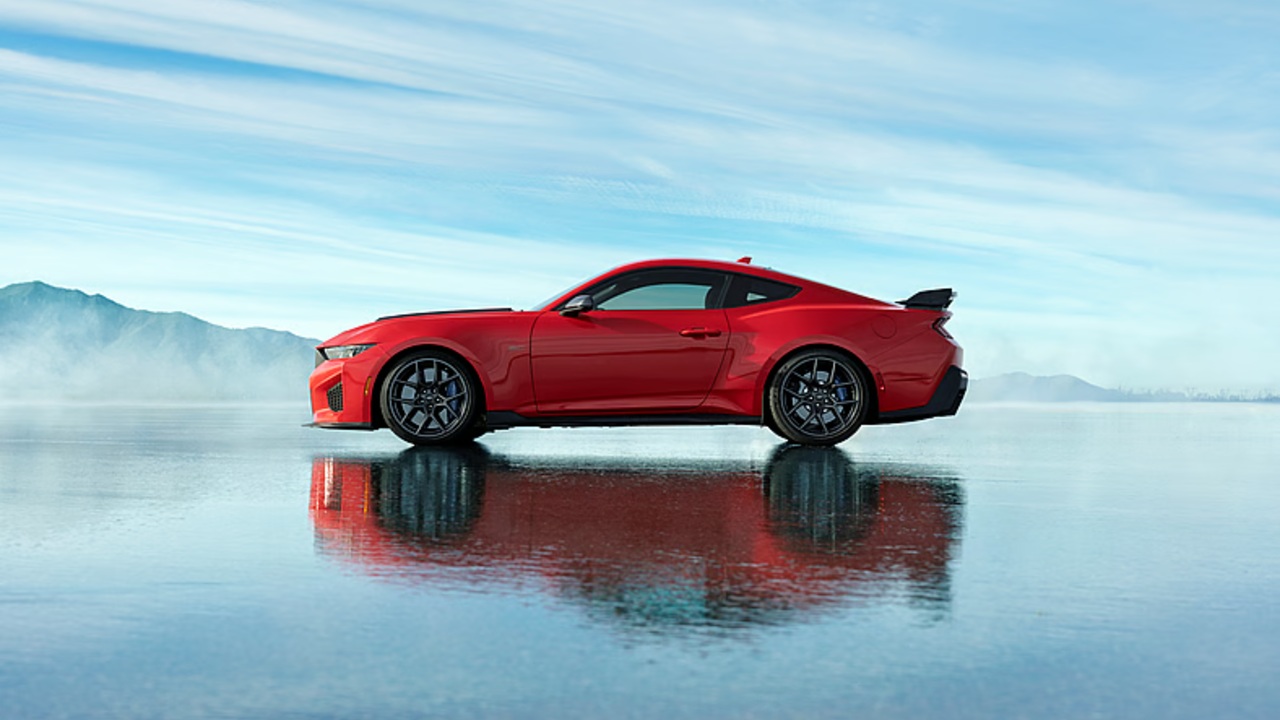
The Shelby GT500 is gone from Ford’s order books, but its spirit has not been retired. With the 2026 Mustang Dark Horse SC, Ford is installing a new standard-bearer for supercharged American muscle, one that blends the GT500’s ferocity with the current Mustang’s more focused track persona. The result is a brutal new flagship that aims to inherit the crown of Ford’s most fearsome pony car while fitting neatly into the brand’s modern performance ladder.
Rather than simply resurrecting an old badge, Ford has used the Dark Horse SC to redefine what its top road-going Mustang should be. The car sits above the existing Mustang Dark Horse yet below the wild Mustang GTD, promising GT500-grade power with a sharper emphasis on circuit development and everyday usability. It is less a nostalgia play than a statement that the age of the supercharged V8 is not over at Ford, at least not yet.
The new apex of the Mustang hierarchy
Ford has positioned the Mustang Dark Horse SC as the direct successor to the Shelby GT500, occupying the space that car once held at the top of the street-legal Mustang range. It is designed to slot above the standard Mustang Dark Horse and its available Dark Horse Performance Package, while stopping short of the track-special Mustang GTD that is effectively a race car with license plates. In that sense, the Dark Horse SC becomes the new apex of Ford’s regular production pony cars, the one that must satisfy customers who once looked to the GT500 for their fix of supercharged excess.
This hierarchy is not theoretical. Reporting describes the Dark Horse SC as sitting between the Dark Horse Performance Package and the Mustang GTD, with Ford explicitly identifying it as the successor to the previous Shelby GT500 and as a variant that builds on the existing Mustang Dark Horse. That structure allows Ford to keep the GTD as an ultra-limited halo while giving buyers a more attainable, if still extreme, flagship in the Dark Horse SC. It also signals that the Shelby nameplate is effectively on pause in this segment, with the new car expected to start around $100,000 according to early pricing guidance for the Ford Mustang Dark Horse SC.
Predator power and the return of supercharged muscle
At the heart of the Dark Horse SC is a supercharged 5.2-litre V8 known internally as “Predator,” a familiar engine architecture to anyone who followed the outgoing Shelby GT500. The decision to bring back a supercharged 5.2-litre unit, rather than rely solely on the naturally aspirated 5.0-litre Coyote used in the regular Dark Horse, is a clear signal that Ford wanted GT500-level performance rather than a mild step up. The engine is paired with a Tremec 7-speed dual-clutch transmission, a configuration that mirrors the GT500’s focus on rapid, repeatable shifts on both road and track.
While Ford is being coy with exact output figures, reporting consistently frames the Dark Horse SC as delivering roughly 800 horsepower, with the supercharged 5.2-litre Predator V8 described as providing GT500-like performance. Spec sheets for the 2026 Ford Mustang Dark Horse SC list the engine as a Supercharged 5.2L V8 and confirm the use of the Tremec dual-clutch gearbox, underscoring that this is not a lightly warmed-over Mustang but a full-bore return to forced-induction muscle. The car’s positioning as an 800-horsepower successor to the GT500, combined with its expected six-figure starting price, makes clear that Ford intends it to be the brand’s most potent mainstream pony car.
Track development and chassis focus
Power alone is not enough to claim the GT500’s mantle, and Ford appears to have recognized that by devoting significant effort to the Dark Horse SC’s chassis and aero development. The car has been tested at iconic U.S. circuits such as Sebring International Raceway and Virginia International Raceway, venues that expose weaknesses in cooling, braking, and high-speed stability. That development work took place alongside the Mustang GTD and GT4 programs, suggesting that lessons from Ford’s more extreme track projects have filtered down into the SC’s suspension tuning and aerodynamic package.
Reporting notes that, beyond added power, Ford focused heavily on reducing weight and improving aerodynamics to sharpen the car’s track capability. The Dark Horse SC is described as the latest evolution of Ford’s pony car, arriving with a singular focus on performance and with a supercharged V8 that remains central to Ford’s performance identity. By pairing that engine with a chassis honed at Sebring International Raceway and Virginia International Raceway, and by emphasizing weight reduction and aero efficiency, Ford is signaling that the Dark Horse SC is intended to be more than a straight-line bruiser. It is meant to be a car that can handle repeated lapping without wilting, a trait that once defined the best versions of the Shelby GT500.
Design, hardware, and the GT500 legacy
Visually and mechanically, the Dark Horse SC builds on the aggressive stance of the Mustang Dark Horse while layering in hardware that aligns it with the GT500’s legacy. The car’s exterior is shaped by functional aerodynamic elements that work with the revised cooling and braking systems demanded by the supercharged 5.2-litre Predator engine. Large intakes, a prominent rear spoiler, and track-oriented wheel and tire packages are not mere styling flourishes but responses to the thermal and grip demands of an 800-horsepower Mustang that is expected to spend serious time on circuit.
Under the skin, the Dark Horse SC’s hardware choices echo the philosophy behind earlier GT500 packages that prioritized cooling and durability for track use. While the specific “The Track Package” branding from the 2013 Ford Shelby GT500 is not carried over, the concept of significantly upgrading cooling for the engine, differential, and transmission is clearly present in the way Ford has engineered the SC. The car’s development focus on weight reduction and aero, combined with its dual-clutch transmission and supercharged V8, places it firmly in the lineage of the GT500 while allowing Ford to present it as a modernized, more globally relevant performance flagship.
Market positioning and the future of Ford muscle
The Mustang Dark Horse SC arrives at a moment when high-performance internal combustion cars are under increasing pressure from emissions rules and electrification, which makes Ford’s decision to launch a new supercharged V8 flagship all the more striking. By pricing the Ford Mustang Dark Horse SC at an expected $100,000 and positioning it between the Dark Horse Performance Package and the Mustang GTD, Ford is effectively creating a three-tier performance structure that can appeal to different levels of enthusiast commitment. The SC becomes the choice for buyers who want near-GTD performance without stepping into that car’s extreme price and limited availability.
At the same time, the Dark Horse SC serves as a statement of intent about the future of Ford’s performance identity. The car is described as central to Ford’s performance strategy, with its brutal supercharged V8 and track-focused development reinforcing that the company still sees value in traditional muscle even as it invests in other technologies. With Ford planning to begin taking Dark Horse SC orders and scheduling deliveries for summer 2026, the model is poised to become the de facto heir to the Shelby GT500’s crown, not by copying the past, but by translating its core attributes into the current Mustang generation and the realities of today’s performance market.
More from Fast Lane Only