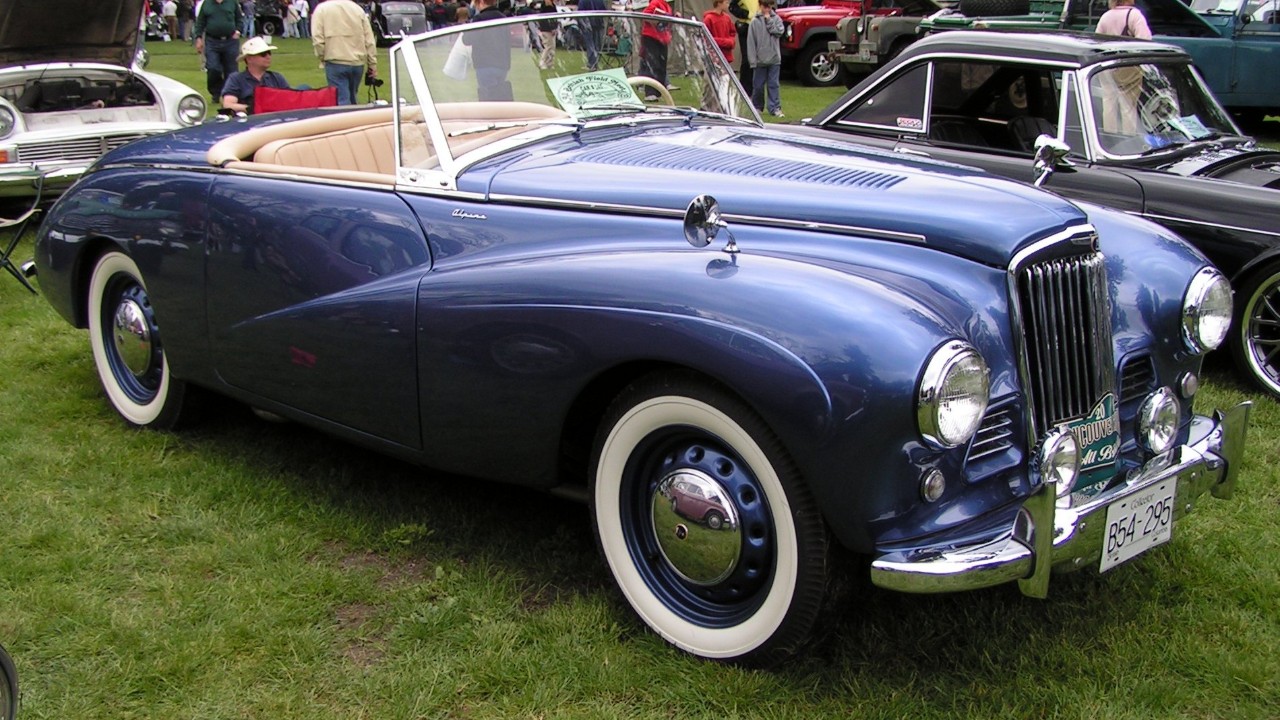
In Alfred Hitchcock’s 1955 film To Catch a Thief, Grace Kelly takes the wheel of a Sapphire Blue Sunbeam Alpine on the cliff roads above the Riviera, opposite Cary Grant. The car was a British roadster launched only the year before filming began. Its role in the film made a fairly rare sports car famous with moviegoers.
The Alpine wasn’t an exotic, though. Instead, it was a sporty two-seater built from a family sedan, with a modest four-cylinder engine and a serious rally record. In our view, that mix of good looks and real competition success made it a natural fit for a glamorous film star.
Below is the story of the car, how it landed the part and what the record says about the cars on screen. Then we’ll look at how many Alpines were built and how few are thought to survive.
A Sunbeam Alpine bred in the Alps
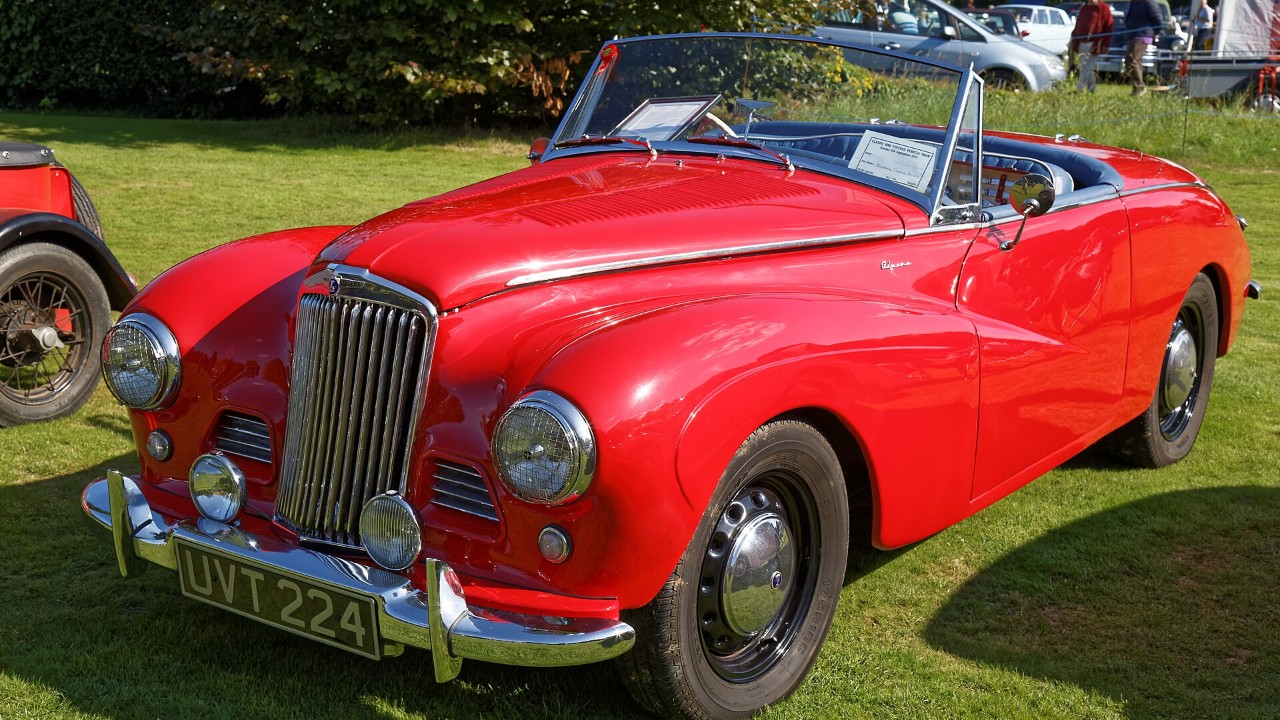
The Rootes Group unveiled the Sunbeam-Talbot Alpine on March 20, 1953, with the slogan “Bred in the Alps.” That’s according to Lancaster Insurance’s 70th-anniversary history of the Alpine. British buyers could then order one from that autumn for £1,210 7s 6d.
The car shared its platform with the Sunbeam-Talbot sedan, as Hagerty’s look back at Kelly’s Alpine points out. For power, Rootes used a 2.3-liter overhead-valve four with a new cylinder head. Lancaster gives the output as 80 bhp at 4,200 rpm, with a top speed of 90 mph and 0-60 mph in 18 seconds. Hagerty, by contrast, quotes 77 horsepower from 2.25 liters.
American testers were impressed, too. A March 1954 Road & Track report predicted that “the Alpine will probably outsell all of its competitors in the $3000 class,” according to Simanaitis Says. In that test, the 3,010-pound roadster reached 87.5 mph. Meanwhile, Hagerty puts the U.S. price at about $2,900. That works out to roughly $28,231 in today’s money, by Hagerty’s math, so this was never a cheap toy.
Rally wins before the film role
Still, the name wasn’t just marketing. In the 1953 Alpine Rally, a team of four factory cars won Coupes des Alpes, Lancaster reports. Stirling Moss then earned his third Coupe des Alpes in 1954, along with the Coupe d’Or. Simanaitis explains that the gold cup marked three penalty-free runs in a row, from 1952 to 1954.
Speed records helped as well. In 1953, Sheila van Damm reached 120.135 mph in an Alpine on the Jabbeke highway in Belgium. Lancaster says that made her Europe’s fastest female driver. Moss and Leslie Johnson also tested Alpines on the same road. As a result, the little roadster had real speed credentials by the time Hollywood called.
Later, a Mk III won the 1955 Monte Carlo Rally outright with Per Malling and Gunnar Fadum, according to Simanaitis. So the car Kelly drove on screen came with a genuine competition pedigree.
How the Alpine got the part
By 1954, Hitchcock needed a car for Kelly’s character. According to Lancaster, it was his wife, Alma Hitchcock, who spotted an Alpine advertisement. Rootes then sent a Sapphire Blue car to Cannes for the production. For a carmaker that wanted American sales, a starring role next to Kelly and Grant was valuable publicity, in our view.
Hagerty describes Kelly’s car as a “rare 1953 Sunbeam Alpine Mk I.” In the film, she drives it at speed and outruns French police along the coast road. Simanaitis places the drive on Monaco’s Grande Corniche. Hagerty adds that the Alpine gets plenty of screen time, so audiences got a long look at it. For a small British roadster, that was exposure no advertising budget could easily match. It also tied the car’s name to Kelly for good.
However, not all of that driving happened on real roads. Hagerty notes that most of Kelly’s driving was filmed on a Paramount sound stage, using rear-screen projection. In other words, the famous scenes mix location shots of the car with studio work. The film premiered on August 3, 1955, Lancaster reports.
Is the film car still out there?
Naturally, fans have wondered whether the screen car survives. PBS’s History Detectives took up the question in an episode about a Los Angeles owner’s Alpine convertible. According to the show’s case page, he had been told it was the car from the film when he bought it.
The program set out to test that claim with people from Hitchcock’s circle. Still, none of the sources we read identifies a surviving To Catch a Thief car. Until someone proves a chassis link, any Alpine sold as “the Grace Kelly car” deserves careful checking.
How many Sunbeam Alpine roadsters were built
Production counts, however, vary by source. Lancaster says the run ended in 1955 after 1,582 cars, and that output of the Special version ended in 1954 after 90 examples. Hagerty, by comparison, estimates about 2,000 Alpines from 1953 to 1955, with about half sent to the United States.
Either way, the Sunbeam Alpine of this era was a small-volume car. Hagerty also reports the belief that fewer than 200 survive, which makes any original example a rare find today.
Even so, for many fans, the Alpine will always be the blue car Grace Kelly drove for Hitchcock. Rootes sent that car to Cannes in 1954, and the film reached audiences on August 3, 1955.
More from Fast Lane Only