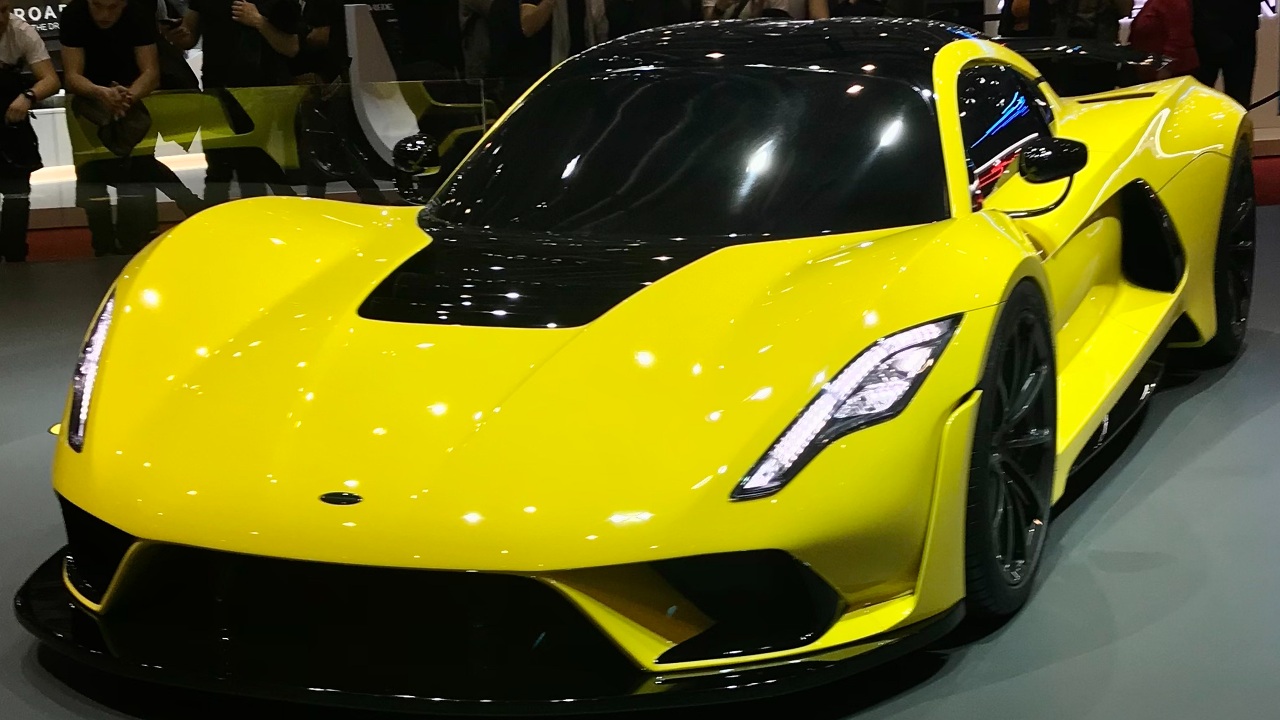
The Hennessey Venom F5 is not a subtle car. It is a 6.6L twin-turbo American hypercar engineered with a single, audacious objective: to push a road‑legal machine beyond 300 mph and into territory once reserved for land‑speed specials. In an era when electrification dominates performance headlines, this front‑engine, rear‑drive V8 outlier is a reminder that brute combustion power, guided by careful aerodynamics and obsessive engineering, still has room to rewrite the record books.
Framed by its maker as “America’s Hypercar,” the Venom F5 is the centerpiece of a broader campaign to claim the title of the world’s fastest production car and to keep that crown in Sealy, Texas. Its 6.6-L Twin‑Turbo V8 “Fury” engine, carbon chassis, and relentless top‑speed program are all aligned toward a single number: a verified 300 MPH run, with ambitions that stretch even further.
The American 300 MPH ambition
Hennessey Special Vehicles has been explicit about its goal: the Venom F5 was designed from the ground up to crack the 300 MPH barrier and secure a place among the fastest production cars ever built. The company describes the project as “The Road to 300 MPH,” positioning the car as the flagship of a Texas‑based hypercar program that wants the world’s speed crown to sit on American soil in Sealy, Texas. That ambition is not a vague marketing line, it is tied to a structured test and development plan that has already produced verified high‑speed runs and a clear roadmap toward a full record attempt.
The Venom F5’s target places it in direct conversation with the very small group of machines that have officially exceeded 300, such as the Bugatti Chiron Super Sport 300+, whose heavily revised drivetrain and longer gear ratios delivered an official top speed of 304.77 mph. Hennessey’s leadership has framed the Venom F5 as “America’s Hypercar,” a car intended to meet and then surpass that benchmark rather than simply brush against it. The company’s own communications around the 300 M program underscore that the car is being developed not just to touch 300 MPH once, but to do so in a way that stands up to scrutiny and cements its status in the record books.
From Venom GT to Venom F5: a Texas speed lineage
The Venom F5 does not emerge from nowhere, it is the latest chapter in a speed‑obsessed lineage that began with the Venom GT. Hennessey Performance used that earlier car to signal its intent, pushing the Venom GT to 270.4 m and celebrating that achievement as a defining moment for the brand. That run, which marked the 10‑year anniversary of the Venom GT’s 270.4 mph speed record, established The Texas outfit as a serious player in the ultra‑high‑speed arena and set expectations that its successor would aim even higher.
Yet the Venom GT’s 270.4 m effort also highlighted the complexities of claiming an “official” world’s fastest title. Despite going quicker than the Veyron Super Sport, the Venom could not formally call itself the fastest production car in the world, a reminder that governing bodies expect two‑way runs and tightly controlled conditions. That experience has shaped how Hennessey approaches the Venom F5 program. The company now emphasizes that any 300 MPH attempt must be a rigorously documented, two‑direction average, a standard that aligns with how other record‑holders have secured their place in history.
Carbon chassis and aero: building a 300 MPH foundation
To chase 300 MPH with a front‑engine road car, Hennessey had to start with a clean sheet. The company has Built an all‑new carbon fiber chassis that serves as the foundation of the Venom F5, a structure designed specifically to cope with the loads and stability demands that arrive north of 250 mph. The Venom platform is described as being built entirely of carbon, a choice that keeps weight in check while providing the stiffness needed for precise suspension tuning and aero control at extreme speeds.
That carbon tub is wrapped in bodywork shaped to minimize drag while still generating enough stability to keep the car planted as it approaches its target. The Venom F5’s design is not a repurposed supercar shell, it is a hypercar silhouette sculpted around the airflow requirements of a 300 MPH machine. The company’s own description of The Road to 300 MPH makes clear that the chassis and aero package were conceived together, with the carbon structure, underbody management, and high‑speed balance all treated as a single system rather than a collection of parts.
“Fury” V8: the 6.6L twin‑turbo heart
At the center of the Venom F5 sits the ENGINE that defines its character: a Hennessey V8 twin‑turbo unit nicknamed “Fury.” This 6.6-L Twin‑Turbo V8 “Fury” is singled out among the fastest production car engines ever made, with its 300+ MPH potential cited as a defining trait. The engine’s layout is conventional on paper, but its execution is anything but, with a focus on delivering immense power while remaining tractable enough for road use. Hennessey’s own materials highlight that the Fury powerplant is the core reason the Venom F5 can credibly target the 300 MPH club.
The technical details reinforce that impression. The engine runs a Compression ratio of 10:1, with a Bore of 104.8 mm (4.1 inches) and a Stroke of 95.3 mm (3.8 inches), dimensions that help explain how a 6.6L unit can spin hard enough to deliver hypercar‑level output. Official specifications link this configuration to a peak figure of 1,817 horsepower, a number that places the Venom F5 squarely in the upper tier of combustion‑powered exotics. That output, combined with the car’s relatively low mass and slippery aero, underpins the claim that the Fury engine is not just powerful, but purpose‑built for sustained high‑speed running.
Testing, records, and the road beyond 300
Hennessey has already moved beyond theory with the Venom F5, subjecting the car to high‑speed tests that validate its trajectory toward 300 MPH. The Hennessey Venom F5 has been tested to 271.6 m, equivalent to 437 km, a figure the company highlights in its own video documentation. Separate reporting on early trials notes that the Hennessey Venom F5 clocks 271.6 M during initial tests, confirming that the car has already surpassed the Venom GT’s celebrated 270.4 m benchmark and is operating in a speed band where only a handful of production‑based machines have ever ventured.
Those runs are framed as milestones rather than endpoints. Hennessey Special Vehicles, headquartered in Sealy, Texas, has tied its 300 M plans to a broader celebration of its status as a Texas‑based hypercar manufacturer, signaling that the Venom F5 program is as much about national and regional pride as it is about raw numbers. The company has also recruited high‑level engineering talent, including figures associated with projects like AMG ONE, to refine the car’s dynamics and ensure that its top‑speed attempts are both safe and repeatable. Internal discussions around The Big 500 In The Cards, in which Hennessey and John contemplate the possibility of a two‑way average of over 500, hint at an ambition that stretches beyond the already daunting 300 MPH target.
More from Fast Lane Only