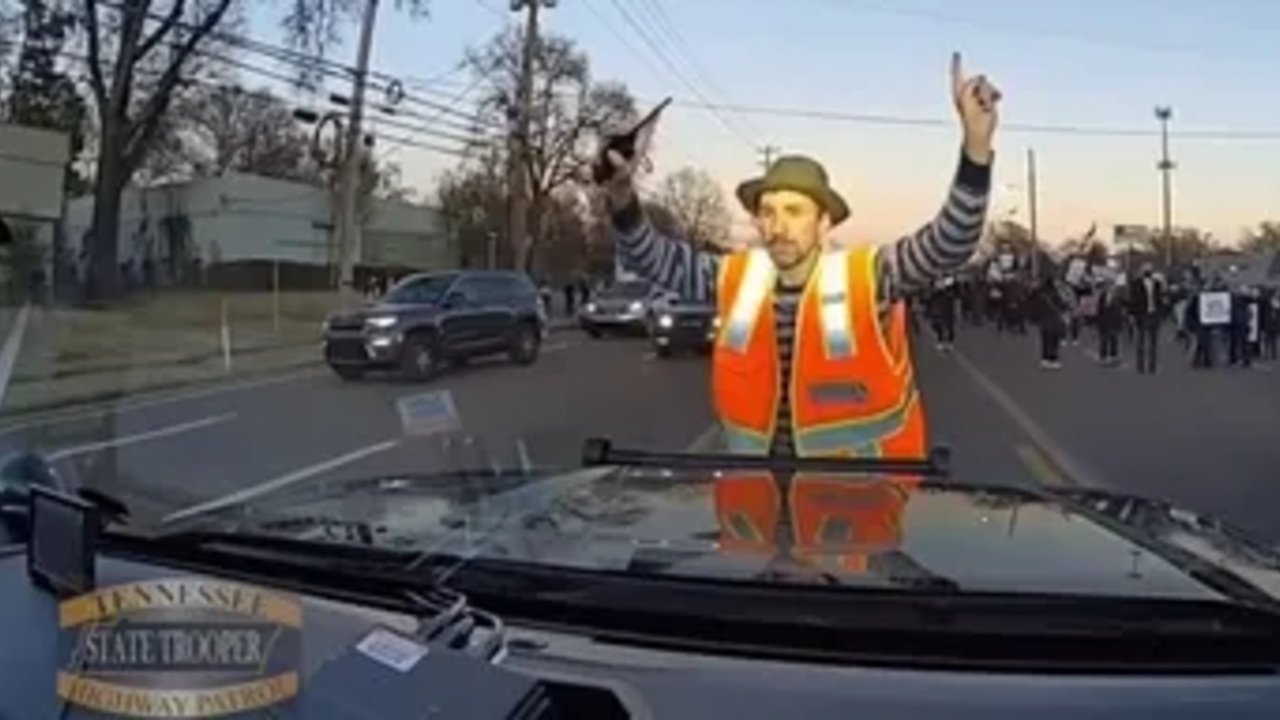
A viral dashcam clip from Memphis has become the latest flashpoint in the battle over protest narratives and police conduct. The footage, released by the Tennessee Highway Patrol, appears to show a demonstrator stepping into the path of a slowly moving patrol SUV, grabbing its front push bar, and then collapsing backward as if struck. The agency says the video proves the trooper did not hit the man, directly contradicting social media posts that had accused the patrol of running over a protester.
The incident unfolded during an anti-ICE protest on a Memphis roadway, where traffic, demonstrators, and law enforcement converged in a tense and chaotic scene. Within hours, short clips and still images spread online, framed as evidence that a Tennessee Highway Patrol Trooper had driven into a peaceful protester. The full dashcam recording, however, has complicated that story and raised broader questions about how quickly partial videos can harden into public belief.
What the dashcam actually shows on the Memphis roadway
The dashcam video begins with a Tennessee Highway Patrol vehicle moving slowly through a crowded stretch of road, edging between stopped cars and clusters of protesters. According to the agency, the trooper was “slowly navigating through traffic and protesters” when a man stepped off the side and into the lane directly in front of the SUV. The footage shows the individual approaching the front of the patrol vehicle, placing his hands on the push bar, and then dramatically falling backward, even though the SUV does not appear to lurch forward or make visible contact.
Officials say the recording confirms that the trooper did not strike the demonstrator and that the man instead entered the roadway on his own, creating a dangerous situation for himself and others. Tennessee Highway Patrol has stated that social media posts claiming a protester was hit by a patrol vehicle in Memphis are false, emphasizing that the video shows the individual “entering the roadway, not being hit.” The agency has framed the release of the full dashcam as a corrective to the viral narrative, arguing that the unedited sequence undercuts claims that the trooper drove into the crowd.
From viral outrage to official rebuttal
Before the dashcam was made public, short clips and eyewitness claims had already circulated widely, portraying the Memphis protest as a clear-cut case of a Tennessee Highway Patrol Trooper striking a demonstrator. Those posts, stripped of context and recorded from ground level, were shared as proof that law enforcement had used a patrol SUV as a weapon against an anti-ICE protester. Within that framing, the man’s fall in front of the vehicle was interpreted as the moment of impact, and the absence of immediate official video allowed that version to spread largely unchecked.
In response, Tennessee Highway Patrol issued a pointed statement saying that “In Memphis, there are social media posts alleging that an individual was hit by a Tennessee Highway Patrol Trooper. This is false.” The agency said the man was not struck by the patrol vehicle and that he had placed himself at “a serious and immediate risk” by stepping into the lane as the trooper attempted to move through traffic. By pairing that statement with the release of the dashcam recording, officials sought to dismantle the viral claim and to reframe the incident as an example of a protester creating a hazard rather than a trooper causing harm.
Safety, protest tactics, and the risk on crowded streets
Beyond the dispute over what happened in a few seconds of video, Tennessee Highway Patrol has used the Memphis incident to underscore its broader message about safety at demonstrations that spill into active roadways. The agency has stressed that its “priority is public safety for all involved, including motorists, protesters and its troopers,” and that troopers are tasked with preventing injuries or worse outcomes when traffic and protests collide. In this case, officials say the trooper was attempting to navigate through congestion when the man stepped into the lane, turning a controlled, low-speed maneuver into a potentially dangerous confrontation.
The dashcam clip also highlights a controversial protest tactic: physically occupying or approaching moving vehicles to dramatize a point or to obstruct traffic. According to Tennessee Highway Patrol, the Memphis demonstrator not only entered the roadway but also grabbed the SUV’s push bar before falling backward, behavior that the agency argues put him and others at risk. The recording shows the trooper continuing at a slow pace and not accelerating into the crowd, which officials cite as evidence that the driver was trying to avoid escalation even as protesters pressed close to the vehicle.
How a few seconds of video fueled a misinformation storm
The Memphis protest underscores how quickly partial footage can ignite a misinformation storm, especially when it appears to confirm existing fears about police behavior. Early clips that circulated online focused on the moment the man fell in front of the patrol SUV, often without showing his approach from the side or his grip on the push bar. Stripped of that context, the fall looked like the aftermath of a collision, and captions framed it as proof that Tennessee cops had run over a man at a rowdy anti-ICE protest. Once that interpretation took hold, it spread rapidly through networks already primed to distrust law enforcement accounts.
When Tennessee Highway Patrol later released the full dashcam video, the longer sequence told a more complicated story. The footage shows the man stepping into the lane as the trooper’s vehicle inches forward, then collapsing in a way that appears disconnected from any sudden movement by the SUV. New reporting on the video described it as refuting claims that Tennessee officers had run over the protester, noting that the recording aligns with the agency’s assertion that the individual was not hit. Yet by the time those details emerged, the initial narrative had already reached a wide audience, illustrating how corrections often struggle to match the emotional impact and speed of the original viral claim.
Trust, transparency, and the stakes for future protests
The Memphis dashcam release fits into a broader pattern in which law enforcement agencies increasingly rely on video to defend their actions and to counter accusations that spread online. Tennessee Highway Patrol has leaned on the recording to argue that its trooper acted appropriately and that the protester’s own choices created the appearance of a collision. By publishing the footage and emphasizing that the viral allegation was “false,” the agency is not only addressing this specific incident but also signaling that it will respond aggressively when it believes social media has misrepresented its conduct.
At the same time, the episode highlights the fragile state of public trust in official accounts of protest policing. For critics, the fact that the man ended up on the ground in front of a patrol SUV during an anti-ICE demonstration is itself evidence of a fraught dynamic between protesters and state power, regardless of whether the vehicle made contact. For supporters of the troopers, the dashcam is proof that some demonstrators are willing to stage or exaggerate confrontations to cast law enforcement in the worst possible light. How the Memphis video is interpreted, and which narrative gains traction, will shape not only perceptions of this protest but also expectations for how future clashes between motorists, demonstrators, and police are documented and judged.
More from Fast Lane Only