Most people learn to drive a boat on a calm lake. An Arizona man who posts as @MURPHYSDIESEL went another way. He built a homemade barge, then pointed it down an Alaskan river to bring back equipment that had been stuck in the wilderness for months.
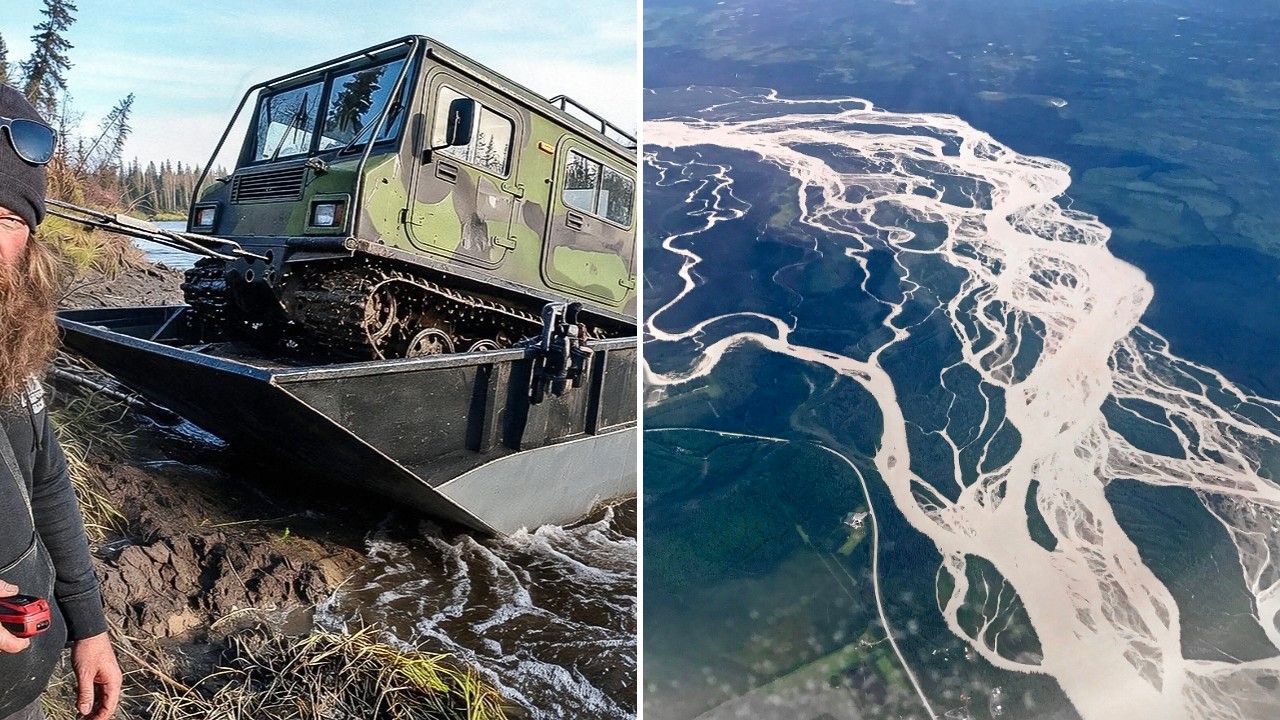
He goes by Wrecker Rick, and he says he built his first boat just three weeks before this trip. The job was huge. By his count, about 33,000 pounds of equipment had sat roughly 70 miles down river for six months.
He also brought the whole family along, from his wife to his young daughters, plus a crew and two local river guides.
Getting The Homemade Barge To The Water
Before the river, there was the road. He describes 76 miles of broken pavement, frost heaves and potholes, and then a long, muddy dirt road into the village of Manley. At one point his Western Star truck got stuck, so the crew had to pull it out.
The barge carries 200 gallons of fuel, and he says its two outboards burn about 30 gallons an hour. Not everyone believed in it, either. He jokes that locals kept offering to pray for him as soon as they saw it.
“It’s a yacht, not a boat,” he insists.
Once the barge hit the water, the group ran down the Tanana River and into the Yukon, then turned up a side slough toward the equipment. That leg took about two and a half hours.
Camping Next To The Stranded Machines
When they reached the site, the crew set up camp beside the machines. Dinner was moose meat cooked over a fire, and breakfast was pancakes. Meanwhile, the girls built a fort with one of the guides.
The haul included a Sisu, a heavy tracked machine he calls his Dodgewell, and a fat-tire truck. He also found an old dresser and a bear-chewed table among the gear, so the crew turned them into a camp dinner table.
The plan was simple: start with the lightest load and work up. So the Sisu went first. With it on board, he says the barge drafted about 12 inches.
Engine Trouble, A Tree And A Sandbar
Then the problems started. On the big river, one outboard stopped pulling. Later he traced it to a fuel tank with no vent, which starved the motor of gas.
On another run, one motor overheated and sent both engines into limp mode. So he used one engine to hold against the current while the other cooled down. After that, the barge hit a large tree that he says came out of nowhere.
The worst moment came on the final trip, with the fat-tire truck aboard and a guide’s boat in tow. The barge ran aground on a sandbar in about a foot of water.
“We’re stuck on a sandbar, folks,” he says.
First, he let the hot engines rest. Then he had an idea: put the motors in reverse and let the prop wash carve the sand out from under the hull. It worked, and the barge floated free.
Lessons From A Long-Distance Recovery
His trip shows how much can go wrong on a remote job. A few lessons stand out:
- Start with the lightest load, and learn how the boat or trailer handles before you add weight.
- Bring more fuel than you think you need, and check vents, filters and screens before you leave.
- Travel with people who know the area. Here, local guides read the water and probed for shallow spots.
- Watch conditions closely, because rivers, roads and weather can change by the hour.
- Keep a way out, such as a long rope and solid anchor points, in case things go wrong.
Where The Homemade Barge Recovery Stands
In the end, every load made it back to the village. By then, he says, the river had dropped about 24 inches in four days.
“Good thing this is our last trip,” he says.
Now he has to decide whether the equipment heads back to Arizona or stays in Alaska. He also says the crew is likely to return in February.
More from Fast Lane Only