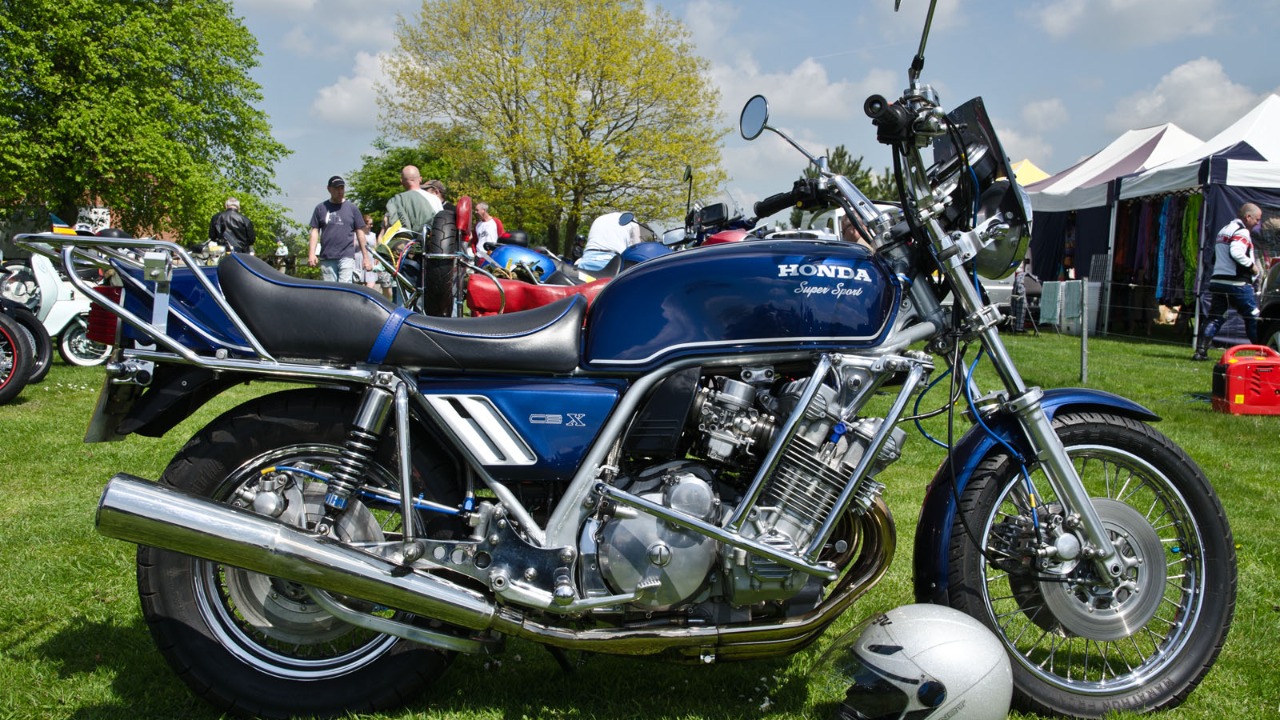
The 1979 Honda CBX took six cylinders, 24 valves and two overhead camshafts off the racetrack and put them under a street rider’s knees. Its 1,047cc inline six made 105 hp, according to Britain’s National Motor Museum. The Honda CBX also showed how far a maker would go to build something its rivals did not have.
Honda launched the bike in late 1978 as a 1979 model. At the time, its rivals all used four cylinders. Honda went to six, and then it had to find a way to fit them into a motorcycle a rider could hold up.
This is the story of that engine, the chassis around it and the short run that followed. Every figure here comes from museum records and enthusiast publications.
Why Honda built a six-cylinder Honda CBX
Before the six, Honda’s big bike was the four-cylinder CB750. According to a Rider magazine retrospective, that 1969 bike had eight valves, made 67 hp and weighed about 500 pounds. By 1978, however, Kawasaki, Suzuki and Yamaha all sold bigger fours of their own.
Rider reports that Honda tested a 1,000cc four that made only five horsepower less than the six. Even so, the company chose the six. In fact, Rider notes that Honda secretly put test bikes in front of American journalists in California in October 1977.
The idea came from racing. Britain’s National Motor Museum says six-cylinder Honda Grand Prix motorcycles of the 1960s inspired the CBX. Likewise, the Audrain Automobile Museum says engineer Soichiro Irimajiri drew on that work, including the RC 165, a 250cc six-cylinder racer.
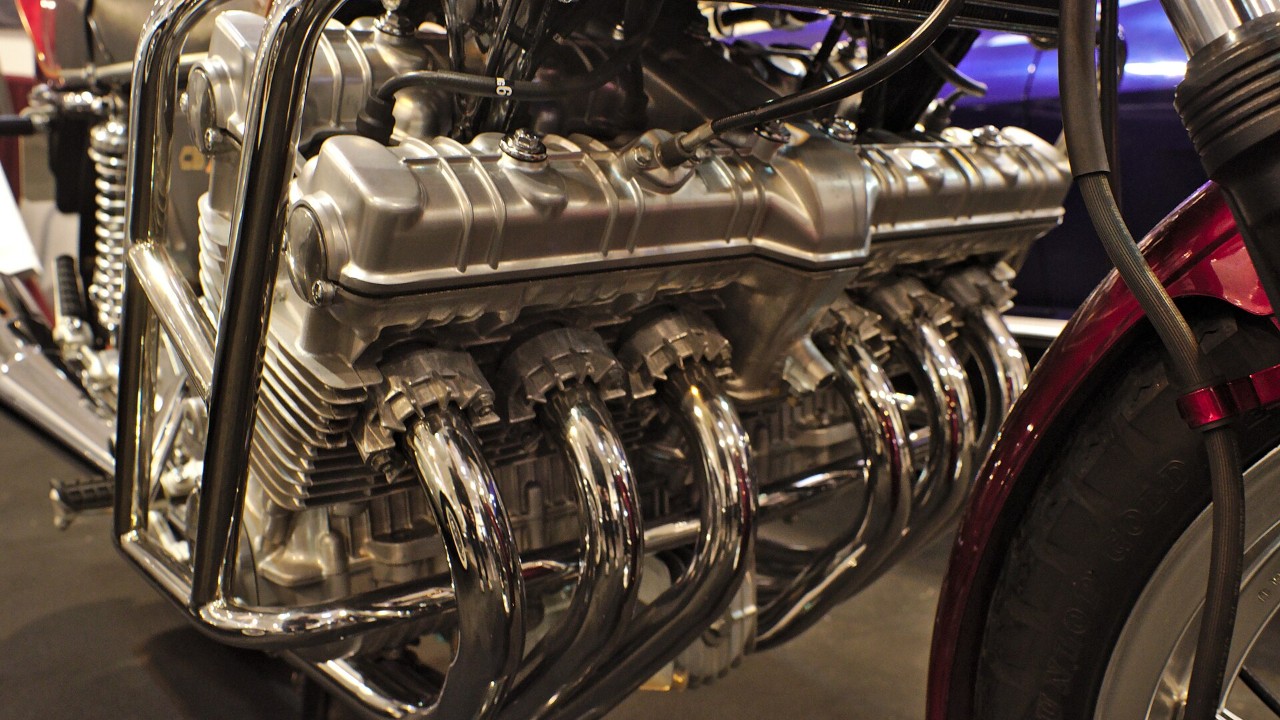
The engine: 1,047cc, 24 valves and six carburetors
The National Motor Museum lists the 1979 CBX engine at 1,047cc, with six cylinders, 24 valves and dual overhead camshafts. It also gives output as 105 bhp at 9,000 rpm. That works out to four valves per cylinder, a layout the Audrain museum also describes.
Fuel came through six Keihin constant-velocity carburetors, one per cylinder, according to Audrain. Power then went through a five-speed manual gearbox. A 2009 retrospective review of the 1979 Honda CBX adds that the engine had a short stroke and fed a six-pipe exhaust.
A six is long, so width was the problem. To narrow it, Honda moved the alternator to a separate jackshaft behind and above the crankshaft, Audrain says. As a result, that 2009 review reports that the six ended up only two inches wider than the CB750’s four.
A chassis built around the engine
Honda also used the engine as a stressed member of the frame. According to Audrain, that removed the frame tubes beneath it and helped keep the center of gravity low. Weight still added up, though, and Audrain gives the curb weight as 600 pounds.
To save pounds elsewhere, Honda used aluminum for the steering triple clamps and the handlebars. It also fitted narrower tires, which Audrain says cost some traction. Up front, telescopic forks and twin disc brakes sat on aluminum Comstar wheels. Meanwhile, a single disc and twin shocks handled the rear.
Not every early detail was right. For example, the 2009 review describes the 35mm front forks and rear shocks as flimsy. It also says early bikes snapped alternator shafts, so Honda added a clutch to the alternator drive. Rider lists early fixes for a lean carburetion spot, a bigger oil cooler and an air-adjustable fork.
The numbers on the road
Speed was the selling point. The National Motor Museum says the CBX was described at its 1978 launch as “the fastest and most powerful road bike in the world.” It records a top speed of 135 mph.
Other sources quote slightly different results. Audrain lists a 140 mph top speed and a standing quarter-mile of 11.36 seconds at 117 mph. By comparison, the 2009 review gives 140 mph and a quarter-mile time of 11.55 seconds.
The price was high too. That same review puts the launch price at more than $4,000. In Britain, the National Motor Museum lists the price new as £2,578.
A detuned six, then a sport tourer
Power limits caught up with the bike quickly. The National Motor Museum notes that Honda built a detuned version for Germany, which had a 100 bhp limit. Rider, for its part, says a proposed German limit led Honda to cut the 1980 CBX to 98 hp.
Sales were weak. In 1980, Rider says, the CBX cost $4,200, while the Kawasaki Z1R, Suzuki GS1100E and Yamaha XS1100G each sold for $3,700. Then, for 1981 and 1982, Honda turned the CBX into a sport tourer with a half fairing and small removable panniers.
That later bike also got new camshafts for more mid-range power. In addition, Rider says it gained a single Pro-Link rear shock, 39mm forks and larger vented front discs. Its price rose to $5,600.
Where the Honda CBX stands today
The run did not last long. The 2009 retrospective says Honda built the CBX for four years, ending in 1982. However, the bike kept its following, and that review counts about 1,100 members in the International CBX Owners Association.
Museums keep examples too. The Audrain Automobile Museum lists a 1979 Honda CBX in its collection. Britain’s National Motor Museum Trust also owns a 1979 CBX 1000, which it records at 1,047cc and 105 bhp.
More from Fast Lane Only
- Unboxing the WWII Jeep in a Crate
- 15 rare Chevys collectors are quietly buying
- 10 underrated V8s still worth hunting down
- Police notice this before you even roll window down
This article was created with the help of AI and was reviewed and edited by Fast Lane Only editors before publication.