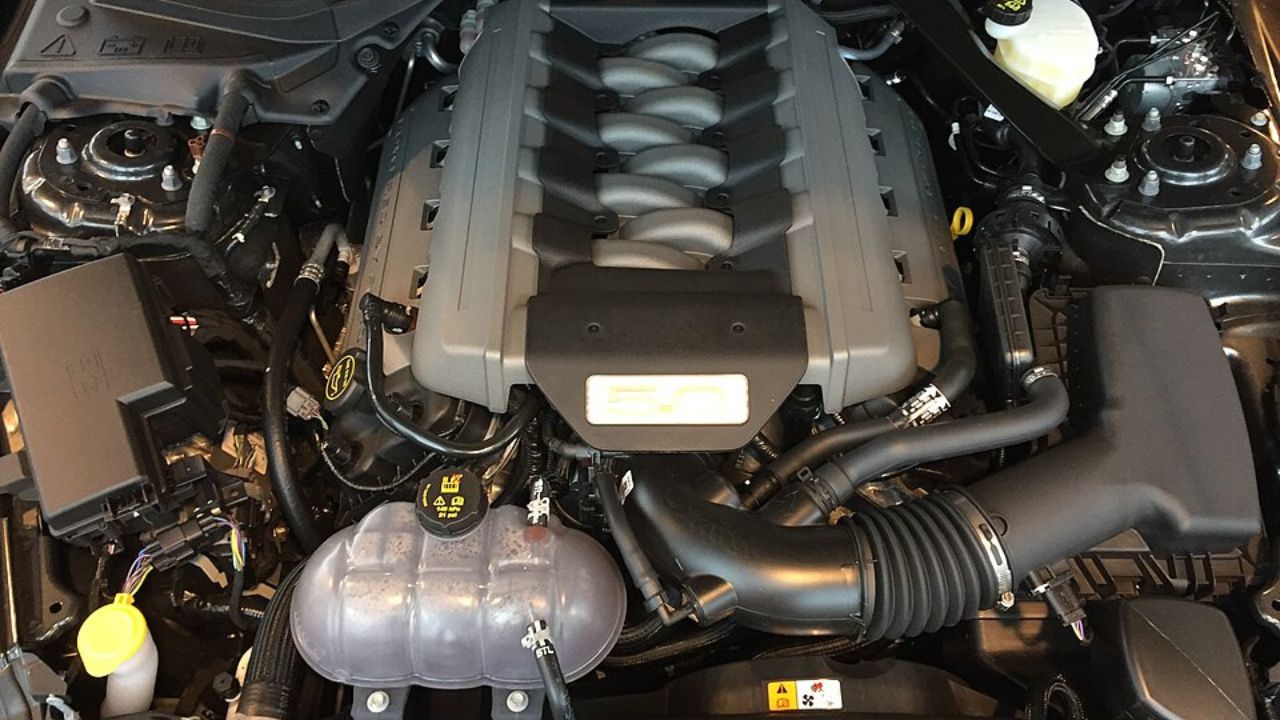
The Mustang has always been defined by the sound and shove of a V8, yet the forces lined up against that formula have rarely been stronger. Tighter fuel economy rules, global emissions standards, and the rise of turbocharged fours all pushed Ford to rethink what its pony car should be. Inside that pressure cooker, a group of engineers worked to keep a big, naturally aspirated engine not just alive but central to the car’s identity.
The result is a modern Mustang that carries its heritage in the engine bay while adapting to a world that increasingly questions thirsty performance cars. The story of how that happened is as much about internal battles over character and feel as it is about horsepower and torque.
How the 2015 Mustang reshaped the V8’s future
The sixth-generation Mustang arrived with independent rear suspension, a global platform, and a turbocharged 2.3-liter EcoBoost four-cylinder that immediately signaled a new era. Yet the heart of the lineup remained the 5.0-liter V8 in the GT, a decision that reflected intense debate inside Ford about what the car should be as it went worldwide. Engineers had to prove that a large, naturally aspirated engine could coexist with stricter efficiency targets and a broader customer base outside North America.
To do that, the powertrain team reworked the Coyote V8 with revised cylinder heads, updated intake and exhaust tuning, and friction-reducing tweaks that improved both power and drivability. The goal was not only more output but a wider, more usable powerband that would make the V8 feel responsive at everyday speeds instead of like a relic that only came alive at the top of the tach. Early drives of the 2015 Mustang GT highlighted how much more refined and tractable the engine felt compared with the prior generation, even as it delivered stronger acceleration.
Chassis engineers were just as focused on preserving the experience that made V8 Mustangs iconic. The move to independent rear suspension risked softening the car’s raw character, so the team tuned bushings, geometry, and stability control calibration to ensure the GT still felt rear driven and playful. Long-term testing of a 2015 Mustang, including a yearlong evaluation of the EcoBoost model, showed how the new platform balanced comfort and performance for daily use and extended road trips.
This broader usability mattered for the V8 as well. If the Mustang was going to be sold in Europe, Asia, and other markets with higher fuel prices and tighter roads, the eight-cylinder car needed to feel like more than an old-school muscle machine. Engineers concentrated on steering feel, brake performance, and ride quality so that the GT could play the role of long-distance tourer and track toy, not just a straight-line bruiser.
Internal battles that kept the V8 on the order sheet
Inside Ford, the Mustang program had to compete for resources with trucks, crossovers, and hybrid projects that promised far higher volumes. Executives looked at the success of turbocharged engines across the lineup and saw an opportunity to push more buyers toward the 2.3-liter EcoBoost, which delivered strong torque and better rated fuel economy than the V8. For some planners, a future Mustang range led by four-cylinder and V6 engines looked attractive from a business perspective.
Engineers who had spent their careers around Mustangs argued that such a shift would hollow out the car’s identity. They pointed to decades of buyers who associated the Mustang name with a V8 burble, burnouts at the drag strip, and a sense of mechanical simplicity that turbocharged engines could not replicate. Within development meetings, they framed the V8 as a brand pillar that justified its own investment, even if take rates were lower than for smaller engines.
To strengthen their case, the team focused on making the V8 variant technically defensible. That meant squeezing efficiency gains from direct injection, variable valve timing, and careful calibration rather than relying solely on displacement. They studied global emissions cycles and tailored the engine’s behavior to hit targets without resorting to heavy-handed power cuts. By presenting the V8 as a modern, compliant powertrain instead of a nostalgic indulgence, they won approval to keep it at the top of the range.
There was also a cultural dimension inside the company. The Mustang has long served as a halo for Ford’s engineering talent, a place where ideas about lightweight materials, advanced electronics, and performance tuning can be tested before filtering into other models. The V8 GT, and later the more extreme Shelby variants, gave engineers a showcase for what they could do. Losing that platform would have meant losing a powerful internal motivator and a clear symbol of Ford’s performance credibility.
Why the V8 fight matters in a changing performance market
The struggle to retain a V8 in the Mustang is not just a Ford story. Across the industry, performance cars face similar pressure from regulators and shifting consumer tastes. Turbocharged four-cylinder engines now power everything from hot hatchbacks to luxury sedans, offering strong numbers on paper and better official fuel economy ratings. For many buyers, that trade-off is acceptable, especially when paired with advanced automatic transmissions and digital driving aids.
Yet enthusiast demand for naturally aspirated V8s remains stubbornly strong. The Mustang GT occupies a particular niche as an attainable way to experience that kind of engine, with a manual gearbox and rear-wheel drive. Competing models that still offer eight cylinders tend to sit at higher price points, which gives Ford a unique role in keeping this type of performance accessible. Engineers understood that if the Mustang dropped its V8, a large group of drivers would simply lose their entry point into that experience.
There is also a brand halo effect that extends well beyond direct V8 sales. Marketing campaigns built around the sound and imagery of a Mustang GT help sell EcoBoost and V6 versions by association. When a Mustang appears in films, games, or motorsport, it is usually the eight-cylinder car that takes center stage. The effort to keep that version alive therefore supports the entire Mustang ecosystem, from entry-level models to special editions.
At the same time, the presence of the EcoBoost engine shows how Ford is hedging its bets. That turbocharged four gives buyers in markets with high fuel costs or punitive taxes a way into Mustang ownership while still delivering respectable performance. Long-term testing of the EcoBoost car highlighted its blend of usable torque and highway efficiency, qualities that appeal to drivers who might never consider a traditional muscle car. The V8 and the four-cylinder do not simply compete with each other; they work together to keep the Mustang viable in a broader set of markets.
Where the Mustang V8 goes from here
Looking ahead, the forces that almost sidelined the V8 are only intensifying. Fuel economy regulations are tightening, and electric vehicles are rapidly improving in both performance and cost. Within Ford’s own lineup, battery-powered models are becoming more prominent, and some future performance projects will likely rely on electric motors rather than large combustion engines. In that context, the Mustang V8 exists on borrowed time unless it can evolve.
Engineers are already exploring ways to stretch its lifespan. Further improvements in direct injection, cylinder deactivation, and friction reduction can deliver incremental efficiency gains without sacrificing the character that defines the GT. Lightweighting elsewhere in the car, from suspension components to body panels, can help offset the V8’s inherent thirst by reducing the energy required to move the vehicle. Hybridization is another path, pairing an electric motor with the engine to provide both performance boosts and lower emissions in urban driving.
Any such changes will require the same internal advocacy that kept the V8 alive for the current generation. Product planners will weigh the cost of reengineering a large engine against the potential returns from investing in all-electric platforms. Regulators in key markets will influence how much room there is for high-displacement engines, and customer demand will determine whether the V8 remains a must-have or becomes a niche indulgence.
More from Fast Lane Only
- Unboxing the WWII Jeep in a Crate
- 15 rare Chevys collectors are quietly buying
- 10 underrated V8s still worth hunting down
- Police notice this before you even roll window down
*Research for this article included AI assistance, with all final content reviewed by human editors