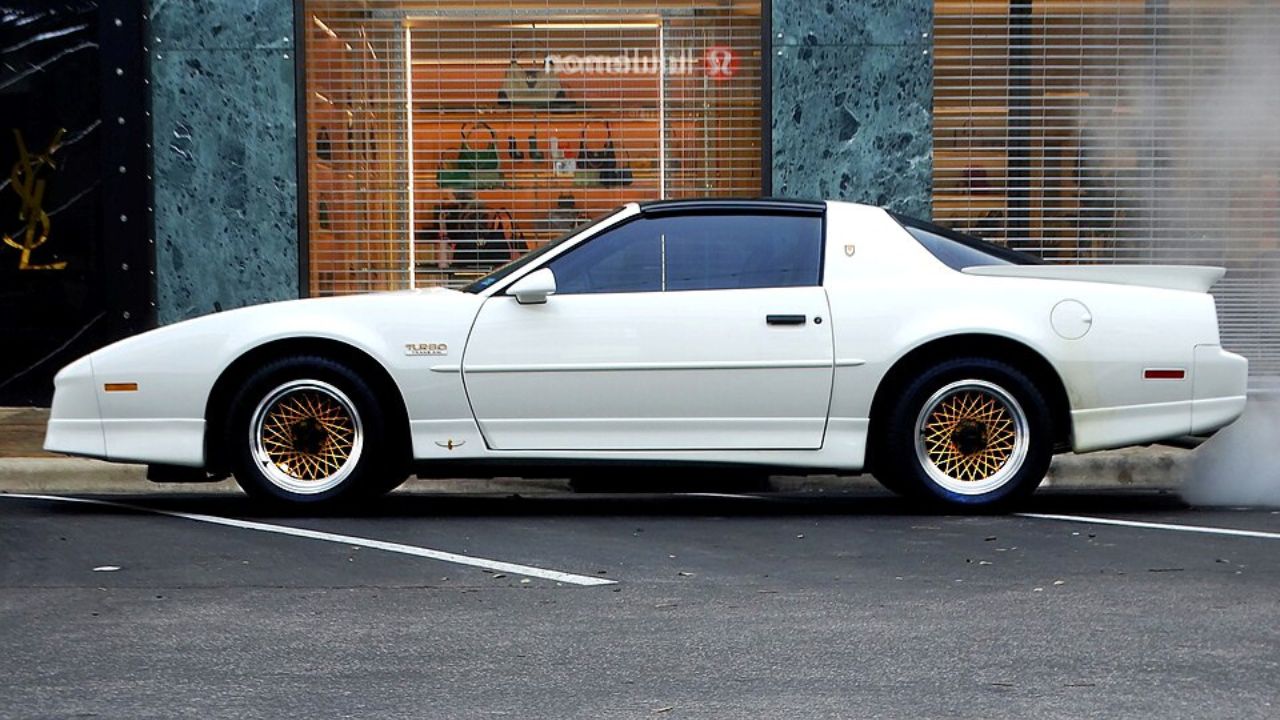
The 1989 Turbo Trans Am arrived as a limited-production outlier that broke several of General Motors’ internal rules at once. Built around a Buick-derived turbocharged V6, tuned with help from outside contractors, and sold in numbers too small to move corporate profit charts, it nonetheless embarrassed GM’s own flagship Corvettes at the drag strip and on the street. That mismatch between corporate priorities and real-world performance created friction inside the company that still fascinates enthusiasts today.
How a Buick turbo V6 ended up in Pontiac’s halo car
Inside GM’s rigid divisional structure, engines were supposed to stay in their home brands, and the Chevrolet small-block V8 was the default performance answer. The 1989 Turbo Trans Am broke that pattern by borrowing the 3.8-liter turbocharged V6 that Buick had developed for the Grand National and GNX. Pontiac engineers saw that compact, torque-rich engine as the quickest route to a modern high-performance Firebird without the weight and packaging compromises of a big V8, so they pushed to adapt the Buick unit rather than wait for a new in-house solution. According to detailed development accounts, the program relied on the same basic 3.8-liter architecture but required new cylinder heads, revised pistons, and bespoke calibration to fit the third-generation F-body platform and meet emissions targets.
The move immediately raised eyebrows inside GM. The company had spent years promoting the Corvette as its purest performance car, powered by a Chevrolet V8, and had just invested heavily in the C4 platform. Allowing Pontiac to install a turbocharged Buick V6 that could potentially outrun the Corvette challenged internal hierarchies rooted as much in brand politics as in engineering. The Turbo Trans Am’s limited run, tied to the 20th anniversary of the model and the Indianapolis 500 pace car program, gave Pontiac just enough justification to slip the project through corporate filters, but it did not erase concerns that the car might overshadow GM’s official flagship.
Why the Turbo Trans Am’s performance rattled the Corvette hierarchy
Once the cars reached the street, those concerns proved well founded. Period testing showed that the turbocharged 3.8-liter V6 delivered acceleration that matched or beat contemporary Corvette figures while returning respectable fuel economy. The combination of a relatively light front end, strong low-end torque, and careful suspension tuning gave the Turbo Trans Am real-world speed that surprised even some GM insiders who had expected a marketing exercise rather than a genuine performance benchmark. The car’s ability to run with or ahead of the company’s more expensive halo model highlighted how far turbocharging and electronic engine management had come inside GM’s own portfolio.
The performance gap created tension on several fronts. Corvette engineers had spent years refining the aluminum-head V8 and composite chassis, and their work was supposed to set the pace for the rest of the corporation. Seeing a limited-production Pontiac, powered by an engine from Buick’s parts bin, steal headlines and drag strip glory cut against the narrative that the Corvette represented GM’s ultimate engineering statement. Marketing teams also had to navigate awkward messaging. The company wanted to celebrate the Turbo Trans Am’s success at the Indianapolis 500 and in magazine tests, yet could not openly admit that a turbo V6 Firebird had eclipsed the car that was supposed to sit at the top of the performance pyramid. Detailed retrospectives on the project describe how the car’s acceleration numbers and real-world reputation quickly outgrew its modest production run, much to the discomfort of those charged with protecting the Corvette’s image.
The friction was not only about straight-line speed. The Turbo Trans Am showcased a different path to performance that relied on forced induction and cross-divisional component sharing instead of ever-larger displacement. That approach implicitly questioned GM’s long-standing reliance on the small-block V8 as the default answer for any performance problem. For engineers who had championed the Grand National and GNX, the Pontiac project validated years of work on turbocharged V6 technology. For traditionalists inside the corporation, it looked like a challenge to the established order.
Inside the low-volume, high-complexity engineering that annoyed GM’s bean counters
Beyond the political fallout, the Turbo Trans Am created practical headaches for GM’s manufacturing and finance teams. The car was built in relatively small numbers, with production estimates clustered around a few thousand units, and each one required specialized parts and extra assembly steps. The adapted 3.8-liter turbo engine needed unique cylinder heads and modified exhaust routing to fit the F-body engine bay, and the program relied on external suppliers for some of the calibration and validation work. That complexity drove up per-car costs and made the Turbo Trans Am an accounting anomaly inside a company structured around high-volume, shared-platform efficiencies.
From a corporate perspective, a limited run of heavily customized cars did little to improve overall profitability or justify major tooling investments. Yet the Turbo Trans Am demanded real engineering resources, testing time, and executive attention. That imbalance irritated some managers who saw the project as a distraction from higher-volume programs that would actually move GM’s bottom line. Retrospective reporting on the car’s gestation notes that the program required internal champions willing to absorb political risk, since any cost overruns or quality problems would be highly visible and easy targets for critics of such one-off ventures.
The car’s uniqueness also complicated service and warranty support. Dealers had to learn the quirks of a Buick-based turbo powertrain in a Pontiac chassis, and parts departments had to stock low-volume components that did not fit other GM models. For a corporation already wrestling with quality perception issues in the late 1980s, the prospect of a temperamental, complex halo car raised real concerns. Enthusiast-focused reporting has described how the Turbo Trans Am’s blend of Buick engine hardware, Pontiac bodywork, and specialized calibration created a parts and service puzzle that did not align with GM’s drive toward standardization.
Why the 1989 experiment still matters to GM’s performance playbook
More than fifteen years later, the Turbo Trans Am still shapes how enthusiasts and some insiders think about GM performance. The car demonstrated that the corporation could deliver world-class acceleration and drivability by mixing components across divisions and embracing turbocharging. It also showed that limited-production halo models could generate outsized brand equity even if they did not directly produce large profits. Modern retrospectives, such as a detailed feature on the 1989 Turbo Trans, highlight how the project’s successes and headaches informed later decisions about cross-brand engineering and special editions.
The tension it created inside GM also serves as a cautionary tale. When a lower-priced, niche model outperforms a flagship, it can energize enthusiasts but unsettle internal hierarchies. That dynamic has influenced how GM manages performance variants across Chevrolet, Pontiac while it existed, Buick, and Cadillac. Subsequent programs have taken care to position turbocharged or supercharged models so they complement rather than overshadow the Corvette and other top-tier offerings. The lesson from 1989 is that engineering excellence alone is not enough; corporate alignment on brand roles and pricing is just as important.
At the same time, the Turbo Trans Am’s legacy supports the argument for giving engineers room to experiment with unconventional combinations. The car’s success with a turbocharged V6 anticipated later moves toward smaller, boosted engines across the industry. It also validated the idea that a well-executed limited run can burnish a brand’s image for decades, even if the short-term financial case looks weak. For GM, that experience has likely informed how it evaluates future halo projects that rely on specialized powertrains or cross-divisional parts sharing.
More from Fast Lane Only
- Unboxing the WWII Jeep in a Crate
- 15 rare Chevys collectors are quietly buying
- 10 underrated V8s still worth hunting down
- Police notice this before you even roll window down
*Research for this article included AI assistance, with all final content reviewed by human editors