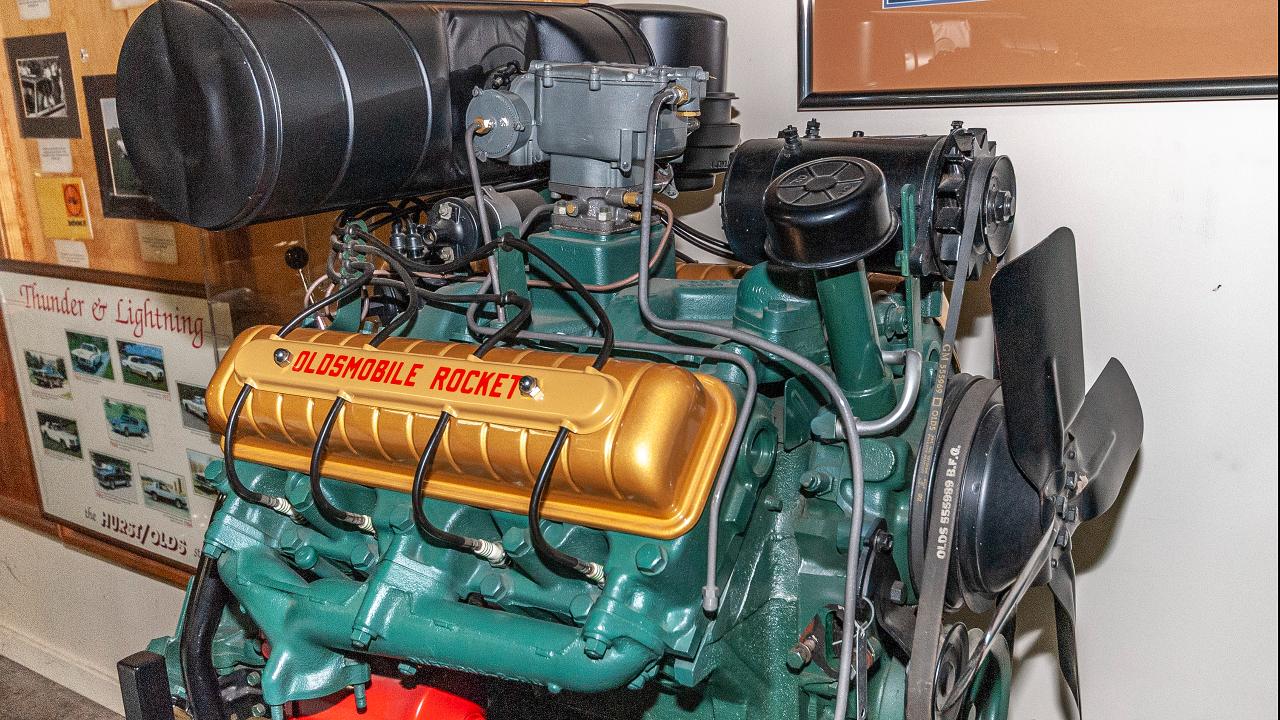
The Oldsmobile Rocket V8 did more than make one model quick in a straight line. It forced Detroit’s engineers to rethink how much power, efficiency, and durability could be packaged into a compact, mass produced engine, and it did so at a moment when American drivers were ready for speed. By combining aviation era combustion knowledge with a new approach to V8 proportions, Oldsmobile created a template that reshaped both family sedans and future muscle cars.
From the first Rocket powered 88 sedans to later turbocharged experiments, the division used its V8 program as a rolling laboratory. The resulting breakthroughs in power to weight ratios, automatic transmissions, and even turbocharging rippled across General Motors and the wider industry, setting engineering benchmarks that competitors were forced to match.
From wartime research to a modern V8
The Rocket V8 did not appear in a vacuum. Oldsmobile engineers were working in a country that had just poured enormous resources into aircraft powerplants, and that wartime research directly shaped how they thought about combustion and fuel. Work on the Army’s Hyper engine program, for example, went hand in hand with efforts to raise the octane rating of gasoline, and those gains in fuel quality made it realistic to run higher compression ratios in postwar passenger cars. Oldsmobile’s engineers could therefore design a relatively small displacement V8 that still produced robust power without detonation, something that would have been far riskier on prewar fuel.
Inside General Motors, there was already a culture of pushing drivetrain technology forward. When Charles F. Kettering developed the Hydra Matic automatic transmission for the 1940 Olds, he was already anticipating that future engines would need to handle higher compression and more power on improved gasoline. That mindset carried into the Rocket program, where the engine and transmission were engineered as a system, allowing Oldsmobile to deliver strong acceleration with the convenience of an automatic at a time when most rivals still paired modest flathead engines with manual gearboxes.
Oversquare design and the birth of Rocket 88
The key technical leap that distinguished the Rocket V8 from many contemporaries was its geometry. While most engines of the era were undersquare, with a narrow bore and long stroke that limited high rpm breathing, Oldsmobile adopted an oversquare layout that favored a wider cylinder bore and shorter stroke. This configuration allowed larger valves and better airflow through the combustion chambers, and it reduced piston speeds at a given engine rpm, improving durability. The result was a compact V8 that could rev more freely than the long stroke straight eights and sixes that still dominated American roads in the late 1940s.
Oldsmobile moved quickly from concept to production. Blast Off came when the new V8, developed in roughly a year, was installed in the lightest full size Oldsmobile, creating the now legendary 88. That car’s 303-cubic-inch Rocket engine delivered a reported 135 horsepower, a striking figure for a relatively small displacement V8 at the time. By combining the oversquare design with efficient combustion chambers, Oldsmobile achieved a power to weight ratio that, as later analysis noted, surpassed competitors while also returning better fuel economy, a balance highlighted in period histories that observed the soon to be family of V8s had superior power to weight and efficiency and were “ready for blast off.”
Engineering a template for muscle
Although the term “muscle car” would not become common until the 1960s, the formula was already present in Oldsmobile’s postwar strategy. The 1949 Rocket powered 88, described in later retrospectives as The Rocket 88 and credited as the first muscle car, combined a 5.0 litre V8 with 135 hp in a relatively modest sized body. That configuration, a strong engine in an intermediate or lighter chassis, would become the blueprint for the entire segment. The car’s success on the street and in early stock car competition demonstrated that buyers would respond to performance that felt closer to aircraft takeoff than to the “massive sluggish boats” with straight eights that had defined the prewar market.
Oldsmobile continued to refine this template through the 1960s. What most muscle car enthusiasts remember are the Rocket V 8 engines introduced in 64 and 65 Oldsmobiles, which shared common tooling across displacements and carried the Rocket name into a new era. These engines, descendants of the original concept, were engineered to deliver strong torque across the rev range, making intermediate models quick in everyday driving rather than only at high rpm. Later commentary on the Oldsmobile 455 Rocket, for instance, recalls how General Motors issued a directive that no intermediate car could have an engine larger than a certain size, and Oldsmobile’s engineers responded by extracting remarkable torque and power within that constraint, a testament to how far the Rocket architecture could be pushed.
Lightweight blocks, small blocks, and the “Killer” experiments
As the Rocket program matured, Oldsmobile shifted from the original heavy castings to a family of lighter, small block V8s. The ancestors of Oldsmobile’s later lightweight, small block Rocket V8 engines were introduced in the mid 1960s, and they carried forward the emphasis on compact dimensions and strong torque. These engines proved versatile enough to power everything from family sedans to performance models, and their relatively low weight improved handling and braking compared with the earlier, heavier big blocks. Period accounts emphasize that the family of V8s maintained favorable power to weight ratios and fuel economy, reinforcing Oldsmobile’s reputation for engineering savvy rather than brute force alone.
Oldsmobile’s engineers were also willing to push far beyond showroom specifications. Internal projects such as the Olds Experimental V8, nicknamed the Killer, explored power levels that were extreme even by the standards of period motorsport. Reporting on that program notes that Oldsmobile, whose 442 was already an impressive car, was still relatively obscure compared with some rivals, and the experimental engine was an attempt to change that perception through sheer performance. Although such projects did not always reach production, they fed lessons back into mainstream Rocket V8 development, particularly in areas like bottom end strength, valvetrain stability, and cooling, which benefited even the more modest engines.
Turbocharging, longevity, and the Rocket legacy
Oldsmobile did not stop at naturally aspirated power. In the early 1960s the division introduced The Jetfire, an Oldsmobile F 85 Jetfire that is widely regarded as the first turbocharged production passenger car. The Innovation timeline for turbocharging notes that the Oldsmobile Jetfire Turbo Rocket, fitted with a Garrett T05 unit with integrated wastegate, marked the first time a turbocharger was offered on a regular production passenger car. To make that work on contemporary fuel, Oldsmobile engineers devised a fluid injection system to cool the intake charge and prevent detonation, a direct descendant of the high octane, high compression thinking that had shaped the original Rocket V8.
The durability and torque rich character of Rocket engines also gave them a second life long after Oldsmobile left showrooms. Enthusiast guides point out that it is possible to make “mountains of torque” without spending heavily by using the commonly overlooked Oldsm Rocket V8, which still abounds in junkyards across the nation. One retrospective on This Oldsmobile Rocket V8 describes it as one of the most influential engines in American automotive history, credited with launching the modern high performance V8 era. That assessment captures why the Rocket V8 changed Detroit engineering: it proved that a carefully designed, relatively compact engine could deliver aircraft inspired performance, support advanced technologies like automatic transmissions and turbocharging, and remain robust enough to be prized decades later by hot rodders and restorers alike.
More from Fast Lane Only