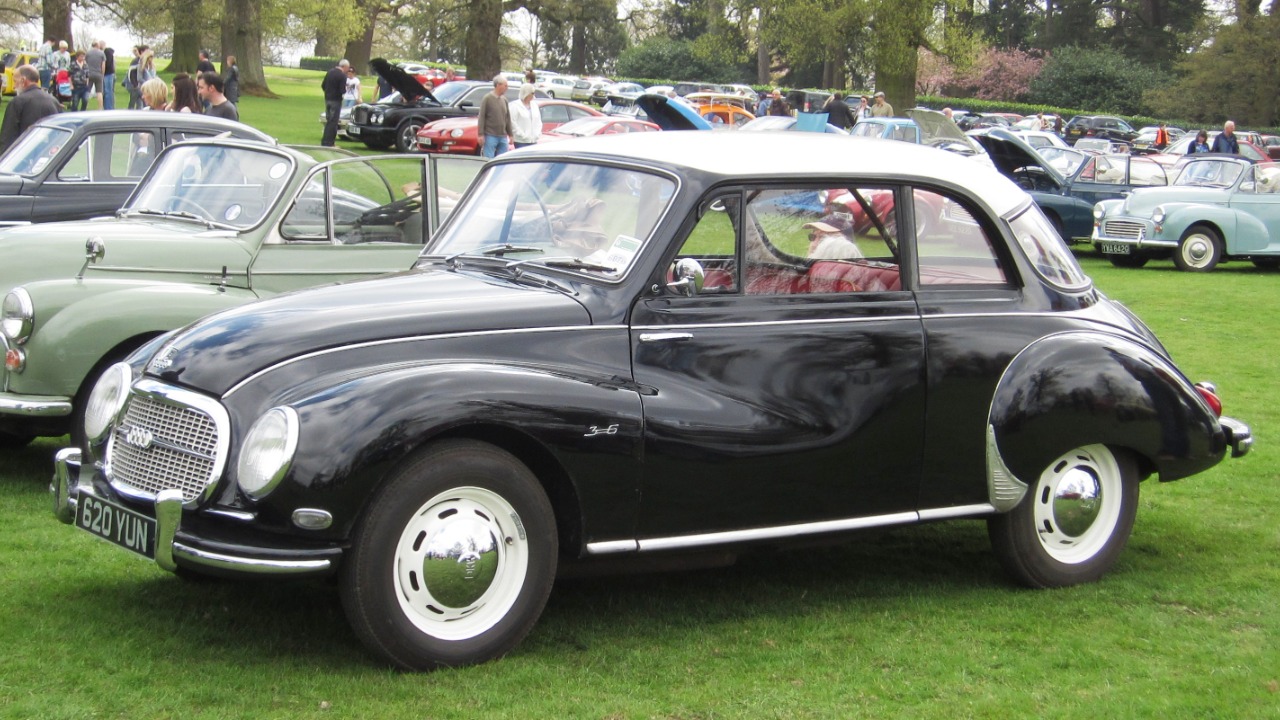
The 1958 DKW 3=6 looked like a modest family saloon, but its engineering was a quiet rebellion against four-stroke orthodoxy. By leaning into two-stroke logic, it promised the performance feel of a six‑cylinder engine from just three pots, and wrapped that idea in a roomy, front‑wheel‑drive body that previewed the modern Audi template. I want to trace how that car turned a simple equation into a whole philosophy of how a small engine, used cleverly, could punch far above its weight.
The strange math behind “3=6”
At the heart of the 3=6 badge was a piece of engineering arithmetic that actually made sense. In a conventional four‑stroke engine, each cylinder only produces power on one of every four strokes, but a two‑stroke fires every time the piston comes up, so a three‑cylinder two‑stroke delivers a power pulse three times per crankshaft revolution. That meant the little DKW unit could mimic the smoothness and output pattern of a six‑cylinder four‑stroke, which is why the company felt justified in saying that three equalled six, a claim that is spelled out in period explanations of the underlying logic of the model name.
That mechanical rhythm shaped the character of the car on the road. Instead of the lazy, off‑beat thrum of a big four‑stroke, the DKW’s three‑cylinder two‑stroke spun up eagerly, with a distinctive exhaust note and a willingness to rev that owners still talk about today. In a modern clip of late‑night maintenance on a daily driven 1958 DKW, recorded in Feb and shared by an enthusiast who casually works on “my DKW” after the shop is closed, you can hear how that compact engine still sounds busy and alive, more like a small racing motor than a sleepy economy car.
Two-stroke thinking in a family car
What fascinates me is how deliberately DKW leaned into two‑stroke virtues instead of apologising for them. A two‑stroke has fewer moving parts, no complex valve gear and a simple lubrication system, which makes it light and easy to service compared with a typical four‑stroke. Modern comparisons of two‑stroke and four‑stroke outboards still stress that, even if mixing oil and fuel might seem like extra hassle, the basic design is simpler and each maintenance session can be more frequent but also more straightforward, a point that mirrors how two‑stroke simplicity was once a selling point in cars.
DKW wrapped that mechanical pragmatism in a surprisingly refined package. The 3=6 sat in a market segment that was increasingly dominated by the Volkswagen Beetle, yet the Auto Union engineers gave their contender front‑wheel drive and a roomy cabin that reviewers described as class leading. Period descriptions of the 1957 DKW Auto Union 3=6 stress that, even as the Beetle loomed large, the car offered generous interior space and, in some versions, a modestly extended wheelbase to improve comfort, details that underline how the Auto Union approach was about more than just an unusual engine.
From university towns to Monza dreams
The 3=6 also found an audience that appreciated its contrarian streak. Contemporary observers noted that university towns tended to be a hot bed for two‑stroke Saabs and DKWs, with intellectuals drawn to cars that let them wrap themselves in an argument about rational engineering and efficiency. That culture of clever contrarians is captured in accounts of how University drivers embraced Saabs and DKWs as much for the story they told as for the way they drove.
Yet the same basic hardware could also be aspirational. The DKW Monza took the Three Equals Six idea and wrapped it in a lightweight sports body, turning the humble saloon’s drivetrain into something that looked ready for an Italian circuit. There are still unusual and interesting examples of this car preserved in places like the Lane Motor Museum, where curators note that the DKW Monza, badged with the phrase Three Equals Six, stood out for its performance and for the way it combined that engine with superior interior space, a combination that helps explain why DKW could sell both practicality and speed with the same core design.
How DKW shaped Audi’s future
When I look at the 3=6 today, I see the outlines of the modern Audi brand hiding in plain sight. DKW’s two‑stroke engines were lightweight, powerful for their size and economical to produce, and the company used them to pioneer front‑wheel drive and packaging tricks that would not become mainstream until decades later. Analyses of Audi’s brand portfolio point out that DKW and the other historic names under the four rings each contributed something distinct, and in DKW’s case it was this blend of compact power and innovative layout.
The cabin of the 3=6 also hinted at the comfort‑oriented direction Audi would later pursue. Descriptions of the model emphasise that the front‑wheel‑drive layout freed up space for the driver and front‑seat passenger, and that the car’s proportions delivered a surprisingly airy interior for its class. That focus on usable space and refinement, built on top of unconventional engineering, is echoed in later histories of the four rings that describe how the two‑stroke engine that was a typical DKW feature eventually lost ground with experts and the public, prompting a shift back to four‑stroke power with technical assistance from Daimler‑Benz, a turning point that is spelled out in Audi’s own history of the brand.
Why two-strokes faded, and why the idea still matters
For all its ingenuity, the 3=6 could not outrun changing expectations. As emissions were starting to be regulated and Consumers began to demand more refinement and fuel efficiency, the smoky, high‑revving character of two‑stroke cars became a liability. Accounts of DKW’s final years describe how the Volkswagen Group, with the Beetle and other four‑stroke models, was better placed to meet those new standards, and how those pressures eventually curtailed Dampf‑Kraft Wagen’s two‑stroke ambitions, a shift that is traced in discussions of how Emissions rules reshaped the small‑car market.
Yet the core insight behind the 3=6, that you can trade complexity for clever combustion timing and packaging, keeps resurfacing. Modern opposed‑piston projects, for example, aim to replace the traditional four‑stroke layout with paired pistons in a single cylinder, eliminating the need for a camshaft and valves and promising higher efficiency from a simpler block. Reports on these engines note that, as Wired explains, the opposed piston concept can cut friction and complexity while still meeting strict emissions targets, a modern echo of the way As Wired once framed the appeal of rethinking the combustion cycle itself.
More from Fast Lane Only: