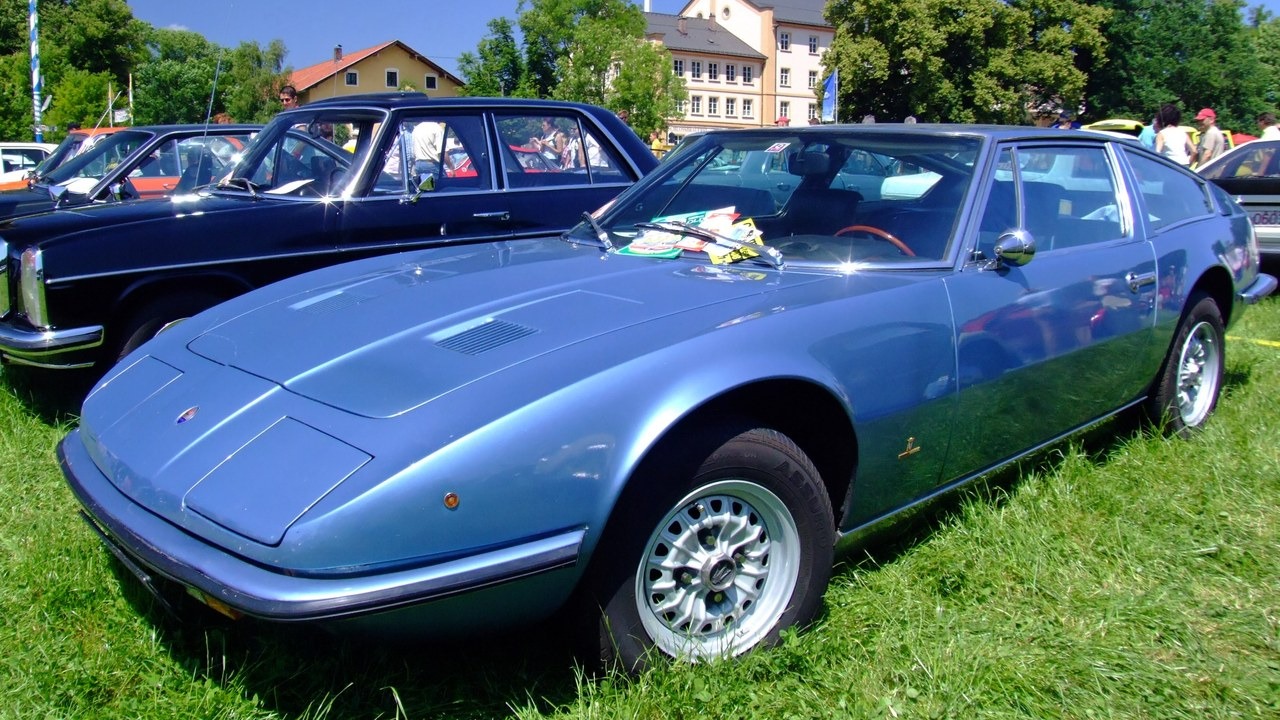
The 1969 Maserati Indy arrived at a moment when grand tourers were expected to be either fast or practical, but rarely both. By pairing genuine four-seat space with serious V8 performance, it quietly rewrote what a family-capable Italian coupe could be. I see it as one of those rare cars that solved a packaging puzzle without losing the glamour that made people fall for Maserati in the first place.
Racing heritage wrapped in a family brief
At its core, the Indy was Maserati’s attempt to turn racing glory into something you could use every day. The name itself reached back to the 8CTF single-seater that won the Indy 500 in 1939 and 1940, a reminder that this comfortable four-seater carried the same badge that had conquered Indianapolis. That heritage was not just a marketing flourish, it set expectations that a car with room for four and their luggage still had to feel alive on a fast road.
At the same time, Maserati knew it needed to broaden its appeal beyond two-seat exotics. The Indy was conceived as a luxurious four-seater grand tourer, produced as a tribute to Maserati’s racing victories at the Indianapolis circuit, and it slotted into the range as a more usable companion to the brand’s pure sports models. Period descriptions of the Maserati Indy underline that blend of comfort and speed, highlighting features such as automatic transmission and power steering that made long-distance travel less of a workout. I read that mix as a deliberate attempt to bring race-bred cachet into the realm of real-world grand touring.
Vignale’s sleek answer to the space problem
Styling a genuinely roomy four-seater without sacrificing elegance is harder than it looks, and this is where Vignale’s work on the Indy still impresses me. The car was officially presented at the Geneva motor show with bodywork by Carrozzeria Vignale, which styled an elegant four-seater coupe on a shortened Quattroporte chassis. That decision to start from a Quattroporte base, rather than a smaller sports car, gave the designers the hard points they needed for real rear legroom, yet the finished shape still reads as low and purposeful rather than boxy.
The design came from Vignale and used a self-supporting structure that not only offered good space but also allowed a flowing roofline and generous glass area. I find the side profile particularly telling: period observers noted that, Without a doubt, the Indy’s side view best demonstrated Vignale’s clever design, with a full-width windowed hatch tapering into a clean tail. That hatch was not just pretty, it made the luggage area genuinely usable, turning the car into something you could load up for a weekend away without feeling like you were compromising on style.
Chassis engineering that carried four at speed
Underneath the sleek bodywork, the Indy’s structure had to reconcile comfort, space and high-speed stability. The technical layout used a semi-monocoque with a front subframe, a configuration highlighted in Key technical summaries of the Maserati Indy that also list its Production dates from 1969 to 1975 and its Chassis type. That semi-monocoque approach gave the car the rigidity it needed for precise handling while still allowing engineers to carve out a roomy cabin and a deep boot.
In terms of lineage, the Indy did not appear out of nowhere. Guides to the model point out that, Like the Ghibli, the Indy was based upon a Mexico-derived steel monocoque chassis, tying it directly to the earlier Mexico grand tourer. That Mexico connection matters, because it meant the engineers were working from a platform already proven to carry a big V8 and serious speed, then adapting it with a 2600 mm wheelbase and a carefully shaped rear structure to make space for two proper rear seats and a wide luggage opening on either side of the boot. When I look at that family tree, I see a company steadily refining a formula for fast, long-legged travel rather than chasing a one-off styling exercise.
A cabin that treated passengers as more than luggage
Plenty of 1960s coupes claimed to be four-seaters, but most treated their rear passengers as an afterthought. Maserati took a different path with the Indy, giving the car a much higher roofline to accommodate rear-seat passengers while still keeping the proportions balanced. One comparison with rival grand tourers notes that it was Named after Maserati’s two wins with the 8CTF at the Indy 500 in 1939 and 1940, and unlike a lot of GTs of the era, it adopted that higher roof to make the back seats genuinely habitable. I read that as a clear signal that Maserati wanted owners to use all four seats, not just boast about them.
Inside, the Indy leaned into its role as a true Grand Tourer, with materials and equipment aimed at making long journeys relaxing rather than punishing. Descriptions of Viewing and pickup days for surviving cars stress that The Maserati Indy is a Grand Tourer produced by the Italian manufacturer Maserati between 1969 and 1975, designed to combine high speed and comfort of a GT. That balance shows up in details like the availability of automatic transmission and power steering, which contemporary notes on the Maserati Indy highlight as key comfort features. As someone who cares about how a car feels after several hours behind the wheel, I see those choices as just as important as the power output figures.
Speed figures that backed up the styling
Of course, none of this packaging cleverness would have mattered if the Indy had been slow. It was not. Reports on the model’s performance explain that Maserati produced 700 Indys in 1968 in order to meet demand, and that the car’s V8 was capable of a top speed of around 155 mph, a figure entirely in keeping with its racing-inspired name. The name Indy itself, as those same accounts note, came from the 8CTF racecar that won the Indy 500 in 1939 and 1940, so there was real pressure for the road car to live up to that heritage.
What strikes me is how calmly the Indy combined those numbers with everyday usability. One detailed retrospective on the Maserati Indy by Vignale The Indy notes that the car was a luxurious four-seater grand tourer, produced as a tribute to Maserati’s racing victories at Indianapolis, and that it was shown at the Geneva motor show in Oct with a specification that balanced performance and refinement. That same source cites the figure 194 in connection with the model’s production context, underlining how carefully Maserati tracked its output and evolution. When I put those details together, I see a car that did not treat speed as a party trick, but as a natural extension of its long-legged, continent-crossing brief.
More from Fast Lane Only: