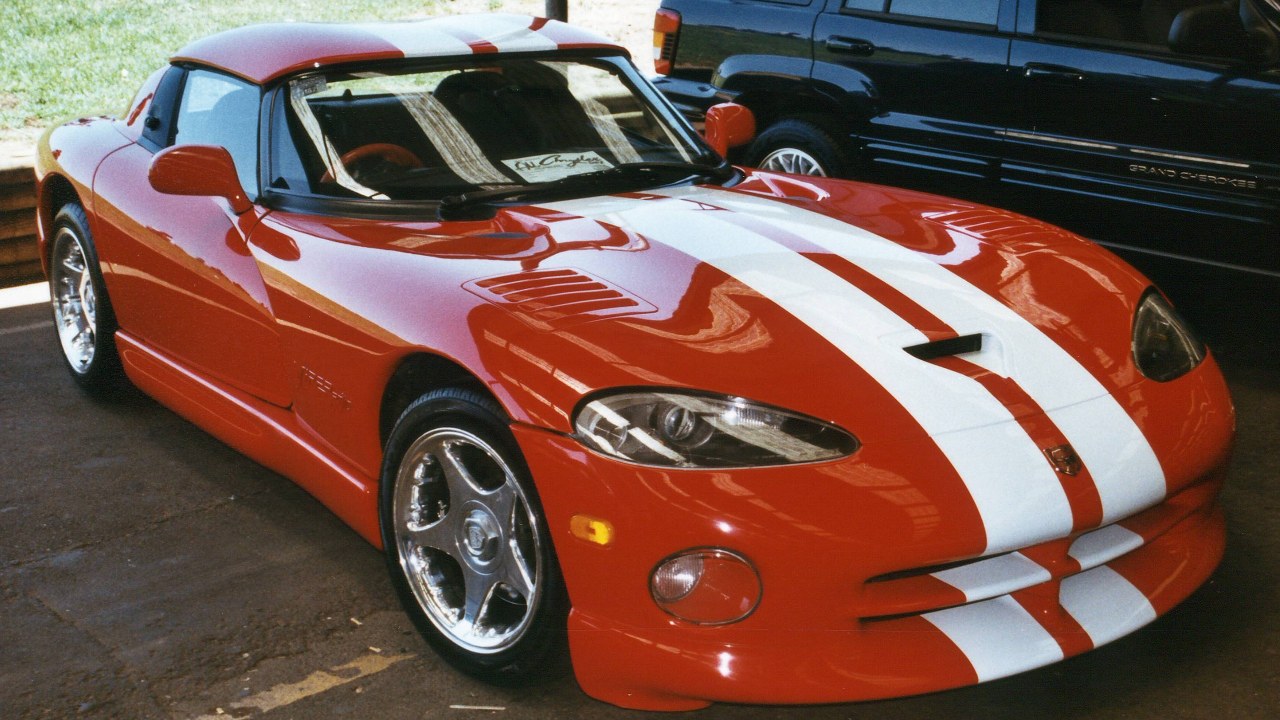
The 1992 Dodge Viper RT/10 arrived at a moment when performance cars were getting cleaner, calmer and more computerized, and it cut straight across that trend with brutal simplicity. Instead of driver aids and plush refinement, it offered a huge V10, a featherweight body and almost no electronic safety net. By stripping the sports car back to its essentials, it brought raw muscle car attitude into the modern era and reset expectations for what an American performance flagship could be.
From sketch to street: how the Viper was conceived
The Viper did not emerge as a cautious committee car, it started as a bold internal challenge to build something as dramatic for its time as the original 1960s American roadsters. Reporting on the program traces its origin to a conversation between Tom Lutz, identified as the Chrysler CEO, and Tom Gale, the company’s head of design, where Lutz pushed for a dramatic halo sports car and Gale responded with a low, long, side-piped concept that quickly gained momentum with buyers once it was shown. That early enthusiasm convinced Chrysler to move from show stand to production, positioning the Viper as a spiritual successor to the classic American two-seat bruisers that had defined an earlier performance era.
Inside the company, the car was framed as a deliberate counterpoint to the increasingly refined and electronic sports cars of the late 1980s and early 1990s. Coverage of The Origins Of The Viper notes that it was meant to provide a raw, unfiltered driving experience in the purest way possible, echoing the appeal of the highly popular 1960s roadsters without copying their styling outright. By the time Production began at a spruced up corner of Chrysler’s New Mack Assembly plant in Detroit, the concept had been locked in as a minimalist, front-engine, rear-drive roadster that would trade luxury for drama and make The Dodge Viper the group’s most visible performance statement.
An 8.0‑liter V10 that made a statement
At the heart of the 1992 Dodge Viper RT/10 was an engine that looked more like a manifesto than a spec sheet. With an 8.0-liter displacement, the V10 was described as not just a performance powerhouse but a statement, arriving in an age when Americ performance cars were trending toward smaller, more efficient powerplants. The bottom end came from Dodge’s truck line, but Lamborghini helped with the cylinder head work, a collaboration that turned a workhorse block into a high-output sports car engine. The Viper offered 400 horsepower, a figure that put it squarely into supercar territory for its time and underlined that this was not a styling exercise but a serious performance machine.
Multiple technical summaries reinforce just how aggressive those numbers were in context. One Tech Specs Summary lists the 1992 to 1995 SR I Viper RT/10 with an 8 L V10, a top speed of 165 m, a 0 to 60 sprint of 4.5 seconds, output of 400 hp and fuel economy of 16.8 m, figures that matched or exceeded many contemporary exotics while relying on displacement rather than complex electronics. A detailed description of a period-correct car notes that it was Powered by an 8.0-liter V10 engine producing 400 horsepower and 465 lb-ft of torque, and that it accelerates from 0 to 60 m in approximately four and a half seconds with a top speed of around 165 mph, aligning closely with the broader performance data. Another account of the Viper RT highlights that the 8.0-liter V10, co-developed with Lamborghini under Chrysler ownership, delivered 400 horsepower and 465 lb-ft of torque and stunned the industry when it arrived, confirming that the engine’s sheer size and output were central to the car’s impact.

Lightweight body, heavy-hitting performance
The Viper’s powertrain would not have felt as shocking without an equally aggressive approach to weight and packaging. Retrospectives on the 1992 Viper emphasize that before discussing power, it is worth mentioning just how light the Viper was, because the combination of a relatively low curb weight and that 8.0-liter V10 created a power-to-weight ratio that rivaled far more expensive European machinery. The car’s minimalist construction, with its open roadster body, side-exit exhaust and sparse interior, was not just a styling choice but a performance strategy that let the chassis make the most of the available torque.
Performance figures from period and modern analyses show how that philosophy translated to the road. The same Tech Specs Summary that lists the 8 L V10 and 400 hp also records a 0 to 60 time of 4.5 seconds and a top speed of 165 m, numbers that placed the Viper among the quickest production cars available from any manufacturer. A sales listing describing the Dodge Viper RT from the early 1990s notes its brutal acceleration, unfiltered driving experience and unmistakable presence, and characterizes the 1992 to 1993 Dodge Viper RT as one of the most iconic American sports cars ever built, a reputation built as much on the way it launched out of corners as on its visual drama.
Analog to the core: no ABS, no traction control, no apologies
What truly set the 1992 Dodge Viper RT/10 apart from its contemporaries was not only how fast it was, but how little it tried to protect the driver from that speed. Commentators looking back on the original car stress that it arrived with no traction control, no ABS and no apologies, describing the first Viper as less a car and more a raw performance tool that demanded respect. Another assessment of the original model points out that you would not find traction control, stability control, airbags or even ABS, and concludes that, clearly, Viper ownership came with a heavy dose of personal responsibility, closer in spirit to the most uncompromising British sports cars than to mainstream American coupes.
That lack of electronic intervention was not an oversight, it was a design choice that defined the car’s character. A later analysis of the Dodge Viper Convertible notes that when it launched in 1992, high-performance cars were becoming more electronic and futuristic, while the Viper stayed analog in the way the muscle car gods intended, prioritizing direct mechanical feedback over digital filters. Video walkarounds of early cars, including one that focuses on a 1992 Dodge Viper the original Viper in fact and identifies it as the fifth Viper ever made, underline how basic the cabin and controls were compared with other early 1990s performance cars. The result was a machine that rewarded skill and punished carelessness, which is precisely why it is now often described as one of the last truly analog muscle cars.
Design drama and lasting legacy
The Viper’s mechanical aggression was matched by styling that made subtlety irrelevant. Contemporary descriptions of The Viper’s striking red exterior and minimalist black interior emphasize how the 1992 Dodge Viper RT/10 Roadst combined a dramatic, low-slung body with a cabin stripped of unnecessary ornament, creating a look that was instantly recognizable even at a distance. The same account notes that the car’s condition and specification make it a highly desirable feature for added comfort, but the core impression is of a bold, almost cartoonishly muscular shape that turned the Viper into rolling theater. Other period reflections on the 1992 Viper RT/10 highlight its side pipes, wide stance and open cockpit as key elements in the way it stunned the industry upon release.
That visual and dynamic impact has translated into a long-term reputation that goes beyond nostalgia. Enthusiast analyses argue that it is arguable that the Viper is actually the true successor to the highly popular 1960s American sports cars, not because it copied their details, but because it revived their focus on big displacement, low weight and minimal interference. A retrospective on the 1992 to 1995 Dodge Viper RT/10 notes that the bottom end came from Dodge’s truck line and that Lamborghini helped with the cylinder head work, and concludes that The Viper offered 400 horsepower in a package that has since become a classic cool icon. Sales and collector listings for early cars, including low-mileage examples of the Viper RT, describe them as among the most iconic American sports cars ever built, and the continued interest in these first-generation Roadst models suggests that the 1992 RT/10 did more than bring raw muscle back for a moment. It carved out a permanent place for unapologetically analog performance in a landscape that was already moving toward digital control.
More from Fast Lane Only: