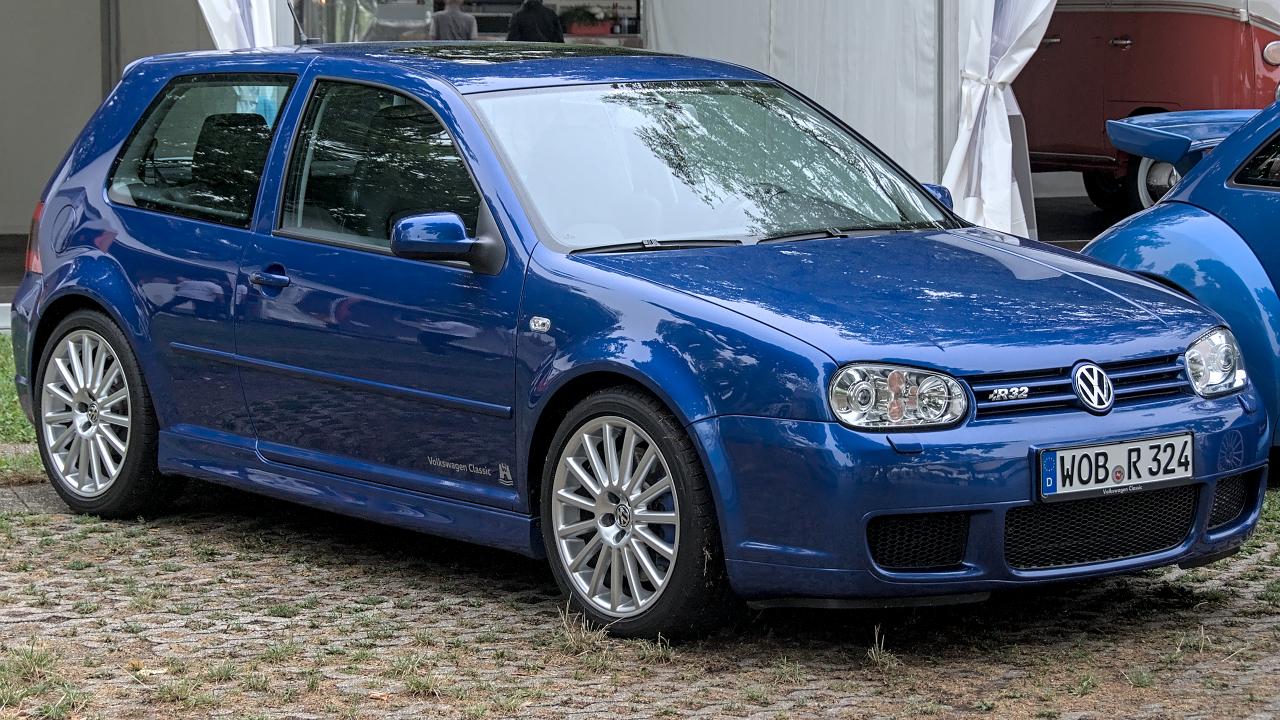
The 2004 Volkswagen R32 arrived at a moment when hot hatches were still mostly front driven, then calmly rewrote the rulebook by adding serious all wheel traction to everyday practicality. By pairing a compact hatchback body with a sophisticated all wheel drive system and a big narrow angle VR6 engine, it showed that a small car could deliver year round grip and near premium refinement without abandoning its enthusiast roots.
Two decades later, I see that first R32 as the bridge between the classic front wheel drive Golf GTI formula and the modern all wheel drive performance hatchbacks that followed. Its hardware, pricing, and reception all help explain how all wheel drive went from rally car niche to a defining feature of the hottest hatchbacks on sale.
The first “R” Golf and a new mission for hot hatches
Volkswagen did not treat the R32 as just another trim level, it positioned the car as the first production Volkswagen Golf to wear an “R” badge from the Volkswagen Racing division, built on the Mk IV Golf platform. That decision signaled a shift from warm hatch to something closer to a road going touring car, with the R32 sitting at the very top of the Golf range rather than beside the familiar GTI. Contemporary descriptions of the Mk IV Golf R32 emphasize that it was the top of the line VW Golf, limited in production and aimed squarely at enthusiasts who wanted more than cosmetic upgrades.
That elevated status mattered because it reframed what a hot hatch could be. Earlier performance Golfs had focused on lightness and front wheel drive agility, but the R32 layered in a larger displacement VR6, more complex drivetrain technology, and a richer interior that pushed the car toward premium territory. Museum notes on the 2004 Volkswagen Golf R32 describe how it popularized the performance hatchback or “hot hatch” idea for a new generation while remaining practical enough to be used as a daily driver, a balance that later all wheel drive Golfs and rivals would copy.
How the R32’s all wheel drive system actually worked
The R32’s reputation rests heavily on its traction, yet the way its system operated was more nuanced than the simple “always on” image that all wheel drive marketing often suggests. Its drivetrain was an adaptation of the VW 4Motion system, which in this application used a Haldex part time all wheel drive setup that behaved like a front wheel drive car in normal conditions. Power went primarily to the front axle until slip was detected, at which point the Haldex coupling could send torque rearward, giving the car the security of all wheel drive when needed without the constant drag of a fixed mechanical connection.
Technical breakdowns of the 2004 Volkswagen R32 make clear that, while being marketed as all wheel drive, it was not a traditional full time system with a center differential. Instead, the Haldex hardware monitored wheel speed and other parameters, then engaged the rear axle proactively to improve traction under acceleration or on low grip surfaces. That approach allowed Volkswagen to package the system into the compact Mk IV Golf shell without the weight and fuel economy penalties of a heavier permanent setup, and it set a template that later hot hatches with similar Haldex based systems would follow.
VR6 power, manual control and the feel behind the badge
All wheel drive alone would not have changed the segment if the R32’s engine and transmission had been forgettable, but the car’s 3.2 liter VR6 gave it a distinct character. Official specifications list an Engine described as a 3.2L, 24 valve DOHC VR6, paired with a Transmission that was a 6 speed manual with overdrive and 4Motion all wheel drive. That combination delivered a broad torque curve and a sound that enthusiasts still single out as one of the most evocative in any hatchback, a point reinforced by later commentary that calls the Volkswagen MK4 R32 the best sounding AWD hatchback of its era.
Inside, the R32 leaned into its performance brief with heavily bolstered front seats that reviewers compared to the molded chairs found in a WRC rally car, along with details like perforated bright metal pedals and a thick rimmed steering wheel. Road tests from the period noted that the car tracked straight at high speed and felt planted in quick transitions, traits that owed as much to the all wheel drive system and suspension tuning as to the engine. Together, the VR6 powertrain and manual gearbox gave drivers a sense of mechanical connection that helped justify the R32’s position as the flagship Golf, even as later generations would move to turbocharged four cylinders and dual clutch transmissions.
Price, positioning and the leap toward premium hot hatches
Volkswagen priced the R32 to reflect its hardware, and that strategy helped push hot hatches into more expensive territory. Period pricing put the 2004 Volkswagen R32 AWD at a Base price of $29,100, with a Price as tested of $30,626, figures that placed it well above a standard Golf or GTI of the time. Those numbers mattered because they showed that buyers were willing to pay near entry level luxury money for a compact hatchback, provided it delivered genuine performance and all weather usability.
That premium positioning also shaped how the market perceived the car. Contemporary commentary framed the R32 as a halo model that restored confidence in the Mk4 platform even as it neared the end of its lifecycle, with some owners treating it as the only car they ever needed thanks to its blend of speed, space, and traction. Later discussions of the Golf V GTI and R32 era describe how the Golf GTI had set the standard for the segment, but the R32 pushed what was technologically possible in this class, particularly in terms of acceleration and all wheel drive sophistication, helping to normalize higher prices for fully loaded performance hatchbacks.
Legacy: from cult classic to blueprint for modern AWD hatches
Looking back from today’s landscape of turbocharged, all wheel drive hot hatches, the 2004 R32 reads like a prototype for the formula that would dominate the 2010s and beyond. Curated collections such as the Audrain Auto Museum highlight the 2004 Volkswagen Golf R32 as a key exhibit, noting that only 5000 examples were imported to the United States and that the car helped Popularized the performance hatchback concept for a new wave of enthusiasts. The same collection points out that the example on display has 18,500 miles, a reminder that many owners treat these cars as cherished long term keepers rather than disposable commuters.
The R32’s influence is also visible in how later Golfs and rival models adopted similar ingredients: compact hatchback bodies, sophisticated Haldex based all wheel drive, and power outputs that would once have belonged to larger sports sedans. Discussions of the Golf lineage describe how the original Golf GTI created the hot hatch template, while the Mk IV R32 provided the template for the future by adding all wheel drive and a more serious performance focus. When I trace the line from that first R32 to modern all wheel drive hatchbacks, I see a clear throughline: the 2004 car proved that buyers would embrace a small, practical vehicle that behaved like a rally bred machine when the road turned slippery, and the rest of the segment has been catching up ever since.
More from Fast Lane Only: