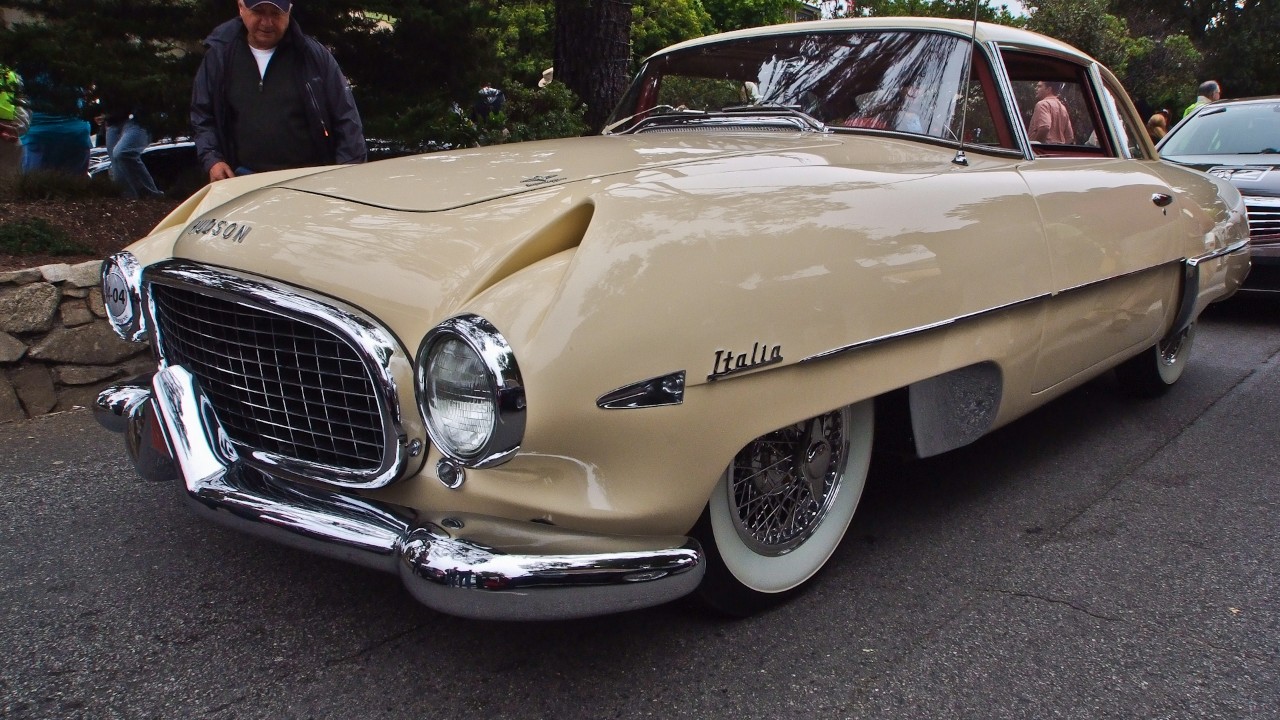
The Hudson Italia was a Detroit coupe with an Italian body, and Hudson made very few of them. Overall, just 25 production cars and one prototype left the program. Each wore hand-formed aluminum bodywork from Carrozzeria Touring of Milan, wrapped around the bones of the compact Hudson Jet.
It came at an odd moment for Hudson. The company had launched the compact Jet in 1953. Then the Italia gave that plain little car a far more glamorous sibling.
What follows is what the auction catalogs and reference histories agree on, and where they part ways. Several details differ between sources, so we name the source each time.
How the Hudson Italia came about
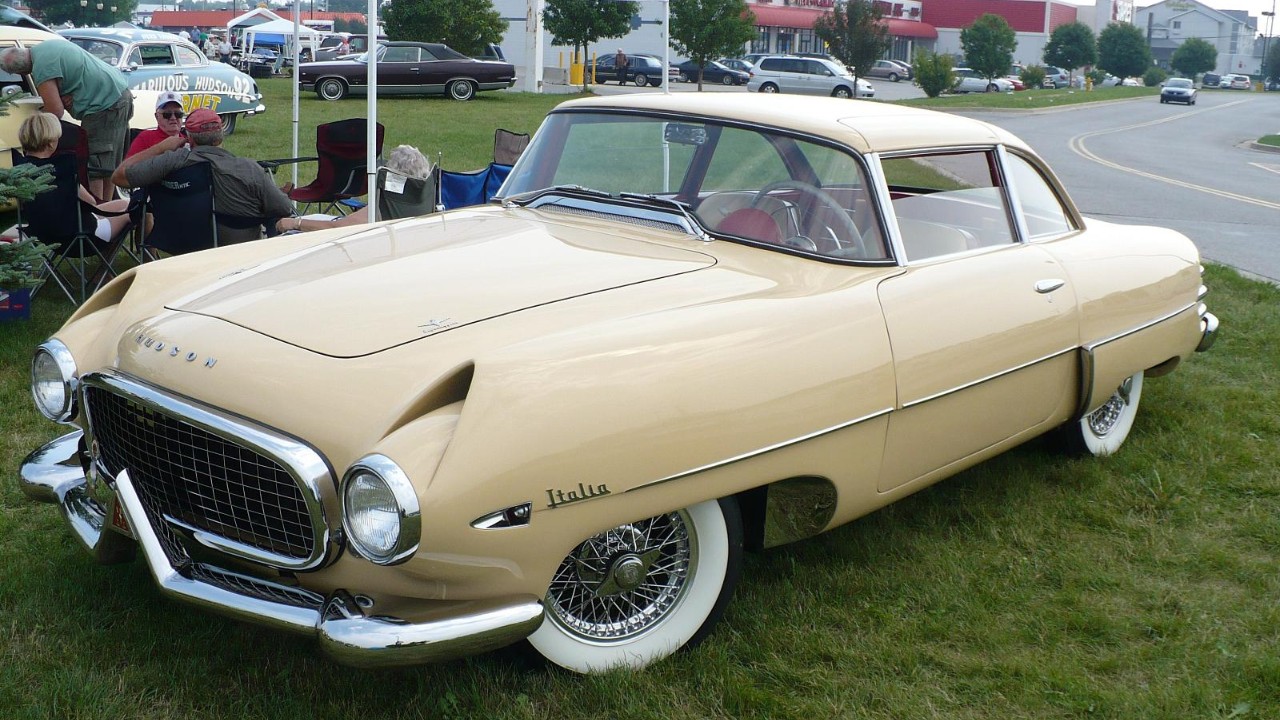
Hudson styling chief Frank Spring led the project. Specifically, he worked with Carrozzeria Touring in Milan. According to RM Sotheby’s catalog for the first production Italia, the car used the Jet as its base.
However, the finished coupe looked very different from a Jet. The Italia had a wraparound windshield, doors that cut into the roof and an inverted-V front bumper, as Conceptcarz’s history of the model describes.
Function shaped the styling as well. For example, scoops on the front fenders fed cooling air to the brakes. The cabin also had flow-through ventilation, according to the same history.
Aluminum bodies by Touring of Milan
Touring built the bodies by hand in Milan. In fact, the coachbuilder used its Superleggera method on the Italia. Sports Car Market’s profile of the car says Touring formed a new aluminum Superleggera body over tubular framing.
After all, Superleggera means “super light” in Italian. Instead of hanging heavy steel panels on a body frame, Touring shaped thin aluminum sheets over a cage of small tubes.
Inside, the Italia felt special too. RM Sotheby’s points to the specially designed reclining front bucket seats as part of a sporty interior. Meanwhile, Conceptcarz notes that the cars rode on Borrani wire wheels.
The Hudson Italia by the numbers
Above all, production is the number that defines this car. RM Sotheby’s states that “just 25 Jet-based Italias, plus one prototype, were produced.” Sports Car Market gives the same count, 25 plus a prototype, so 26 cars in all.
Under the hood sat a Hudson inline six, not anything Italian. Conceptcarz lists a 202-cubic-inch L-head straight-six with dual carburetors, rated at 114 horsepower. RM Sotheby’s describes the same twin-carbureted six, paired with a three-speed overdrive transmission.
Survival rates are high for such a small run. RM Sotheby’s says only 21 of the 26 cars are known to survive. Conceptcarz also gives the same figure of 21 survivors. As a result, most of the Italias ever made still exist today.
The car did not make Hudson rich, though. RM Sotheby’s says Hudson reportedly lost money on each one. Conceptcarz also mentions a later four-door prototype, the X-161.
Why Hudson stopped at 26 cars
At first, the plan was bigger. According to Carrozzieri Italiani’s entry on the coupe, Hudson and Touring originally planned around 50 cars. On the Italian side, Spring teamed up with Touring’s Carlo Felice Bianchi Anderloni.
Timing worked against the car. In 1954, Hudson merged with Nash, the same source notes, and the combined company became American Motors. Meanwhile, the Italia was expensive to make. Sports Car Market reports that each car reportedly cost $28,000 to build. Also, Wikipedia’s Italia history, citing RM Auctions, says AMC showed little interest in marketing the car.
The first production car’s story
In particular, one Italia shows how these cars lived. Chassis 259254, serial IT-10001, is the first production Italia. Hudson used it as a show car across the United States and Canada before it went to a private buyer.
Its first owner, Earl Armstrong of Santa Barbara, California, customized it. He swapped the Hudson six and gearbox for a Buick V8 and an automatic transmission. Then, in the fall of 1980, the car passed to a second owner, who restored it to factory-correct form with a correct-type Hudson engine and transmission.
Today it wears cream paint over a red and white interior, with Borrani wire wheels. After the second owner died, his nephew kept the car. Its file includes letters with Armstrong and AMC, along with Hudson memos about the Italia’s development, according to RM Sotheby’s.
What a Hudson Italia sells for
Public sales give the clearest sense of value. In January 2013, Barrett-Jackson sold one at Scottsdale, Arizona, for $396,000 including buyer’s premium, as Sports Car Market reported in its sale analysis.
Ten years later, the first production car came to market for the first time in nearly 70 years. RM Sotheby’s offered chassis 259254 as Lot 256 at its 2023 Hershey sale in Pennsylvania. There, the first Hudson Italia off the line sold for $495,000.
More from Fast Lane Only
- Unboxing the WWII Jeep in a Crate
- 15 rare Chevys collectors are quietly buying
- 10 underrated V8s still worth hunting down
- Police notice this before you even roll window down
This article was created with the help of AI and was reviewed and edited by Fast Lane Only editors before publication.