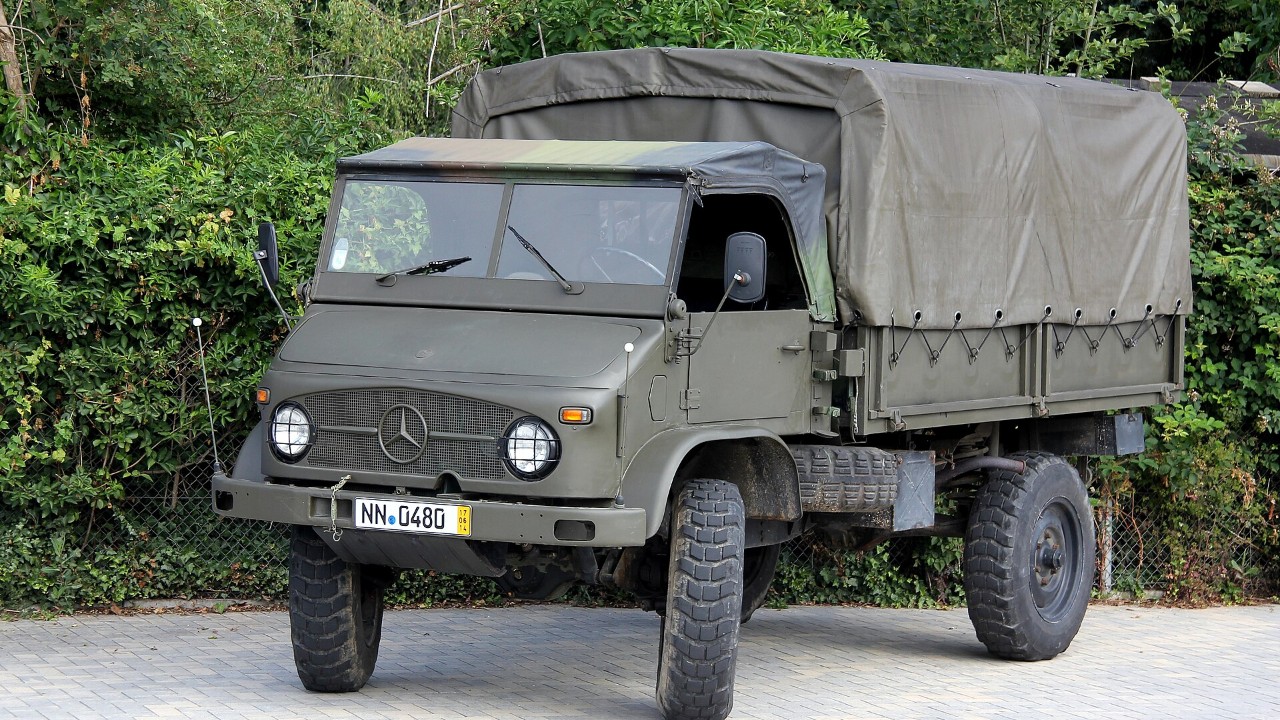
The Unimog began as a farm machine and grew into a military, municipal and rally truck. Across each early Unimog series, Mercedes kept the same basic recipe: all-wheel drive, portal axles, a differential lock and power take-offs for tools. What changed over five decades was size, power and purpose.
These seven models trace that path, from the small Boehringer-built original to the 437 series. Each figure below comes from Mercedes-Benz Trucks’ own heritage pages or a named reference.
1. 1948 Unimog 70200 (Boehringer)

Engineer Albert Friedrich led the project after World War II, working with Heinrich Rößler and Hans Zabel. Zabel also coined the name, shorthand for “Universal Motor Device for Agriculture.” The target was simple, because small and mid-sized German farms badly needed tractors.
According to Mercedes-Benz Trucks’ heritage history, the Unimog made its public debut at the 1948 DLG fair in Frankfurt. Gebrüder Boehringer then built it in Göppingen. That first 70200 series ran to about 600 vehicles and wore an ox-head badge. It used the Daimler-Benz OM 636 diesel and topped out at 50 km/h.
2. 1953 Unimog 401 and 402

Daimler-Benz took over production in 1951 and moved it to its truck plant in Gaggenau. In fact, Gaggenau built just over 1,000 Unimogs in its first seven months, Mercedes says. From that point on, the Mercedes-Benz star replaced the ox head on the hood.
Then, from 1953, the company introduced the 401 and 402. For the first time, buyers could order a closed cab. The U 401 kept a 1,720 mm wheelbase, while the U 402 stretched it to 2,120 mm. Meanwhile, the round headlights earned the pair a nickname that stuck: “frog-eye.”
3. 1955–1980 Unimog S (404)

The 404 took the Unimog away from the farm and toward the army. Mercedes-Benz Trucks describes it as a military design with high-horsepower petrol engines and 45-degree approach and departure angles. Gaggenau kept building it until 1980.
Its total reached 64,242 vehicles, and Mercedes calls the 404 its most successful Unimog series to date. That page doesn’t give a launch year, but both History Garage and Truck Encyclopedia date it to 1955. Truck Encyclopedia lists the M 180 straight-six at 82 PS. It also says the Bundeswehr took no fewer than 36,000 of them.
4. 1962 Unimog 406

By the early 1960s, farmers and contractors wanted more muscle. As a result, Mercedes unveiled the 406 at the 1962 DLG exhibition and called it the “heavy series.” Its diesel started at 65 PS and later versions reached up to 110 PS, according to the same heritage page.
This Unimog series also showed how wide the truck’s working range had become. Top speed reached 65 km/h. At the other end, a creeper gear let it crawl at 0.03 km/h for implement work. It was also the first Unimog with padded, adjustable seats for the driver.
5. 1966–1988 Unimog 421

January 1966 brought the U 421, which Mercedes later called the “light-duty model series.” Its OM 621 engine started at 40 hp and later reached 60 hp. Production ran from 1966 to 1988 and totaled almost 19,000 vehicles.
The timing also mattered for the brand, because the 100,000th Unimog left the line in May 1966. Only five years later, the count hit 150,000, Mercedes-Benz Trucks notes. In 1987, the 407 series replaced the 421 after more than two decades.
6. Unimog 435 heavy-duty series
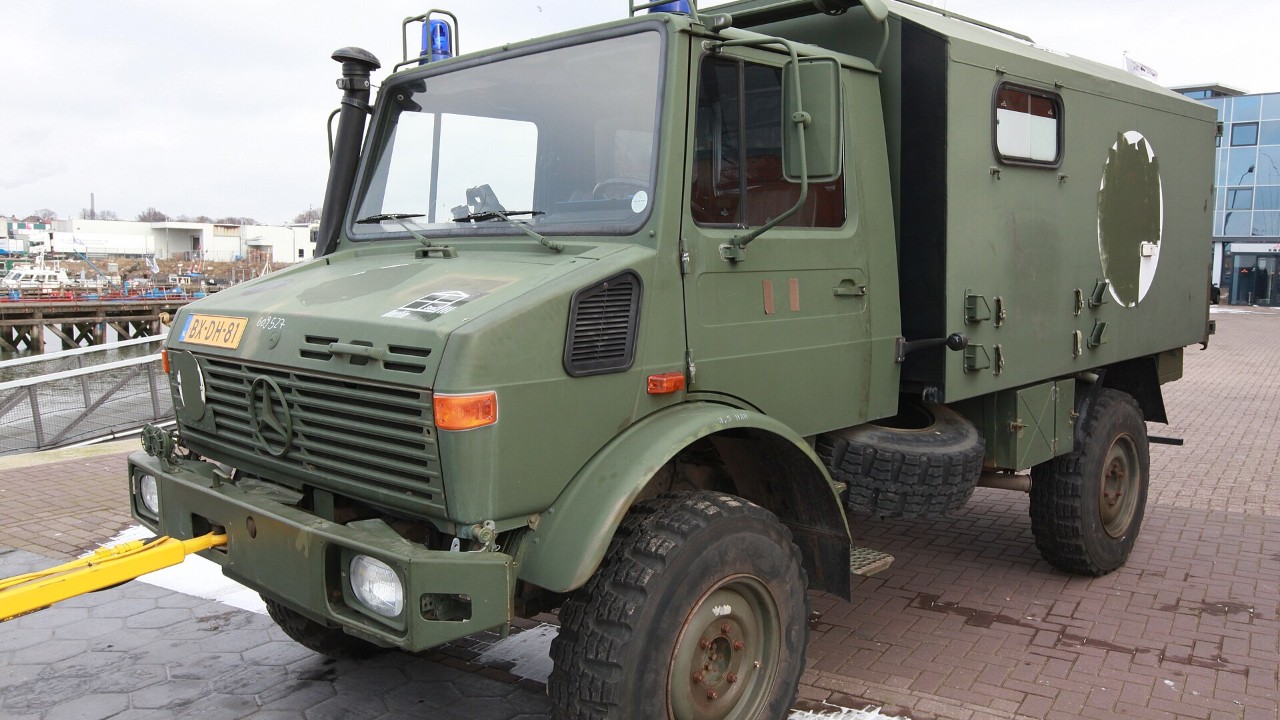
The 435 became the workhorse of the Unimog’s heavy-duty range. With 30,726 units built, Mercedes calls it the most successful “heavy-duty model series.” For example, the U 1700 L version used a turbocharged six-cylinder rated at 168 hp and carried a payload of up to 5 tonnes.
The 435 also won in the desert. In 1985, Karl-Friedrich Capito’s team drove a U 1300 L from the 435 series to victory in the truck class of the Paris-Dakar Rally. That rally truck made 180 hp and covered 14,000 km from Versailles to Dakar, according to Mercedes-Benz Trucks’ 1976–1985 history.
7. 1988–2002 Unimog 437
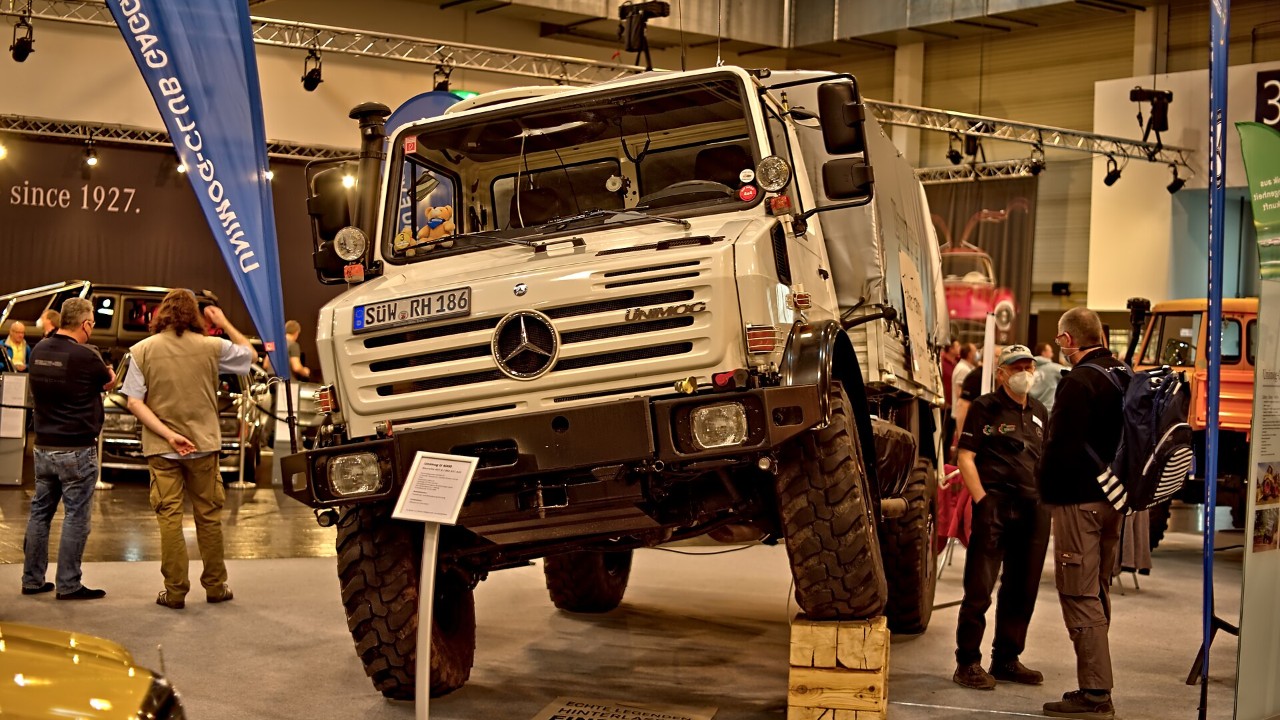
The 437 series arrived in 1988 as the big Unimog for a new era. It used a charge-air-cooled OM 366 A or LA engine. Over its life, it came in 26 different variants, and it stayed on sales lists until 2002.
Production kept climbing during its run. In 1994, the 300,000th Unimog left the assembly line, according to Mercedes-Benz Trucks. Then, in June 1995, 300 Unimogs returned to their birthplace in Gaggenau for a reunion.
More from Fast Lane Only
- Unboxing the WWII Jeep in a Crate
- 15 rare Chevys collectors are quietly buying
- 10 underrated V8s still worth hunting down
- Police notice this before you even roll window down
This article was created with the help of AI and was reviewed and edited by Fast Lane Only editors before publication.