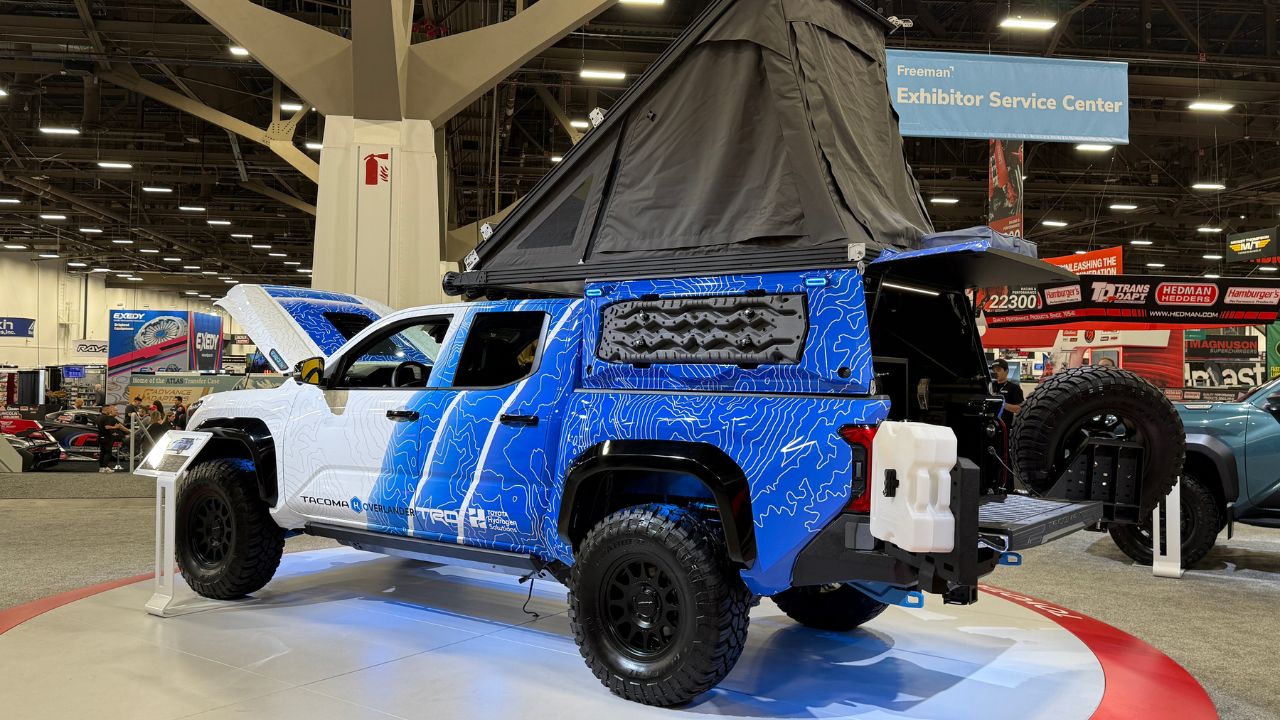
You spend your weekends chasing remote ridgelines and lonely desert tracks, so every gallon of fuel and every liter of water you pack has to earn its place. Toyota’s Tacoma H2-Overlander Concept takes that reality seriously by turning its hydrogen fuel cell exhaust into filtered water you can actually use at camp. Instead of wasting the vapor that usually disappears into the air, this truck captures it, cleans it, and hands it back to you as a practical trail resource.
At the same time, you are not giving up performance or capability to get that trick plumbing. The concept wraps a hydrogen powertrain, serious suspension hardware, and exportable power into a familiar mid-size pickup footprint built for long-distance overlanding. The result is a rig that drives like an electric truck, treads lightly like a fuel cell prototype, and doubles as a rolling utility hub when you finally shut it down for the night.
How the hydrogen Tacoma actually makes water you can use
You start with a basic fuel cell reality: when hydrogen meets oxygen inside the stack, you get electricity, heat, and water vapor. In most vehicles that water simply exits the tailpipe as steam, but on the Tacoma H2-Overlander, Toyota routes that byproduct into a patent-pending TRD exhaust water recovery system that condenses and captures it before it escapes. Official material describes this setup as one of the concept’s most distinctive features, with the system built directly into the truck’s underbody and tailpipe hardware so it can operate every time you drive, not just when you choose to harvest it at camp, which is why the TRD exhaust system sits at the center of the concept story.
Once the truck has condensed that vapor back into liquid, it runs through a filtration process designed to strip out remaining contaminants from the fuel cell reaction path and the exhaust plumbing. Coverage describing the Tacoma H2-Overlander notes that this captured water, which originates as the only byproduct of the hydrogen fuel cell, is then routed to a dedicated outlet where you can dispense it at camp for chores, cooking, or washing. Toyota’s own engineers have previously compared fuel cell drainage water to everyday beverages, and internal testing referenced by company representatives suggested that, in one case, said that compared to drinking milk, the drainage water had much fewer organic impurities, yet still the company does not recommend that you treat it as a primary drinking source.
From exhaust to campsite faucet: what you can actually do with the water
On the trail, that distinction between “safe in lab conditions” and “recommended in the real world” matters. Coverage that walks through the Tacoma H2-Overlander’s plumbing explains that the captured exhaust water runs through filters and is technically clean enough that Toyota staff have been willing to sip it in controlled demonstrations, but that official guidance continues to frame it as utility water rather than something you should rely on as your only hydration source. Reporting on the Capturing and Filtering system notes that one of the concept’s signature elements is precisely this TRD recovery hardware, even as Toyota repeats that it is not recommended for drinking.
That still leaves you with a surprisingly useful resource once you park. You can route the stored water to a faucet or hose connection for rinsing dishes, cleaning gear, or topping up a portable shower, which means you can carry less separate gray-water supply and let the truck replenish itself as you drive. Coverage of the Tacoma H2-Overlander’s broader systems describes how the water outlet is paired with other camp-focused features, so you can, for example, wash up under LED camp lighting powered by the same fuel cell that generated the water in the first place. One report on how the truck reuses emissions notes that the captured water can also support accessories such as fog lights and camp lighting integrated into the Tacoma H2-Overlander Concept, which reinforces the idea that you are dealing with a closed-loop utility system, not just a party trick.
Powertrain, range, and why hydrogen suits long-distance overlanding
Underneath the water party piece, you are still driving a serious off-road truck. The Tacoma H2-Overlander integrates a second-generation Toyota Mirai fuel cell stack and three hydrogen tanks into the familiar mid-size platform, then uses that electricity to feed dual motors, one on each axle, for through-the-road all-wheel drive. Reporting that walks through the concept’s specs notes that Toyota claims the H2-Overlander delivers a combined output of 547 horsepower, a figure repeated in material that introduces the truck as the ultimate overlanding Toyota Tacoma concept and in video coverage that highlights how the Toyota Tacoma H2-Overlander makes 547 horsepower while treading lightly with its fuel cell and battery electric setup.
Hydrogen also changes how you plan your trips. Instead of waiting for a large battery pack to charge, you refill hydrogen tanks in a process that feels more like visiting a conventional pump, then you get back on the trail with electric-style torque and no tailpipe emissions beyond water. One report on the H2-Overlander explains that the truck can travel roughly 300 miles on a fill of hydrogen while producing drinkable water straight from the exhaust, a combination that lets you string together long sections between resupply stops as long as you can find hydrogen fueling along your route. Another piece that introduces the concept at SEMA notes that Toyota claims the H2-Overlander uses its fuel cell to generate electricity that is sent to two electric motors for through-the-road all-wheel drive, while the water is emitted from the exhaust, a setup described in coverage of the Toyota claims that H2-Overlander system.
Camp life: exportable power, filtered water, and shared energy
When you finally shut the doors and start setting up camp, the Tacoma H2-Overlander does not just sit there cooling off. The fuel cell stack and traction battery double as a silent generator, with official material describing how the truck can send significant power out through dual NEMA 14-50 outlets mounted in the bed. Coverage of the concept explains that you can use this exportable power to run induction cooktops, charge e-bikes, or even top up another electric vehicle, a capability highlighted in social posts that describe how the Hydrogen Fuel Cell Toyota Tacoma H2-Overlander Concept Can Charge Your Buddy’s EV in the Great Outdoors and Filters Water, Too, language reflected in a Hydrogen Fuel Cell community description of the Overlander Concept Can Charge Your Buddy in the Great Outdoors and Filters Water, Too.
That dual role as generator and water source changes how you plan gear. Instead of packing separate gas generators, jerrycans, and extra water cubes, you can lean on the truck’s built-in systems for both electricity and non-potable water, then reserve your carried drinking supply for emergencies and high-exertion days. A detailed walk-through of the SEMA build notes that the Tacoma H2-Overlander sits on the TNGA-F platform and that its Zero-Emission Performance With Real Off-Road Muscle is paired with a camp setup that includes roof-mounted accessories and integrated power distribution, with the hydrogen powertrain and output described as offering meaningful utility for long-distance trips, context that appears in coverage of the Zero-Emission Performance With Road Muscle Built on the TNGA platform.
Where this concept fits in Toyota’s wider hydrogen strategy
If you already follow Toyota’s alternative power experiments, the Tacoma H2-Overlander does not appear out of nowhere. The company has been public about its belief in a multi-pathway approach that treats batteries, hydrogen fuel cells, and efficient combustion as parallel tracks rather than a single winner-takes-all solution. Coverage that zooms out from the concept truck explains that the Hydrogen Fuel Cell Concept Tacoma Filters Water and Charges EVs as part of Toyota’s broader multi-pathway approach, language that appears in analysis of how Hydrogen Fuel Cell fits into Toyota’s long-term view.
More from Fast Lane Only