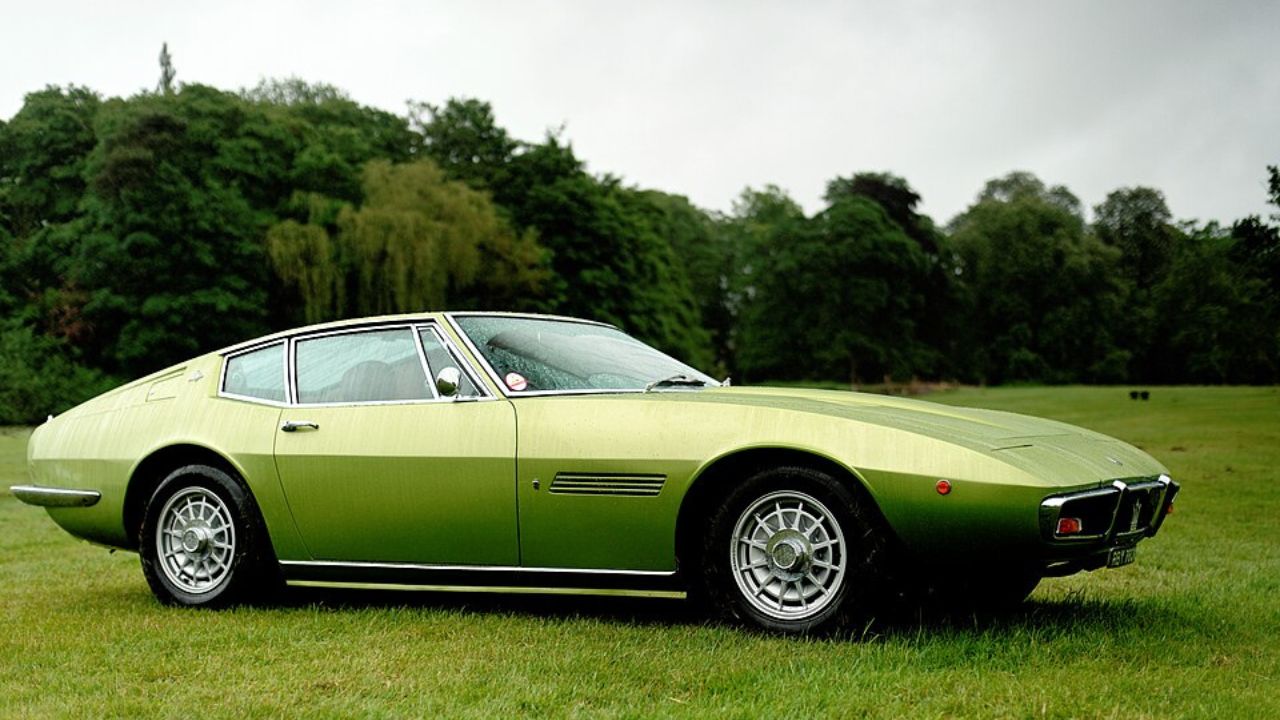
The 1968 Maserati Ghibli arrived at a moment when Italian design was already reshaping the sports car world, yet its low, predatory stance and sharp-edged elegance still managed to steal the spotlight. Styled by Giorgetto Giugiaro at Ghia, the car fused sculpture and speed so convincingly that even among exotic contemporaries it looked like the future. More than half a century later, the Ghibli’s bold presence still anchors discussions about how style, power and grand touring comfort can coexist in a single, unmistakably Italian package.
The Italian Giorgetto Giugiaro moment
By the late 1960s, Italian designer Giorgetto Giugiaro was already emerging as one of the defining automotive stylists of his generation, and the Ghibli became the car he would later describe as his masterpiece. Its long hood, cab-rearward cabin and razor-thin glasshouse created a profile that looked almost impossibly low, yet the proportions were carefully balanced rather than theatrical. The steel body wore a distinctive shark nose that gave the front end a sense of motion even at rest, a theme that would echo through later performance cars from Italy and beyond.
That shark-nosed body was not only beautiful, it was also highly distinctive. The steel skin with its low, prow-like front was described as a rolling sculpture, and the Ghibli quickly gained a reputation as a car that combined visual drama with real-world usability. Its design language, with crisp lines and minimal ornamentation, stood apart from the more voluptuous forms of earlier Italian exotics and set a template for the wedge era that followed.
V8 muscle with grand touring manners
Underneath the styling, Maserati engineered the Ghibli to be more than a static showpiece. Contemporary descriptions highlight how it combined V8 muscle with grand touring comfort, presenting one of Maserati’s most celebrated classics as a genuine cross-continent companion rather than a fragile toy. Enthusiasts often describe the car as a rolling sculpture with a V8 heartbeat, a phrase that captures both its aesthetic ambition and its mechanical intent.
The mechanical layout reinforced that dual personality. The car was powered by a front placed quad-cam 4.7 L engine, a configuration that delivered serious performance while still allowing for a relatively spacious cabin and usable luggage space. With a 0 to 60 m time of 6.8 seconds and a top speed of 250 km/h, the Ghibli sat firmly in the top tier of period performance cars, yet owners could cover long distances in comfort and style.
Performance figures that matched the looks
Period data for the Ghibli’s 4.7 liter V8 underline how thoroughly the car backed up its visual promise. The engine produced around 306 horsepower in some specifications, and independent figures state that a Ghibli with this 4.7 liter, 306 HP dry sump engine was capable of reaching 60 M P H in 6.8 seconds and a top speed of 155 M P H. These numbers placed it among the quickest grand tourers of its era, especially considering its relatively luxurious interior and long-legged gearing.
Other sources describe a 310-horsepower engine with four carburetors, quad camshafts and dry-sump lubrication that pushed the svelte coupe to speeds beyond 164 mph. A separate performance listing for The Maserati Ghibli cites a naturally aspirated eight cylinders in V longitudinal front engine with a maximum power output of 330, and another entry for The Maserati Ghibli confirms that it delivers 330 horsepower. While the exact figure varied by specification and market, the pattern is clear: the Ghibli’s performance was fully in line with, and often ahead of, its visual aggression.
Tipo 115 and the shark-nosed identity
Internally, Maserati identified the Ghibli as Tipo 115, and the production run stretched from 1967 to 1973. Under the hood was a 310 hp V8, a figure that sits comfortably alongside other reported outputs for the model. The Ghibli was known for its boundless thirst, its low, shark-shaped nose and its status as a design benchmark. Those characteristics combined to create an image of a car that was unapologetically powerful, visually assertive and engineered with performance as the first priority.
The steel body with the distinctive shark-nose was designed by Giorgetto Giugiaro, and that single styling element did much of the work in giving the car its identity on the road. Under the hood was a 310 hp V8, and The Ghibli was often described in period as a car that drank heavily but rewarded its driver with immense torque and a sense of occasion that few rivals could match. The shark nose, low stance and long hood became visual shorthand for Italian performance in the late 1960s.
Italian muscle car with a grand touring brief
Owners and historians alike have come to see the Ghibli as an Italian muscle car, with a massive amount of low end torque that delivered fierce acceleration. At the same time, the chassis and cabin were tuned for comfort, so the car remained very comfortable to drive and befitted its grand touring capability. That blend of straight-line force and relaxed cruising ability distinguished it from some of the more highly strung alternatives of the period.
The Ghibli’s reputation as an Italian muscle car also reflected Maserati’s willingness to prioritize torque and tractability over peaky, race-derived power delivery. In practice, this meant that drivers could access the engine’s strength at everyday speeds, pulling hard from low revs without constant gear changes. Combined with a relatively compliant ride and supportive seats, the car felt as capable on a long motorway run as it did on a mountain road.
From coupe to Spyder: rarity and glamour
The Ghibli story did not end with the original coupe. Initially, the model was offered as a two-door coupe, and 1,170 units were produced. The Ghibli then spawned a Spyder variant in 1969 that was built in 128 examples, a tiny fraction of the total, which immediately elevated its desirability. Collectors now see those early open cars as some of the most glamorous expressions of late 1960s Italian design.
The Ghibli Spyder variant elevated the design further by removing the roof and exposing the cabin to the elements. The Ghibli Spyder featured a powerful 4.7-liter V-8 engine producing 330 horsepower, which meant its performance remained fully in line with the coupe. Contemporary pricing placed the car in rarefied company, with a price tag of $18,900 that reflected both its engineering content and its exclusivity.
Facing Ferrari and the 365 G T B competition
In period, Maserati’s open Ghibli found itself compared with some of the most famous Ferraris. One reference highlights the Ferrari 365 G T B/4 Daytona, which despite carrying a higher price tag of $18,900, shared the same rarefied market space. Only 128 Spyders were produced, making them particularly rare. That scarcity, combined with the car’s design pedigree and performance, has helped the Ghibli Spyder become one of the most sought-after Italian convertibles of its era.
Those comparisons with Ferrari also underline how seriously the industry took Maserati’s design and engineering work. The Ghibli did not exist on the fringes of the exotic market. It sat squarely in the same conversations as the most celebrated V12 Ferraris, yet it offered a different character, with a front-mounted V8, a slightly more relaxed grand touring focus and a distinctive visual identity.
Prototype thinking: Maserati Ghibli Spyder and research trails
The development of the open car involved more than simply cutting the roof off the coupe. References to the Maserati Ghibli Spyder Prototype Designed by Giorgetto point to a process of experimentation, where designers and engineers explored how to maintain rigidity and preserve the car’s proportions without the fixed roofline. Discovered accounts of this Maserati Ghibli Spyder Prototype Designed by Giorgetto show how closely the production Spyder followed the concept’s basic themes while refining details for road use.
Following the research trails around that prototype highlights how Maserati and Ghia treated the Ghibli as a platform for continuous exploration. Discovered documentation on the Maserati Ghibli Spyder Prototype Designed by Giorgetto reveals an iterative approach that balanced aesthetics, structural requirements and customer expectations. The result was an open car that looked cohesive rather than improvised, with the same long hood and strong rear haunches that defined the coupe.
The Simun and Giugiaro’s design vocabulary
Giugiaro’s work on the Ghibli did not occur in isolation. Around the same time, The Simun mounted an eight cylinder engine (4.136 cc) with 260 horses, and served as another showcase for his ideas while at Carrozzeria Ghia. This prototype designed by Giugiaro was a two-door sedan with retractable headlights and very special proportions, with a long hood and a reinforced rear. The similarities in stance and proportion between the Simun and the Ghibli underline how Giugiaro was refining a particular visual language built around length, tension and minimal surface decoration.
The Simun, like the Ghibli, used a long hood to emphasize the presence of a substantial engine and a rear-biased cabin to create a sense of motion. Its retractable headlights and clean flanks echoed the Ghibli’s restraint, while the reinforced rear suggested a focus on structural integrity that would have appealed to engineers as well as stylists. Together, these projects show how Giugiaro’s ideas about proportion and surface treatment were crystallizing in the late 1960s.
Technical character: from quad-cam to boundless thirst
From a technical perspective, the Ghibli’s quad-cam V8 gave it a distinctive character. The car was powered by a front placed quad-cam 4.7 L unit, and period figures record a 0 to 60 mph time of 6.8 seconds and a top speed of 250 km/h. That combination of a relatively large displacement, sophisticated valve gear and long gearing allowed the car to surge forward with minimal effort, even at higher speeds.
The Ghibli’s appetite for fuel became part of its legend. The Ghibli was known for its boundless thirst, its low, shark-shaped nose and its presence on the grand touring stage. Owners accepted the fuel bills as part of the experience, trading efficiency for the sensation of a large, naturally aspirated V8 operating in its sweet spot. In an era before emissions and consumption dominated the conversation, that trade-off felt entirely in character for a flagship Italian performance car.
Why the 1968 Ghibli still dominates design conversations
Looking back, the 1968 Maserati Ghibli occupies a special place in automotive design history. It combined the talents of Giorgetto Giugiaro, the engineering ambition of Maserati and the broader cultural appetite for expressive, high performance machines. The result was a car that looked aggressive yet refined, and that backed up its styling with serious performance and genuine long-distance comfort.
Collectors today often describe the car in almost sculptural terms, and one detailed account notes that it combined V8 muscle with grand touring comfort, presenting a rolling sculpture with a V8 heartbeat. That phrase captures why the Ghibli still resonates. It was not simply fast, and it was not simply beautiful. It was a coherent statement about what Italian design could achieve when aesthetics, engineering and usability were given equal weight.
More from Fast Lane Only