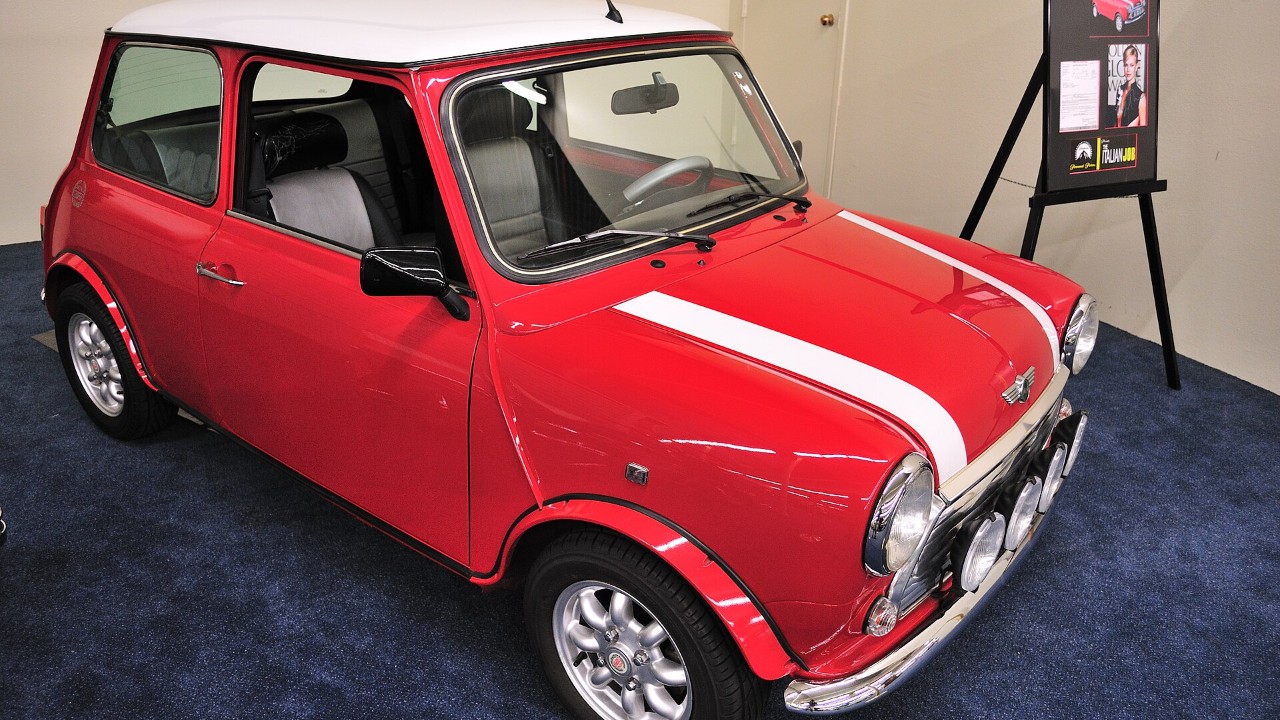
The rooftop jump in The Italian Job lasts only seconds on screen. In real life, the Italian Job Minis left a roof 15 meters above Turin at 68 mph and cleared a 24-meter gap. Yet the company that built them still wanted paying.
The 1969 heist comedy starred Michael Caine as Charlie Croker. It sent a red, a white and a blue Mini through the streets and over the rooftops of Turin. In our view, those three small cars are the real stars of the film.
Here is how the stunt team pulled off the jump, what the cars really had under the hood, and why BMC wanted paying.
The Italian Job Minis and the 24-meter jump
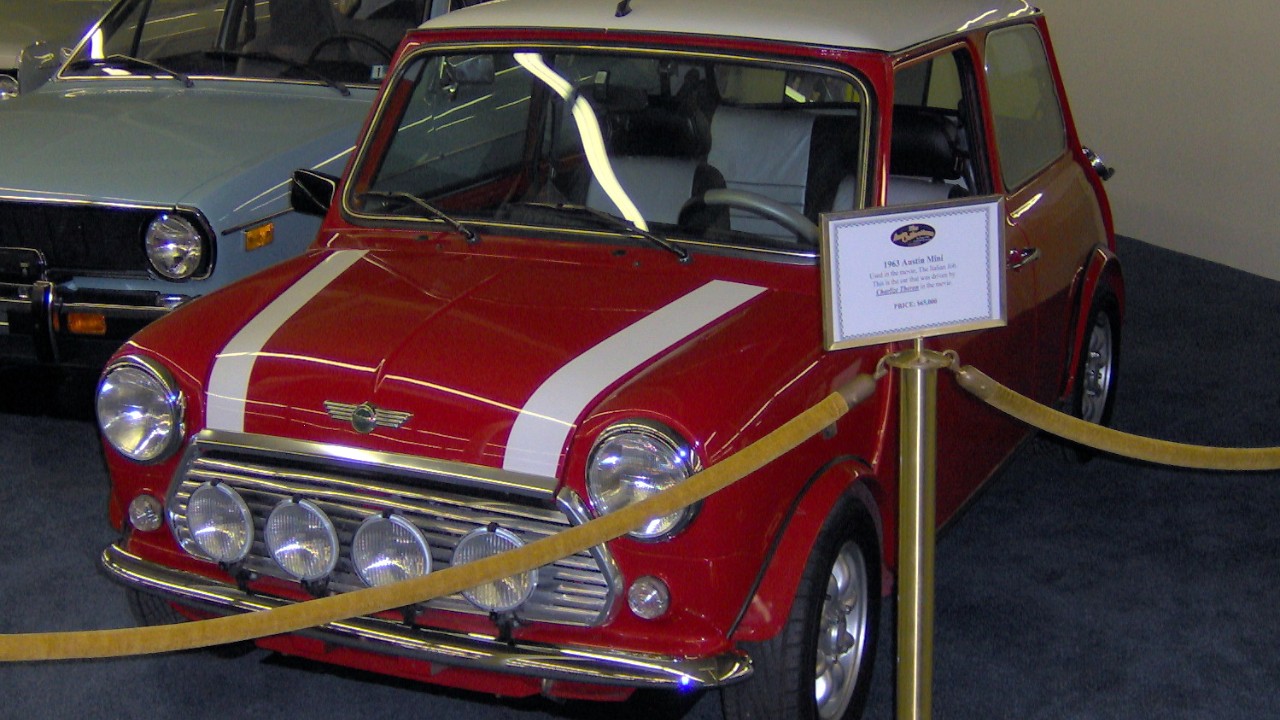
Stunt coordinator Rémy Julienne ran the car work on the film. Later, he described the jump in his own words to Hagerty UK. “The scene actually happened 15 metres up in the air at a vehicle speed of 110km/h (68mph) jumping a 24 metre (78 feet) gap,” he said.
The local helpers did not expect a happy ending. Julienne recalled that they said goodbye while touching their crucifixes. After the jump, however, director Peter Collinson climbed onto the roof with his team and a bottle of champagne, Hagerty UK reports.
Julienne also did the main jump himself, according to Top Gear. Stunt driver David Salamone, who drove the red Mini in the chase, praised his precision. “He was a scientist. Everything was calculated to one mile an hour,” Salamone told Top Gear.
Six Minis, three drivers
The production did not have a big fleet. “(We had) three complete cars and three in reserve,” Julienne told Hagerty UK. In total, that makes six Minis. The cars took a beating, but none was actually destroyed, the magazine says.
Meanwhile, three drivers handled the chase. Salamone drove the red car, Barry Cox the white one and Richard Essame the third, Top Gear reports. Salamone already knew producer Michael Deeley, because he had supplied the cars for Deeley’s earlier film Robbery.
The crew had no car transporters, either. So they drove every car from the UK to Italy, according to Top Gear. Salamone’s mother drove one of the E-Types, and his girlfriend drove one of the Minis. At the end of filming, Salamone, Cox and Essame drove three Minis back from Turin.
What was under the hood
Over the years, stories grew about tuned engines in the chase cars. Salamone shot them down. “They were standard cars,” he told Top Gear. In other words, nobody modified the engines.
However, the bodies did get some work. First, the crew stripped the interiors and fitted magnesium sump guards and roll bars inside, Top Gear reports.
Of course, the chase did not end on the roofs. For the final scene, the Minis drove into a moving Harrington-bodied Bedford coach. The cars were doing 120 km/h (75 mph) and the bus 80 km/h (50 mph), Hagerty UK says. Collinson himself played the man who guided them in.
Why BMC still wanted paying
To us, a film like this looks like a gift for the Mini’s maker. Instead, “Mini-maker, BMC, wanted payment for the six Minis,” Hagerty UK reports.
Deeley saw it as a missed chance. In Matthew Field’s 2019 book, he called the film “a project tailor-made to make a movie star of the Mini.” Still, he added, “Astonishingly, BMC could not have cared less.”
By comparison, the leap across the Turin rooftops did plenty for the car’s image anyway. “The sight of the three Minis leaping across Turin factory buildings was better than any TV ad,” Hagerty UK says.
The other cars that paid the price
The Minis survived, but other cars did not. On a mountain pass, a digger destroys two Jaguar E-Types and an Aston Martin DB4 Convertible, Hagerty UK notes. The crew rigged one Aston with explosives, but they went off too early. As a result, a disguised Lancia Flaminia Convertible stood in for the second take.
In fact, Salamone found that Lancia himself. He drove overnight through Turin and Milan and bought a silver Flaminia 3C with a black roof, he told Top Gear. The production had bought the DB4 for under £1,000. Forty-five years later, Salamone said, the same car carried a £700,000 value at the Villa d’Este concours.
Even the opening Lamborghini Miura was a borrowed customer car, Hagerty UK says. Instead, the crew wrecked a written-off Miura of the same color in the La Thuile Tunnel. Finally, the crew shot the coach interior scenes at Twickenham Studios in a stationary coach, and that took about 50 to 60 takes, according to Top Gear.
More from Fast Lane Only