Los Angeles traffic is rarely subtle, yet even in that daily spectacle there are moments that stop drivers cold. One of those moments arrived when Jay Leno threaded a prewar Bentley through the congestion, its long hood hiding an engine originally meant for the sky rather than the street. Watching that airplane powered brute idle between crosswalks and coffee runs, I saw more than a celebrity stunt; I saw a rolling argument for mechanical excess in an era of quiet efficiency.
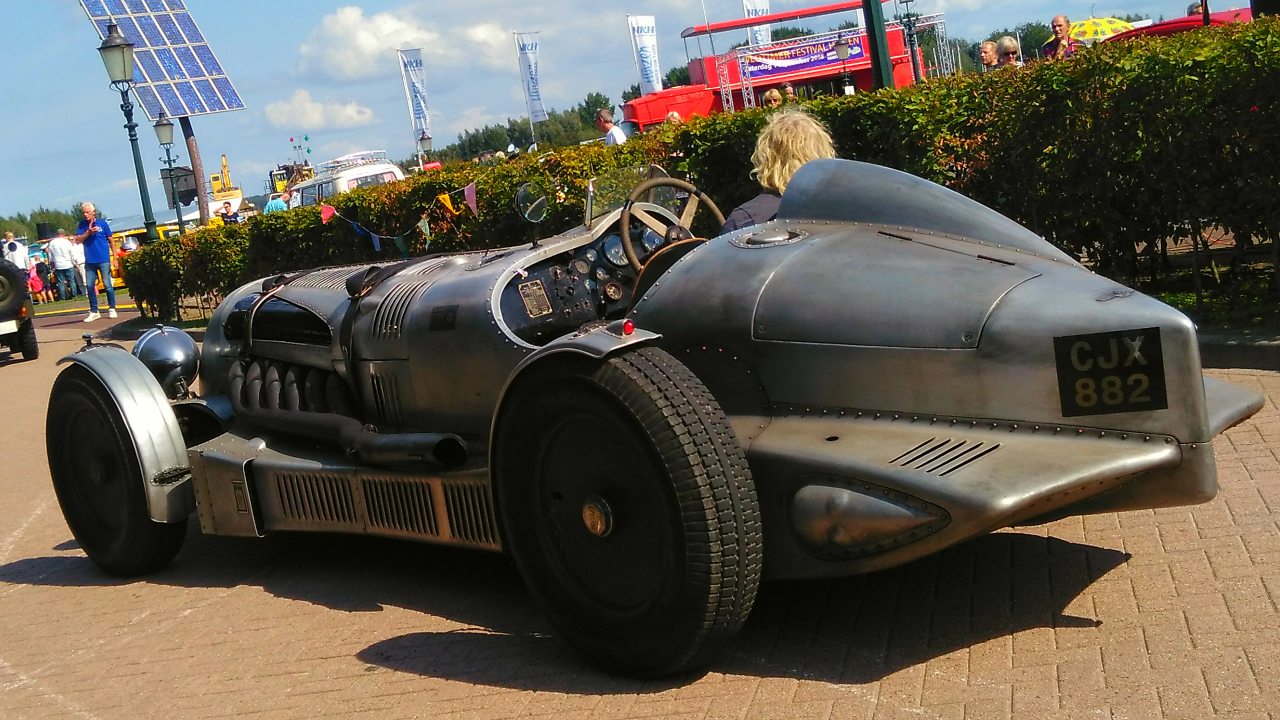
The car in question is a 1930s Bentley that Leno has turned into a kind of land based fighter plane, a machine that treats the commute as a runway. Its centerpiece is a 27 liter Rolls Royce Merlin V12, the same type of engine that once pushed World War II aircraft into combat, now tasked with creeping along the 405. The sight of that much history and hardware squeezed into a traffic lane says as much about Los Angeles car culture as it does about Leno’s own appetite for engineering theater.
The surreal sight of an airplane engine in LA gridlock
What struck me first about Leno’s latest outing was not the celebrity behind the wheel but the mismatch between machine and setting. Here was a prewar Bentley, tall and imposing, inching forward between crossovers and ride share sedans, its proportions and exposed hardware making everything around it look disposable. The car’s 1930s bones are unmistakable, from the upright grille to the long, slab sided body, yet the way it sits in modern traffic feels almost defiant, as if the car has wandered out of a museum and refused to go back.
That defiance is powered by the 27 liter Rolls Royce Merlin V12 under the hood, an engine that once belonged in fighter planes during World War II and now finds itself idling at red lights. Reports on the car describe how the Bentley works its way through daily traffic with this aircraft heart, a combination that turns even a slow crawl into a spectacle. When Leno pilots the car through Los Angeles, he is not just commuting, he is staging a moving demonstration of what happens when aviation scale power is dropped into the most ordinary of urban routines.
Inside the 27 liter Rolls Royce Merlin powered Bentley
From a technical standpoint, I find this Bentley fascinating because it is less a restoration and more a reimagining. The original chassis from the 1930s has been heavily reworked to accept the Rolls Royce Merlin, a V12 that dwarfs typical automotive engines in both displacement and physical size. Accounts of the build describe how the car was essentially constructed around that 27 liter block, turning the Bentley into a kind of ground based test stand for an engine that was never meant to see a stop sign. The result is a machine where the bodywork and frame exist primarily to serve the powerplant.
Leno has showcased the car in his own Garage, walking through details that underline how far from stock this Bentley really is. The drivetrain has been adapted with a suitable transmission and modern touches like electric power steering to make the car at least somewhat manageable on public roads, even if its character remains unapologetically raw. Other coverage of the car notes that the Merlin engine, referred to in some descriptions as The Merlin or Rolls Royce Merlin, was originally built for aircraft and later adapted into this automotive context, a transformation that required extensive engineering just to keep the car drivable at low speeds.
From airfield to boulevard, the Merlin’s unlikely second life
What I find most compelling about this Bentley is the way it reframes the Merlin’s legacy. The Rolls Royce Merlin V12 is usually associated with wartime airfields and the urgency of World War II combat, yet in Leno’s car it has been granted a second life as a boulevard cruiser. One detailed account of the build notes that the massive 27 litre Rolls Royce Merlin was added after the Bentley had already been modified, a deliberate decision to fuse aviation history with prewar luxury. The Merlin aero motors, described collectively as The Merlin, were built for many an aircraft, and seeing one now tasked with navigating crosswalks instead of clouds is a reminder of how technology can be repurposed long after its original mission ends.
That repurposing is not casual tinkering, it is a carefully engineered homage. Earlier coverage of Leno’s 1930 Bentley GJ 400 explains how the car evolved into its current form, with the Merlin engine becoming the defining feature of the build. When I watch the car glide through Los Angeles, I see a kind of rolling museum exhibit that refuses to sit still, a machine that keeps the sound and presence of an aircraft engine alive in a context where most people only know such power from documentaries. The fact that this history lesson unfolds in the middle of everyday traffic, rather than behind velvet ropes, is part of what makes the car so arresting.
How Leno presents the beast in his own Garage
Leno has never been shy about sharing his enthusiasm for this car, and his own walk through of the Bentley in his Garage offers a revealing look at how he thinks about it. In one episode, introduced with a casual “welcome to another episode of Jaylaw’s Garage,” he presents the 1930 Bentley and quickly highlights that “this one’s got a 27 L Merlin aircraft engine,” treating that fact as both punchline and thesis. Watching him move around the car, I am struck by how he frames it not as a fragile artifact but as a tool meant to be used, a philosophy that explains why the Bentley keeps appearing in real traffic instead of staying parked.
Other video coverage of the same car reinforces that attitude, noting that in its current state the Bentley is a formidable performer even by modern standards. One report, while focused on a separate 802 HP Turbo I6 1987 Ram Truck Just Set World Record, references Leno’s 1930, 27L Bentley as another example of extreme engineering brought to the street. The juxtaposition is telling. Where the Ram Truck leans on turbocharging and drag strip numbers, Leno’s Bentley relies on sheer displacement and aviation heritage, yet both vehicles end up sharing the same basic goal, turning mechanical excess into something that can be experienced rather than merely admired from afar.
Why this prewar Bentley still captivates car culture
For all its spectacle, I see Leno’s Merlin powered Bentley as more than a novelty. In an automotive landscape increasingly defined by software updates and silent electric drivetrains, the sight of a 1930s Bent with a 27 liter aircraft engine cutting through Los Angeles traffic feels like a statement about what we risk losing. Reports describing how Leno steals the spotlight in LA Traffic Behind the Wheel of His Aircraft Powered Pre War Bentley emphasize how the car instantly becomes the center of attention, even in a city saturated with exotic machinery. That reaction is not just about celebrity; it is about the visceral impact of exposed mechanics, visible exhaust, and an engine note that sounds like it belongs on a runway.
Coverage of the same outing underlines that this is not just any vintage Bentley, but a one off creation that continues to fascinate enthusiasts years after Leno first introduced it. Articles describing how he turns heads in a 1930s Bentley with an aircraft engine point out that the car is a mechanical marvel built around the 27 liter Rolls Royce unit, a configuration no modern car could match in character. When I watch that car nose through LA traffic, I am reminded that automotive culture is at its most compelling when it embraces extremes, whether that means a silent electric commuter or, in this case, a prewar chassis carrying an engine designed for the sky. The Bentley’s ongoing presence on public roads keeps that conversation alive, one traffic jam at a time.
More from Fast Lane Only: