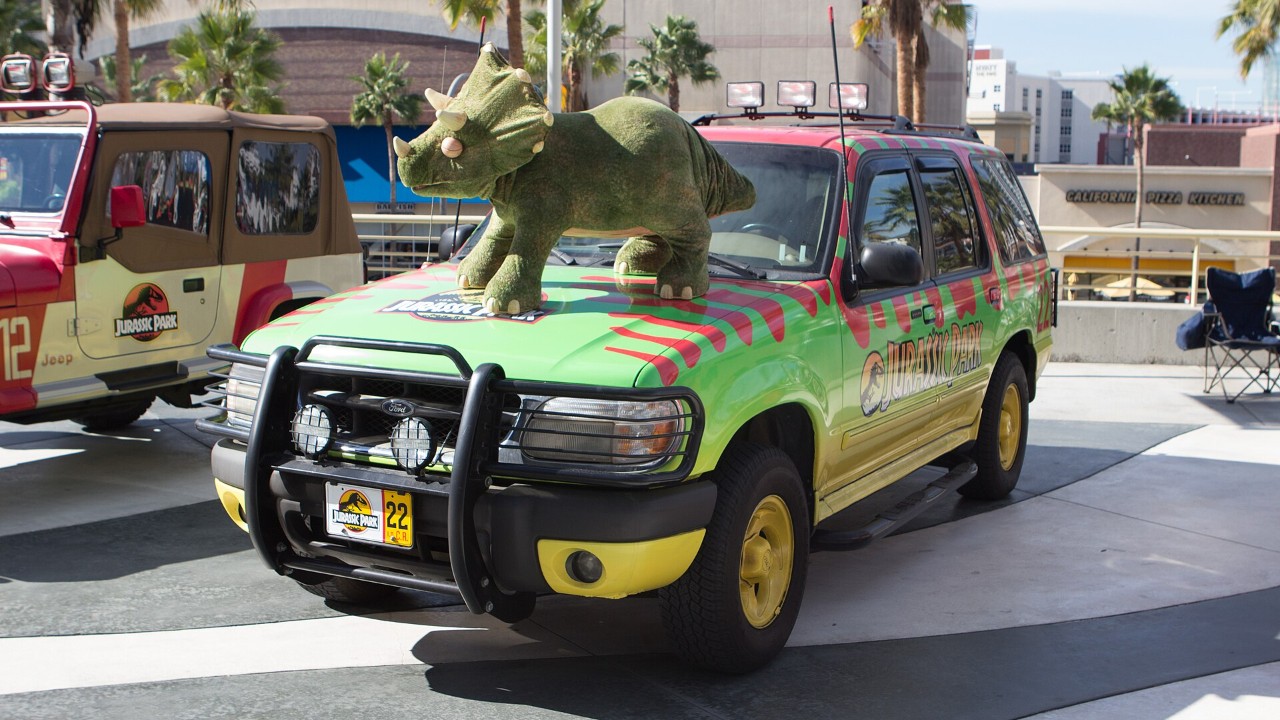
The Jurassic Park Ford Explorer looked like the future in 1993: a tour SUV that drove itself along a track while guests watched dinosaurs through a clear roof. In reality, each one hid a person at a second set of controls. Ford supplied seven of them, and all seven were ordinary 1992 Explorer XLTs under the paint.
That detail matters because the trick has aged so well. Today, self-driving and electric SUVs are real products. Back then, the film’s crew had to fake both ideas with cameras, monitors and a driver tucked out of sight.
Ford has told the story itself. So here is what the company says about its most famous movie fleet, and where the surviving trucks ended up.
Seven 1992 Explorer XLTs, painted for the park
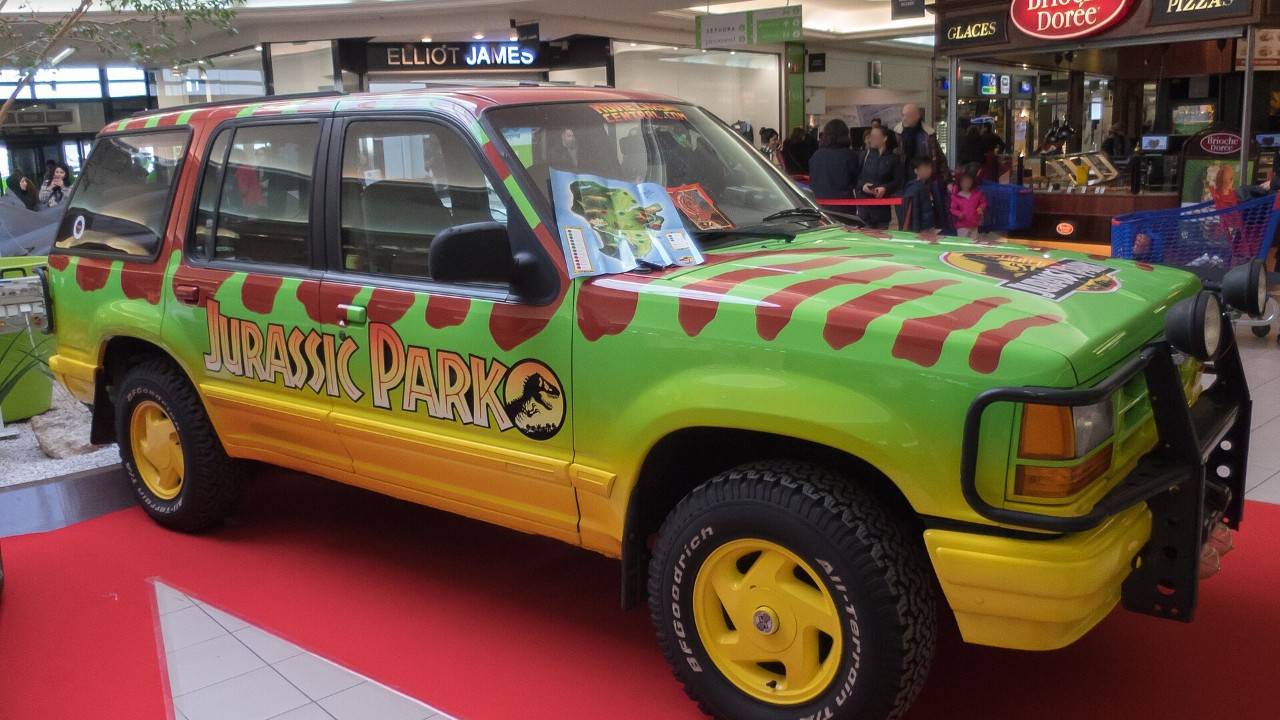
In a February 2024 throwback post on Ford’s newsroom, the company said seven 1992 Explorer XLTs were painted lime green, yellow and maroon to carry guests around the fictional park. Those trucks were only two years into the Explorer’s production run at the time. In other words, the film cast a brand-new nameplate as the star vehicle of a high-tech theme park.
Ford also quoted one of its own 1993 ads in that post. According to the ad, the producers wanted rugged vehicles, and that meant Explorers. Ford ran the throwback because an electric Explorer had just joined its lineup in Europe, which made the movie’s fake electric SUV newly relevant.
That electric link is a little ironic. The movie trucks only pretended to be electric, while the real electric Explorer arrived more than 30 years later.
How George Barris made the Jurassic Park Ford Explorer look self-driving
Customizer George Barris handled part of the conversion, Ford says. His brief was to make the trucks look like the world’s first self-driving vehicles. As a result, the finished SUVs carried brush guards, auxiliary lights, sensors, cameras and video monitors for the passengers.
The most memorable change sat overhead. Each tour vehicle got a clear bubble roof, and Ford notes that the roof featured in the T. rex attack scene. That piece of plastic gave the audience a direct view of the dinosaur, and it gave the dinosaur a direct view of the guests.
The self-driving look was pure stagecraft, though. Ford says the trucks had an additional set of controls in the cargo area. A human operator drove from back there while the actors up front appeared to ride hands-free.
An electric SUV that never was
On screen, the Explorers also seemed to run on electricity. The film showed them guided by an electrified track, and Ford’s post notes that MotorTrend once speculated the setup could imply inductive charging. The trucks even appeared to switch to backup batteries when the park lost power.
None of that hardware existed. Instead, the film used real gasoline Explorers with movie dressing on top. A 1992 Explorer that Bring a Trailer offered in 2024, as Ford Authority reported, shows what sat underneath. That truck used Ford’s 4.0-liter V6, rated at 160 horsepower, with a four-speed automatic driving the rear wheels.
That particular truck was a tribute, not a film car. It left the factory in Medium Mocha Metallic, and a later owner repainted it in a red, green and yellow Jurassic Park-style livery. It also gained a front brush guard, a roof rack and auxiliary lights to match the movie look.
Replicas, museum shows and two survivors
Fans have copied the tour SUVs for three decades. Ford says replicas are common, and one appeared at the 2022 North American International Auto Show in Detroit. The tribute that went to Bring a Trailer even came with a Jurassic Park brochure, walkie-talkies and replica night-vision goggles.
Meanwhile, a 1992 Explorer XLT tour SUV went on show at the Petersen Automotive Museum in Los Angeles. According to Ford-Trucks.com, it was part of the Hollywood Dream Machines exhibit, which ran until March 15, 2020. That exhibit also gathered KITT from Knight Rider, the 1989 Batmobile and the original DeLorean from Back to the Future, InsideHook reported when it opened in 2019.
The Explorer itself went on to a much bigger career than any movie fleet. Ford calls it America’s best-selling SUV of all time, with more than eight million sold. Still, few of those millions carry a story like the seven painted XLTs from 1993.
Where the film trucks are now
Ford does not account for all seven of the original vehicles. However, its 2024 post says two of them reportedly now live at separate Universal Studios theme parks. For a Jurassic Park Ford Explorer fan, those two parks are the closest thing to a registry the fleet has.
The other five are not traced in Ford’s account. So the confirmed record stands where Ford left it: seven 1992 Explorer XLTs built for the film, a hidden driver in every cargo area, and two reported survivors at Universal.
More from Fast Lane Only