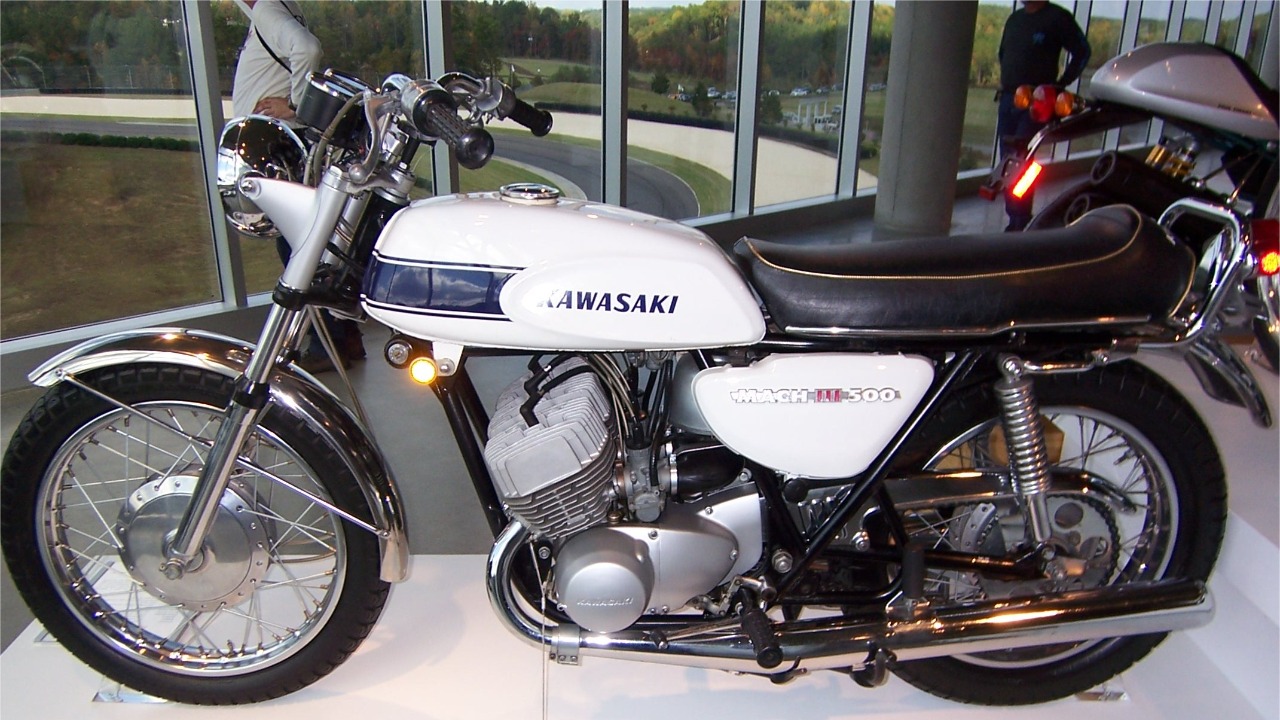
The Kawasaki Mach III arrived in 1969 with three cylinders, a two-stroke engine and a price that undercut almost everything near its speed. Internally, Kawasaki called it the H1. Riders quickly learned it could out-accelerate far bigger machines, and that it asked for respect every time the throttle opened.
At heart, the formula was simple. Kawasaki took a 499cc air-cooled engine, gave each cylinder its own carburetor and exhaust, and wrapped it in a light chassis. The result made about 60 horsepower and sold for $999.
Soon, that combination made the bike a cult machine in America. It also built a reputation for wheelies, weak brakes and nervous handling that has followed it ever since. Here is how the H1 came together, what it could do, and how Kawasaki changed it over eight model years.
How the Kawasaki Mach III came together
Kawasaki was a newcomer to big motorcycles in the late 1960s. Hagerty’s model overview notes that the company first tried a 624cc twin, the W1, in 1966. Yet that bike did not change the market. However, the next idea did.
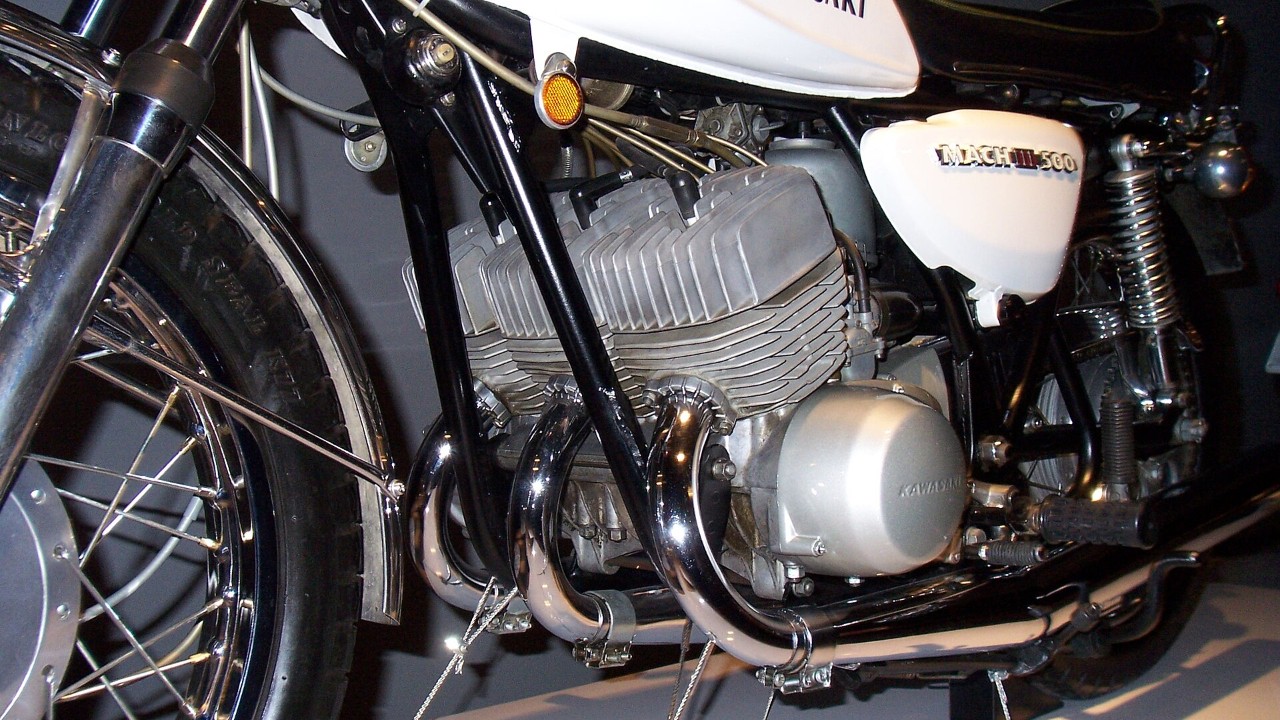
According to Kawasaki’s own history of the Mach III, published by Cycle World, the H1 came “right on the heels of the 350cc A7 Avenger.” The company describes the engine as “like three highly tweaked two-strokes ganged together.” It was a piston-port design, so the piston itself opened and closed the intake ports. In other words, there were no reed valves or rotary valves.
Also, each cylinder breathed through its own Mikuni carburetor. Each one also exhaled through its own tuned pipe. As a result, Kawasaki lists three individually tuned exhausts, and those three chrome pipes became part of the bike’s look.
The bottom end was unusual too. Jim Witters, writing for the American Motorcyclist Association’s cult bike series, says the crankshaft ran on six main bearings with six small flywheels to reduce vibration. That layout required a long crank and extra-wide cases. The cylinders also tilted slightly forward, and a five-speed gearbox sent power to the rear wheel.
The ignition and the numbers
Kawasaki gave the H1 a capacitor discharge ignition, or CDI, with three separate inductive pickups. Kawasaki calls it “hot.” The AMA calls the H1 the first mass-production motorcycle with electronic ignition. Its benefits were real, because spark plugs lasted longer and cold starts were easier.
The system was not perfect, though. Witters notes that electrical short circuits caused a few damaging fires. Hagerty also records that Kawasaki added a waterproof electrical cover for 1970.
Meanwhile, the headline numbers were easy to remember. Hagerty lists about 60 bhp and a $999 price. The AMA gives a claimed 60 hp and a dry weight of 383 pounds. Kawasaki and the AMA both put displacement at 499cc, while Hagerty’s guide lists 498cc. Either way, few bikes of the day offered that much power per dollar.
Price was the bigger story. Hagerty points out that at $999, the Kawasaki cost almost half as much as Harley-Davidson’s XLH. For a young rider, that gap often decided the sale.
Quarter-mile runs and a wild reputation
Next, Kawasaki proved the point at the drag strip. Its history says development rider Tony Nicosia ran 12.96 seconds at 100.7 mph on a brand-new H1 at Lions Drag Strip in Southern California. Kawasaki calls that “the world’s first sub 13-second 1/4-mile run on a production bike.”
Nicosia was more than a hired rider. Kawasaki describes him as an accomplished drag racer, a Kawasaki service technician and a development rider for the H1. The company also says it tested the bike widely across the Southwest, including near Nevada’s Area 51.
Factory claims varied with the source. The AMA cites a Kawasaki claim of 118 mph and a 12.2-second quarter mile. Hagerty, by comparison, quotes a 12.4-second quarter mile and a 124 mph top speed. Both agree on the main point: the H1 was very quick for its size and price.
However, the power came with a catch. Hagerty explains that most of the weight sat over the rear wheel, and the small-tube frame was fairly weak. The drum brakes were underwhelming, and the bike could “tank slap” in corners. Witters puts it more kindly. The frame and suspension were not fully up to the engine, he writes, and that made spirited riding entertaining.
Everyday use had its own costs. Hagerty says the H1 managed about 80 miles per tank and vibrated noticeably. Kawasaki adds that the bike earned “a number of nicknames, some of which are not repeatable here.” Meanwhile, the company says, owners of Corvettes, GTOs and Mustangs soon became aware of it too.
Eight years of changes to the H1
Kawasaki did not leave the formula alone. Hagerty’s timeline shows a larger fuel tank and a strengthened frame for 1971. After that, a front disc brake followed in 1972. Then, in 1974, Kawasaki added valves to oil the main bearings.
Kawasaki’s history frames the run in two halves. The 1969 to 1971 H1 and H1A used drum brakes. By the end, though, the 1976 KH500 carried disc brakes.
Its role at the top of the lineup did not last. Hagerty notes that the four-stroke Z1 took over as Kawasaki’s performance flagship. Kawasaki says the triple finally “became a casualty of emissions laws.” In fact, the four-stroke KZ650 replaced it.
Buying a Kawasaki Mach III today
Today, survivors are not common. Hagerty says “the number of survivors is not particularly high,” and it blames the demanding handling for much of that.
That shapes how to shop for one now. Hagerty advises buyers to favor bikes with documented history and to check for accident repairs. It also warns that parts are hard to find and costly. The AMA’s verdict explains why people keep looking anyway: the engine and the low price made the flaws easy to overlook.
For a rider used to modern sport bikes, an H1 feels raw. Even so, that is the appeal. It is a direct line back to the moment Kawasaki decided to win on acceleration and price. By Kawasaki’s count, the line ran eight years, from the first drum-braked 1969 H1 to the disc-braked 1976 KH500, before the four-stroke KZ650 took its place.
More from Fast Lane Only