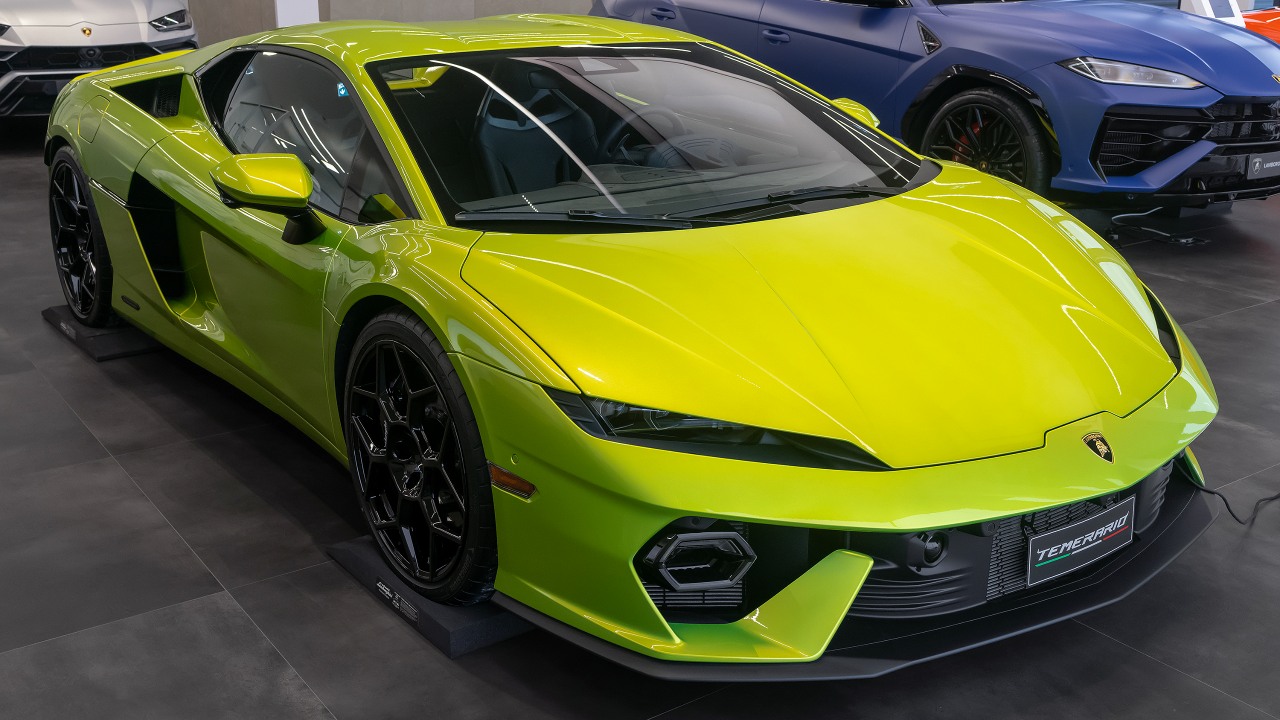
The Lamborghini Temerario arrives as a technological showcase, yet its most arresting statistic is not its power output but its mass. Tipping the scales at around 1,905 kg, or roughly 4,200 lb, it challenges long‑held assumptions that a mid‑engined Italian supercar must be featherweight to be truly exotic. Instead, Lamborghini is betting that sophisticated aerodynamics, hybrid power and chassis electronics can offset the sheer heft baked into its new flagship.
That strategy places the Temerario at the center of a broader debate about what a modern supercar should be. As batteries, electric motors and ever‑stricter safety standards add kilos to every new generation, the question is no longer whether these cars can be kept light, but how intelligently that unavoidable weight is managed.
The 4,200 lb talking point
The headline number is stark. Reports put the Lamborghini Temerario at 1,905 kg, which equates to about 4,200 lb, even when specified with a costly lightweight package. That figure sets a new benchmark for a mid‑engined supercar that is not a four‑seat grand tourer, and it lands well above what many enthusiasts still consider acceptable for something wearing a raging bull on its nose. One detailed account notes that the car reaches this 1,905 kg kerb weight despite measures specifically intended to trim mass, underscoring how much hardware is now packed into the chassis.
Enthusiast reaction has been predictably sharp. In one discussion, owners and observers highlight that Lamborghini itself has quoted a 3,750 lb dry weight, yet once fluids, options and real‑world equipment are factored in, estimates climb to “around 4,100lbs at the moment,” with some commenters arguing that 4,200 lb is a more realistic figure. The same thread points out that weight is “kinda unavoidable” when a car carries multiple electric motors and a battery pack, a sentiment that neatly captures the engineering bind in which the Temerario finds itself.
Hybrid power and the cost of complexity
At the heart of the Temerario is a new hybrid powertrain that trades the traditional naturally aspirated V10 for a more complex layout. Reporting describes a “revolutionary 4.0L twin‑turbo V8 engine paired with” electric assistance, a configuration chosen to deliver both towering performance and improved efficiency. That combination helps the car produce power figures in the region of 900 hp, with one enthusiast‑focused piece referring to “907 horsepower” and emphasizing how the calibration aims to make that output approachable rather than intimidating.
Such sophistication carries a clear weight penalty. Electric motors, inverters and a high‑voltage battery add mass that simply did not exist in earlier generations, and packaging them around a twin‑turbo V8 only compounds the challenge. Commenters dissecting the Temerario’s specifications note that these components, along with the associated cooling systems, are central to why the car ends up so heavy, even before luxury features and safety structures are considered. Yet the same sources also stress that the hybrid system contributes to a lower center of gravity and carefully tuned weight distribution, suggesting that Lamborghini is using the extra hardware not only for straight‑line speed but also to refine handling balance.
Dimensions that rival a grand tourer
The Temerario’s footprint helps explain why its kerb weight has crept into grand‑tourer territory. Official figures list a WHEELBASE of 2,658 mm (given as 2,658 m, 104.6457 in.), a LENGTH of 4,706 mm (4,706 m, 185.2756 in.) and a WIDTH (EXCLUDING MIRRORS) of 1,996 mm (1,996 m, 78.5826 in.). Those numbers place the car firmly in the realm of large, wide‑track supercars, closer in size to some front‑engined GTs than to the compact mid‑engined machines that defined the segment two decades ago. The Lamborghini Temerario’s own technical summary also lists its Width as 1,996 mm (78.6 in), reinforcing just how broad it is on the road.
That scale is not accidental. A longer wheelbase and broader track create space for the hybrid system, improve high‑speed stability and allow more dramatic aerodynamic surfaces. However, they also demand more structural material, larger body panels and more substantial suspension components, all of which add mass. The result is a car that occupies a significant amount of physical and visual space, with its 1,996 m width and 78.6 in stance making it feel more like a low‑slung missile than a lithe sports car. In this context, the 4,200 lb figure becomes less surprising, even if it still jars against traditional expectations for a mid‑engined Lamborghini.
Lightweight packages that barely dent the scales
Lamborghini is not blind to the criticism, and the company has developed an Alleggerita strategy to claw back some of the weight. The Temerario LB634 Alleggerita package is described as reducing the car’s weight by 12.65 kg (27.83 lbs) through revised body components alone, with a total reduction of “over 25 kg (55 lbs)” when the full suite of parts is fitted. Another specification sheet for the Alleggerita Package For the Temerario echoes that figure, stating that it “strips over 55 pounds” through lighter panels, a different engine cover and a high‑load spoiler panel.
The problem is that these savings are fighting a rising tide. One enthusiast report notes that the lightweight option costs £37,000, yet even with that investment the car still “tips 1905kg(4200lbs).” In other words, buyers can spend a substantial sum to remove roughly 55 pounds from a vehicle that still weighs more than 4,100 lb in everyday trim. The Alleggerita approach demonstrates that Lamborghini is willing to chase grams where it can, but it also highlights the limits of what carbon fiber panels and lighter hardware can achieve when the underlying hybrid architecture is so inherently heavy.
Handling, distribution and the new supercar baseline
Weight alone does not define how a car feels, and Lamborghini has worked to ensure that the Temerario’s mass is at least intelligently placed. One technical overview notes that “another key element of the Temerario’s handling package is its weight distribution,” explaining that while the hybrid system and added battery pack inevitably increase overall mass, they also help deliver a lower centre of gravity than the Huracán. That lower centre of gravity, combined with a carefully tuned front‑to‑rear balance, is intended to preserve the agility and responsiveness expected of a supercar, even as the scales creep upward.
Context from other models suggests that this is part of a broader trend rather than an isolated case. The 2025 Lamborghini Revuelto, for example, is described as carrying nearly 500 pounds more than its predecessor, despite efforts such as the elimination of the old central Haldex unit, front driveshaft and front differential. That car’s experience shows how quickly mass can accumulate once hybrid systems and modern safety structures are added, and it helps explain why the Temerario’s 4,200 lb figure, while startling, may soon look less like an outlier and more like the new normal for high‑performance flagships.
Enthusiast discussions reflect this uneasy acceptance. Some voices argue that buyers in this segment are less concerned with curb weight than with the on‑paper performance that hybrid systems unlock, pointing to the Temerario’s roughly 907 hp output and advanced electronics as justification. Others remain skeptical, insisting that a supercar should feel light and communicative above all else, and warning that ever‑heavier machines risk blurring the line between focused driver’s cars and high‑speed luxury objects. For now, the Lamborghini Temerario stands as a vivid example of that tension, a 1,905 kg statement that raw numbers are only part of the story, but also impossible to ignore.
More from Fast Lane Only