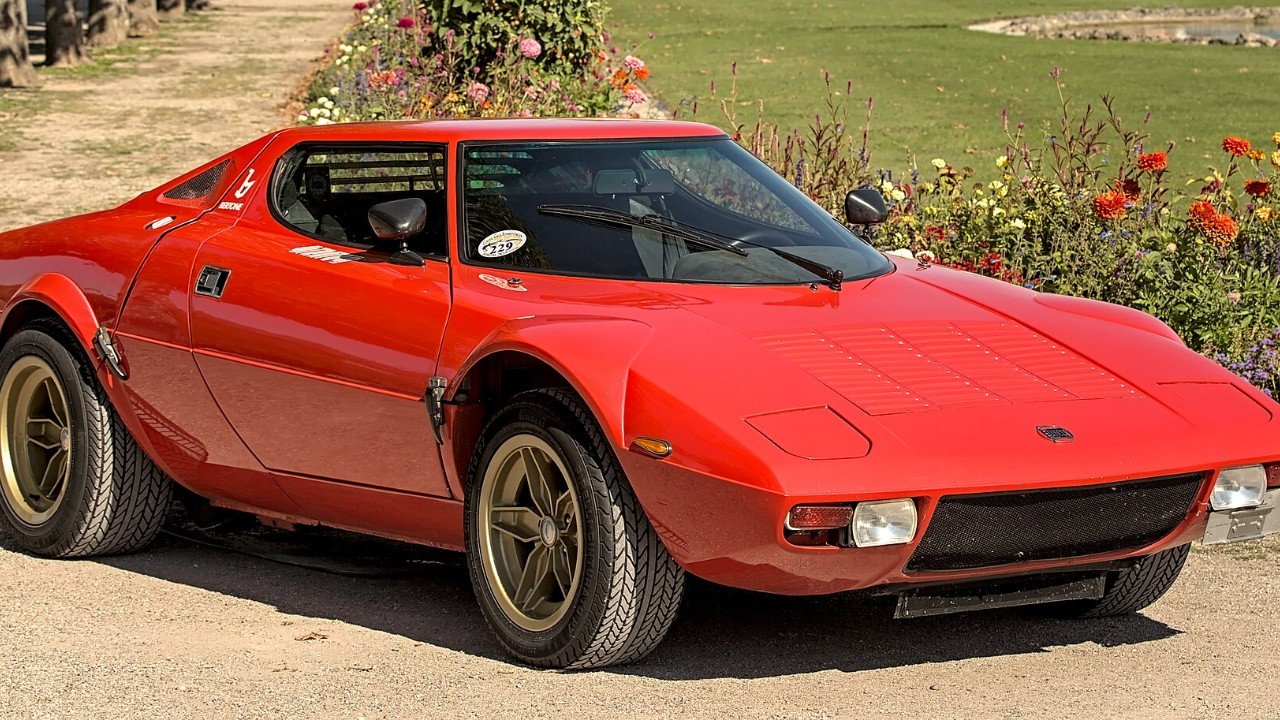
The Lancia Stratos Stradale was a road car built so a rally car could exist. Lancia needed hundreds of street versions to make its wedge-shaped racer legal, so it fitted each one with the 2.4-liter V6 from Ferrari’s Dino. The road car made 190 hp, and the rally car it made possible won the world title three years running.
Few homologation specials have been this honest about their purpose. The Stradale had two seats, a tiny cabin and an engine right behind the occupants’ heads. In other words, it was a competition car first and a road car only on paper.
That gap between paper and reality shows up everywhere in its story, from how many Lancia built to when it built them. Even the official count depends on which record you read.
A concept car that became a Lancia Stratos Stradale
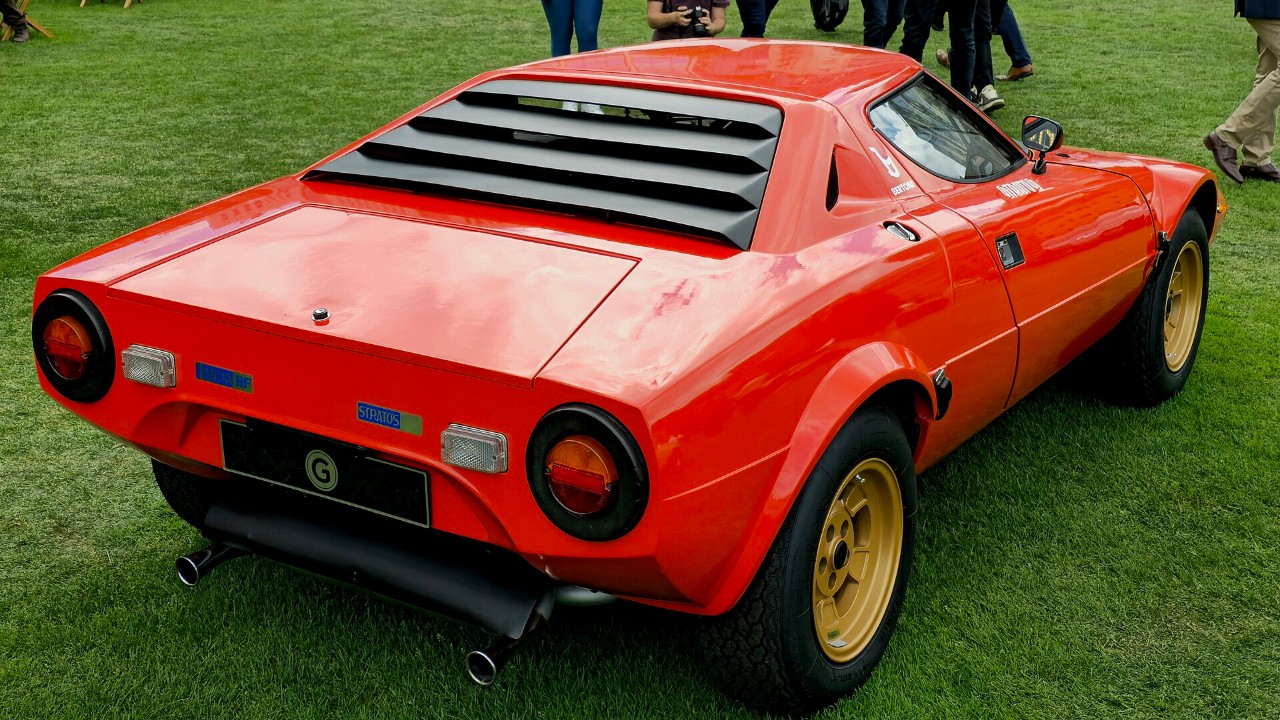
The shape began as a show car. Marcello Gandini styled the Stratos Zero concept at Bertone, and it appeared at the 1970 Turin show. Lancia’s rally boss, Cesare Fiorio, then used it as the starting point for a purpose-built rally car.
According to Motor Sport magazine’s history of the Stratos, Fiorio wanted the compact V6 from the Ferrari Dino. Enzo Ferrari agreed to release the engines, which surprised Fiorio. Lancia, in turn, later described the result as “the first car ever built with the sole aim of winning rallies,” as a 2019 Stellantis heritage release puts it.
A second concept, the Stratos HF, followed at the 1971 Turin show. RM Sotheby’s notes that it kept the Zero’s 2,180 mm wheelbase. That figure was 135 mm shorter than the wheelbase of an Alpine A110, according to the auction house.
The Ferrari Dino V6 behind the seats
The heart of the car was a 2,418cc Ferrari Dino V6 with overhead cams and three twin-barrel Weber carburetors. Hagerty’s price guide rates the road version at 190 hp and 166 lb-ft of torque. It sat transversely in the middle of the car and drove the rear wheels through a five-speed manual transaxle.
The rest of the package was just as focused. Hagerty describes a stamped-steel monocoque cabin with space frames front and rear, plus fiberglass bodywork at each end. As a result, the Stradale weighed 2,161 pounds, while the lightened rally car came in at 1,940 pounds.
That light weight made the road car quick for its time. Hagerty lists a recorded top speed of 144 mph and 0-60 mph in about 6.8 seconds. In rally trim, by contrast, the same engine family made up to 320 hp, Hagerty says. Lancia’s own heritage release puts the later 24-valve rally engine at 300 hp, so the exact figure depends on the source.
How many Lancia actually built
Group 4 rules required 500 identical cars built over 24 months. However, Lancia never had that many when the paperwork went through. Rallycars.com says the FIA homologated the Stratos on October 1, 1974, when “a maximum of 141 cars had been built.”
RM Sotheby’s gives a slightly different figure, saying Bertone had finished 147 cars by that date. Either way, the real count came well short of 500. Meanwhile, the total also varies by source: Hagerty says 500 were built in 1973 and 1974, though some list 492 chassis. Motor Sport says production ended in May 1975 after 457 cars, and RM Sotheby’s gives a range of 491 to 498.
Selling them proved harder than building them. Rallycars.com notes that the road car only had type approval in Germany, Belgium, Switzerland, the Netherlands and Italy. Consequently, many sat unsold until 1978, and the site says they were essentially given away at that point.
Three straight rally titles
On the stages, the Stratos delivered what Lancia paid for. Hagerty credits it with the championship in the 1974, 1975 and 1976 seasons. The Stellantis release confirms three Constructors’ World Championship titles from 1974 to 1976.
Monte Carlo became its signature event. Motor Sport says Sandro Munari opened 1975 with the first of three straight Monte Carlo Rally wins for the car. Then, in 1977, Munari won the FIA World Rally Driver’s Cup in a Stratos, according to Lancia’s release.
Fiat, Lancia’s parent, ended the factory program in the fall of 1977 in favor of the Fiat 131 Abarth. Even so, the Stratos kept racing, and Hagerty notes privateers ran it into the 1980s. Motor Sport records its last world championship win in October 1979, when “Tony” Fassina won the Sanremo Rally.
What a Stradale sells for today
Values have climbed a long way from the days of unsold stock. Hagerty’s guide lists the 1974 Stratos at $563,000. It also warns buyers to check provenance carefully, since many replicas exist. Rallied cars also deserve a close look for frame damage and fatigue.
Documented originals draw strong bids. At its Monaco sale in 2024, RM Sotheby’s sold a 1975 Stratos HF Stradale for €590,000. That car was the 323rd built, wore Azzurro Chiaro paint and showed fewer than 12,000 km. It also kept its matching-numbers Dino V6, with a Lancia Classiche certification folder from 2020.
More from Fast Lane Only