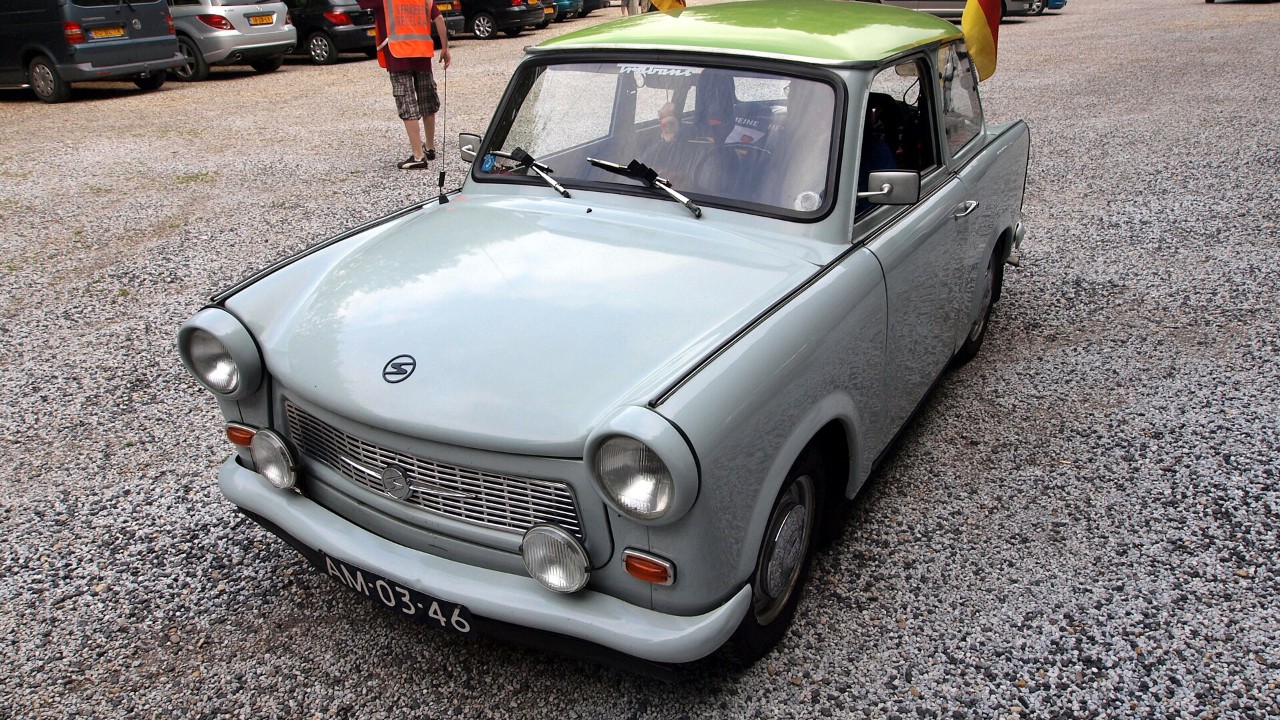
One Trabant in a museum collection carries a whole East German story in its paperwork. Its buyer ordered it in 1976 and then waited 13 years for delivery. The little car was finally registered on November 9, 1989, the day the Berlin Wall fell.
Today that car, a 1989 Trabant P601L, belongs to the Collier Collection at the Revs Institute. Its owner drove it only 2,361 miles before parking it for good. As a result, it survives almost exactly as East Germany built it.
The Trabant was the car that put East Germans on the road, and also the car they waited longest to get. Here is how this one came to be, and what made the model so unusual.
The Trabant that waited 13 years
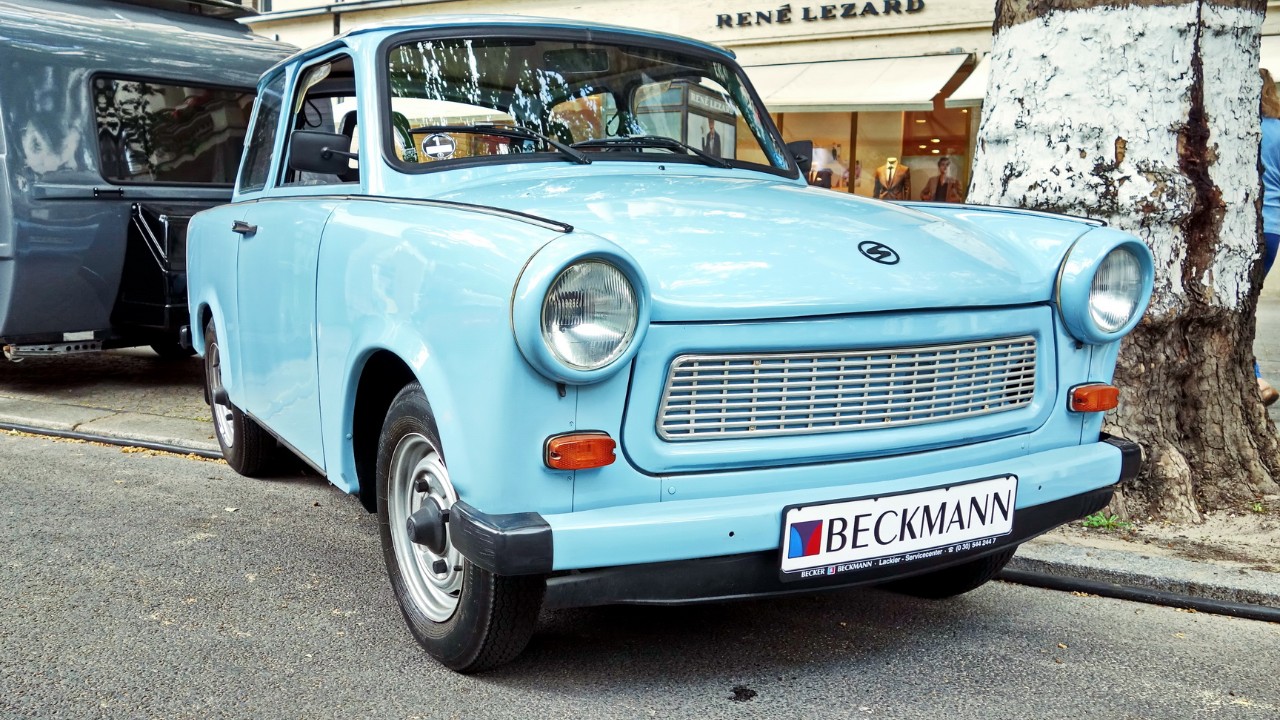
The Revs car is a P601L, the roomier version of the 601, finished in a color called papyrus. Its serial number is 4260867, according to a 2017 Revs Institute feature by Jayme Moore. It joined the Collier Collection in 2004.
Moore writes that the car was ordered in 1976 and delivered 13 years later. Then its owner registered it on November 9, 1989, the same day the Wall came down. After 2,361 miles, the owner parked it.
The car is not licensed for road use now. Instead, Revs staff run it now and then to keep the engine working. In fact, the museum has posted a video of its exhaust note.
Why East Germans waited so long
East Germany ran a planned economy, and cars were scarce. Buyers often waited years for a Trabant and paid roughly a year’s salary for one, Moore writes. By comparison, West Germany was enjoying a postwar boom.
Another source puts the wait even more bluntly. Many buyers waited more than 10 years for delivery, says deutschland.de. That’s why a 13-year wait, though long, was not unheard of.
The Trabant also earned a nickname, “Trabi,” and a running joke. According to deutschland.de, people said it went “from zero to a hundred on the same day.”
A body made from resin and cotton
Steel was scarce in the East, so the Trabant’s body used Duroplast instead. Revs describes the material as phenol resin from the dye industry mixed with waste cotton. Deutschland.de adds that the cotton fibre came from the Soviet Union and was soaked in plastic, then pressed into shape.
The material was easy to form and durable, and it saved weight and cost. However, the panels sat on a conventional steel chassis. The car measures 140.0 inches long, 59.3 inches wide and 56.7 inches tall, per Revs.
For comparison, Revs notes that a Fiat 500 is about the same length. The Trabant, though, is 4.8 inches narrower and 3.1 inches lower.
Two strokes, two cylinders, 26 hp
Under the hood sat a transverse two-stroke, two-cylinder engine. Early cars used 500 cc from 1957 to 1962, and later cars used 594 cc from 1963 to 1989. In the final years, from 1989 to 1991, Volkswagen Polo engines replaced the two-stroke.
The 1989 Revs car makes 26 hp and weighs 1,352 pounds. Revs says it needs 21 seconds to reach 62 mph through its four-speed manual. Owners also had to mix oil with the fuel in the tank, and the exhaust was heavy.
Meanwhile, the rest of the hardware was simple. The car had independent transverse leaf suspension, rack-and-pinion steering and drum brakes on all four wheels. Inside, early models even used a dipstick instead of a fuel gauge.
The models, from the 500 to the 1.1
Revs lists four main versions. First came the Trabant 500 from 1957, then the 600 from 1962 to 1964. Next, the facelifted 601 ran from 1963 to 1991. Finally, the Volkswagen-engined Trabant 1.1 arrived for 1990 and 1991.
Buyers could choose a sedan or a station wagon. There was also a “jeep” version called the Tramp.
From Zwickau to the Collier Collection
Every Trabant came from Zwickau, in Saxony. The city had earlier built Auto Union racing cars and Horch luxury cars, and it is where Audi began. In 1957, the plant became VEB Sachsenring, which built the Trabant.
About 3.1 million Trabants were built from 1957 to 1991, according to Revs. Deutschland.de gives “over 3 million” and dates the start of production to 1958. Either way, the last car left the Zwickau line on 30 April 1991.
Today, about 30,000 Trabants survive worldwide, and about 250 are in the United States, says deutschland.de. The International Trabi Association in Zwickau runs a museum and keeps an international Trabant register. More than 150 Trabi fan clubs also keep the cars running.
Among those survivors, the Revs car may be the one with the best story. Its odometer shows 2,361 miles, and its registration date marks the night the Wall opened.
More from Fast Lane Only