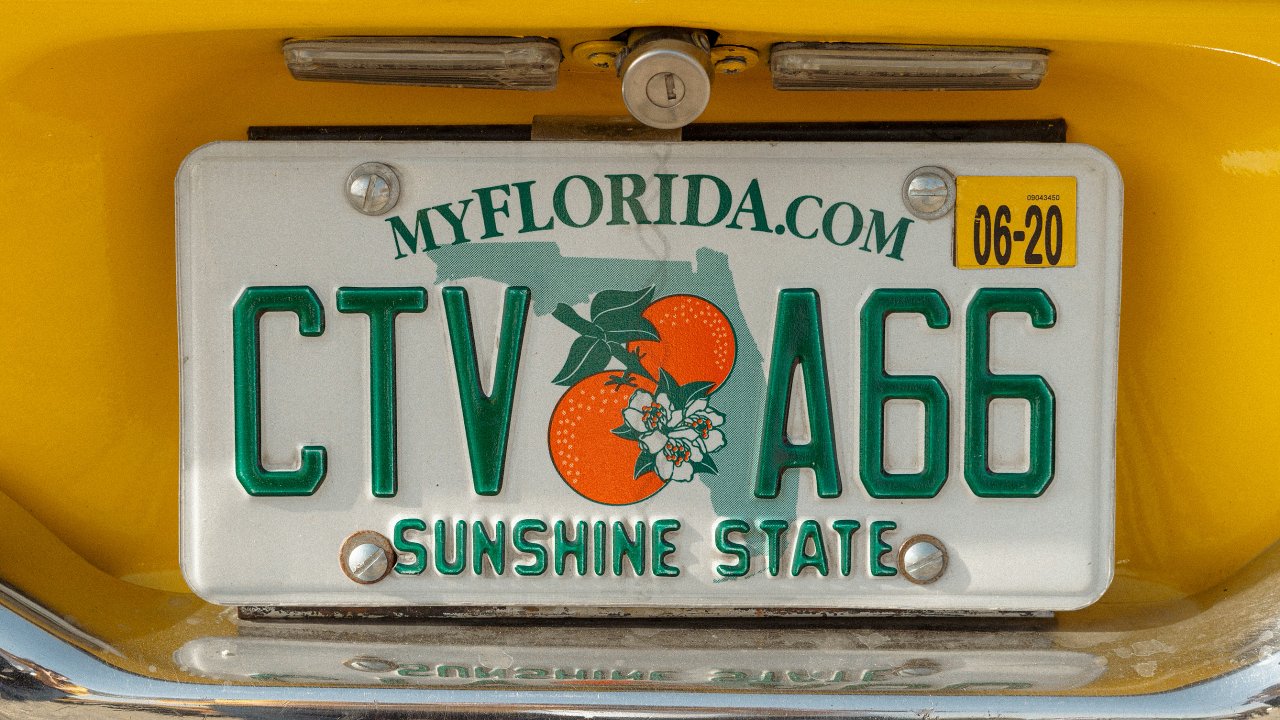
Florida drivers are discovering that a simple decorative border around a tag can now trigger traffic stops, steep fines, and even the threat of a criminal record. A new state law has turned license plate frames and covers into a legal minefield, and a flurry of memos and clarifications has only partly eased the whiplash for motorists trying to stay on the right side of the rules.
What began as a crackdown on obscured plates has morphed into a statewide debate over how much plastic or metal can touch the edge of a tag before it becomes a crime. I have found that the core tension is simple: the law is written broadly, while drivers live in a world of dealership frames, tinted shields, and sports team logos that were once routine accessories.
How a technical tweak became a statewide headache
The new regime traces back to House Bill 253, which took effect in October and sharply tightened what can legally touch a Florida plate. The statute makes it illegal to display anything that obscures a vehicle’s identifying information, which includes the alphanumeric tag number, the registration decal in the upper corner, and other key markings that help officers and toll cameras read a plate. In practice, that means the law does not just target obviously altered tags, it sweeps in common accessories that wrap around the edges or tint the surface.
Earlier this fall, a separate measure that took effect on October 1 went even further by banning anything that blocks or alters a plate, including frames, covers, and clear shields that might seem harmless to the average driver. Reporting on the New Florida crackdown notes that even transparent covers can be treated as illegal if they interfere with legibility. Combined with the language in House Bill 253, the result is a legal standard that treats many off-the-shelf accessories as potential violations, even when they were installed years ago by dealerships or previous owners.
What is actually illegal on a Florida plate now
At the heart of the confusion is a simple rule that has been repeated by state officials: nothing can cover or distort the tag number or the small registration decal in the upper corner of the plate. The Florida Department of Highway Safety and Motor Vehicles, often shortened to FLHSMV, has stressed in a memo that any device that renders those elements illegible is a violation. That includes tinted license plate covers, smoked plastic shields, and frames that creep over even a sliver of the numbers, letters, or the yellow sticker. Analysts have described these accessories as anything that, in effect, makes key plate information hard to read at a glance.
State guidance has also made clear that full plate covers are out. A recent Florida memo explained that license plate covers are banned outright and that drivers cannot use any overlay that changes the appearance of the tag, even if the numbers are still visible. That aligns with broader reporting that the law targets anything blocking or altering the plate, from novelty shields to anti-camera sprays, and treats them as grounds for a stop and a potential criminal charge under the new rules. In short, if a product sits on top of the plate or wraps tightly enough to touch the printed area, it is now suspect under Florida law.
Frames are not dead, but the margin for error is tiny
Despite some early panic, frames themselves are not universally banned, which is where the legal whiplash really sets in. State officials have clarified that frames are allowed as long as they do not cover the plate number or the registration decal. One detailed breakdown of the law notes that Frames can remain on vehicles if they sit outside the printed border and leave every character and sticker fully visible. That means a thin metal border that hugs the outer edge of a standard Florida plate can be legal, while a thicker plastic frame that dips even a few millimeters into the lettering can trigger a violation.
Law enforcement voices have tried to translate that nuance into practical advice. In Tallahassee, TPD Detective Michael Carter has urged drivers to keep their plates “clear and visible” and to remove any frame that raises doubts about legibility. Other Florida law enforcement agencies have echoed that approach, explaining that tinted frames are illegal and that any accessory that blocks the state name, county designation, or specialty design is a problem if it also interferes with the core identifiers. The message from these clarifications is blunt: if a driver has to squint or step closer to read the tag because of a frame, an officer is likely to see that as a violation under the new law.

State memos try to calm drivers, but penalties raise the stakes
As confusion mounted, The Florida Department of Highway Safety and Motor Vehicles stepped in with a statewide memo aimed at standardizing enforcement. The agency’s guidance, circulated to law enforcement and highlighted in multiple reports, explains that officers should focus on whether the tag number and the yellow decal are fully visible from a normal viewing distance. The Florida Department of Highway Safety and Motor Vehicles has emphasized that the goal is to improve safety and eliminate confusion among drivers, not to punish people for harmless personalization. A related video briefing from the Florida Department of Highway Safety and Motor Vehicles reinforces that anything covering the tag number or yellow decal is off limits.
Even with that softer tone, the penalties attached to the law are serious enough to make drivers nervous. A widely shared explanation of the new 2025 rules notes that almost any frame that obscures part of the plate can now lead to fines and a permanent record, a sharp escalation from the minor equipment tickets many motorists expected. Another report from WEST PALM BEACH, Fla, describes how the new Florida law already on the books is catching drivers off guard, not because they are intentionally hiding plates, but because common accessories have suddenly become grounds for a criminal charge. When a decorative border on a 2019 Honda Civic or a tinted shield on a 2022 Ford F-150 can be treated as a crime, the stakes of a seemingly cosmetic choice look very different.
Everyday drivers caught between fear and compliance
The human side of this crackdown is playing out in parking lots and driveways across Florida, as drivers unscrew frames they have had for years. Reports describe Florida motorists as “stunned” that a new 2025 law can make almost any license plate frame that obscures anything on the tag a potential violation, with the specter of fines and a permanent record attached. Social media posts show people removing dealership frames from Toyota Camrys and Jeep Wranglers, often with the simple logic that if there is any doubt, it is safer to drive with a bare plate than risk a stop. One analysis summed up the simplest approach in plain language: “Remove the license plate frame” if there is any chance it could render the plate illegible, a recommendation that reflects how nervous many drivers have become.
Local police and sheriffs have tried to strike a balance between strict enforcement and public reassurance. Coverage of What Florida law enforcement says about the new rules notes that tinted license frames are clearly illegal, but that a plain frame that does not cover any identifiers is “perfectly lawful.” In Tallahassee, TPD Detective Michael Carter has framed his advice in similar terms, telling drivers that if they have any concerns or doubts, they should take the frame off rather than risk a citation. That kind of guidance acknowledges the legal gray areas while nudging motorists toward the safest option, even if it means giving up a favorite sports team logo or a custom frame from a local dealership.
Why the confusion persists despite official clarifications
Even after multiple memos and public explanations, the confusion has not fully lifted, and the reasons are baked into how the law is written and enforced. The statute hinges on whether a plate is “obscured” or “illegible,” terms that can feel subjective when applied on the side of the road. A frame that looks fine to a driver in a garage might look problematic to an officer in traffic, especially at night or in heavy rain. Coverage of The Brief on the new Florida law notes that the state’s own clarification effort had to spell out basic questions, such as whether decorative plates and covers are acceptable, which underscores how far the law has drifted from everyday expectations.
There is also a gap between the letter of the law and the way accessories are marketed and sold. Retailers still offer “clear” plate covers and thick chrome frames for popular models like the Tesla Model 3 and Chevrolet Silverado, even though state guidance now treats many of those products as illegal once installed on a Florida tag. A recent Florida memo explained that the law bans license plate covers outright and that additional guidance may be needed, a tacit admission that the first wave of communication did not fully resolve the uncertainty. Until the market catches up and drivers see fewer questionable products on store shelves and dealership lots, I expect the legal whiplash to continue every time someone walks behind their car and wonders if a simple frame is worth the risk.