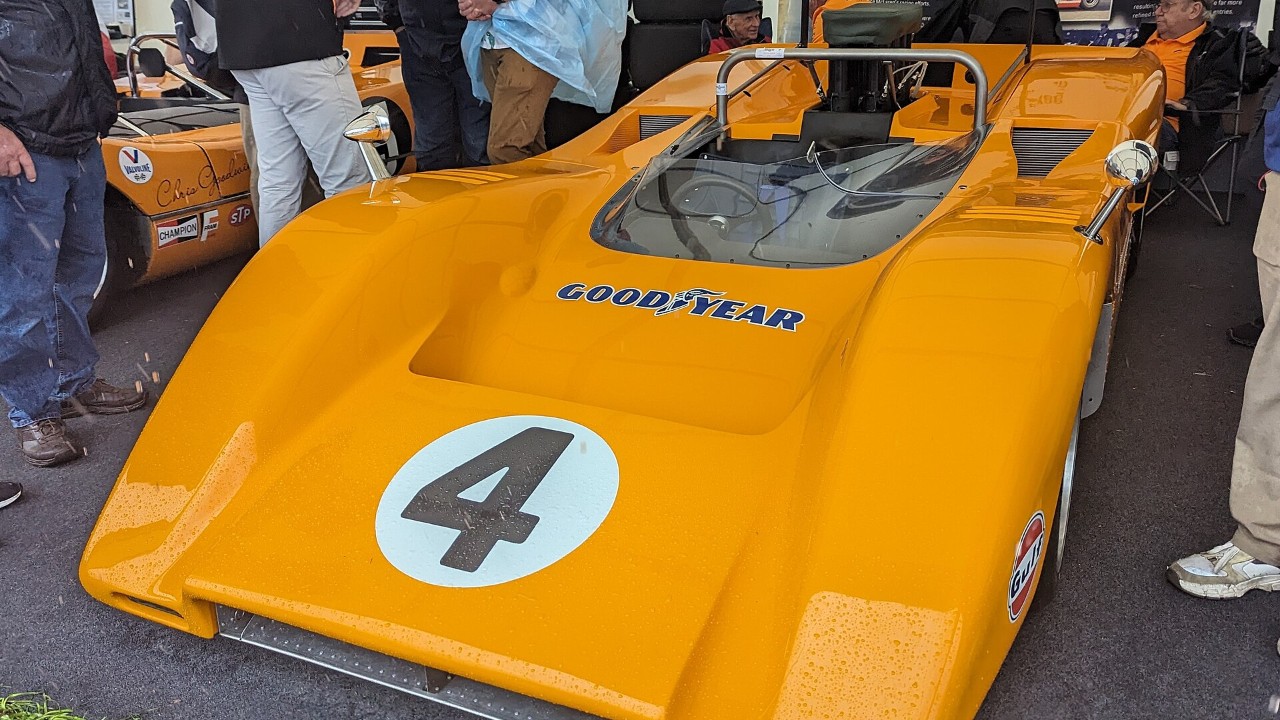
The McLaren M8B started 11 Can-Am races in 1969 and won every one of them. Bruce McLaren took six of those wins and Denny Hulme took the other five. In fact, the cars also started all 11 races from pole. That’s why Autosport has called the M8B the most dominant car in McLaren’s history.
Can-Am was a sports car series for big two-seat racers with huge engines. In 1969 the field included Ferrari, Porsche and Chaparral, and some rivals ran wild ideas. Against that, McLaren brought a car that looked almost plain.
Still, it wasn’t a revolution. The M8B was a careful update of the car that had won the year before. However, it was built by a small team that tested hard, prepared well and rarely made mistakes. Here’s how it came together, how the season played out and where the one surviving original car lives now.
How the McLaren M8B grew out of the M8A
The M8B was a development of the 1968 M8A. According to Autosport’s history of the car, Bruce McLaren, Jo Marquart and Gordon Coppuck shaped the update. Engineer Gary Knutson also came back from Chaparral for the project. The changes were mostly to the bodywork and aero, plus wider wheels.
After all, the 1968 car had set a high bar. The team’s official history site says the M8A’s seven-litre engine made 620 bhp. Hulme won the opening 1968 race at Elkhart Lake and later won at Las Vegas, while Bruce won at Riverside. So the brief for 1969 was simple: keep what worked and make it faster.
Testing began early. First, the crew ran a modified M8A, then converted it to full B specification. They also cut back the front wheel arches to help air escape from under the nose. Meanwhile, the old rear spoiler disappeared.
Motor Sport’s Gordon Cruickshank later described the chassis as a half monocoque that stopped at the front of the engine. Behind that, a tubular frame carried the rear of the car. The suspension used simple wishbones with outboard spring and damper units. In his words, it was “a very straightforward car, but very successful.”
A big-block V8 and a wing on stilts
At its heart was an aluminium Chevrolet big-block V8. According to the Bruce McLaren Trust’s history of the Can-Am cars, it was a short-stroke, big-bore version of the 1968 unit. As a result, it now measured 7,046 cc and made 630 bhp. George Bolthoff prepared the engines. Autosport puts the output at 630 to 640 bhp.
Reliability wasn’t perfect, though. Autosport cites a January 1970 Motor Racing report that McLaren used eight engines in 1969 and had four failures. Even so, the team won every race.
The most visible change was the wing. Instead of a spoiler, the M8B carried a tall airfoil on struts. Those struts mounted directly to the rear hub carriers. As a result, the downforce pushed on the tires, not on the chassis. That let the springs stay soft enough to soak up bumps, as Sports Car Digest explains.
McLaren didn’t invent the idea. Chaparral had run high wings in Can-Am since 1966. By comparison, McLaren’s approach was low-tech. Cruickshank wrote that the team tested the wing on a small van in the streets around Colnbrook, because wind tunnels were rarely used then.
Eleven races, eleven wins for the McLaren M8B
For 1969, Can-Am grew from six rounds to 11. It was the series’ fourth season. The McLaren M8B won all of them, and the works cars finished first and second eight times. At Michigan, the team went one better. Bruce won, Hulme took second and Dan Gurney finished third in the spare car.
Overall, the wins split almost evenly. Bruce won at Mosport, Watkins Glen, Road America, Michigan, Laguna Seca and Texas. Hulme, meanwhile, won at Mont-Tremblant, Edmonton, Mid-Ohio, Bridgehampton and Riverside. Bruce took the championship, his second Can-Am title.
Meanwhile, the gap to the field was huge. Autosport worked out that McLaren’s average qualifying margin was 2.1 seconds. For comparison, the famous 1988 McLaren MP4/4 Formula 1 car averaged 1.1 seconds. At the Texas finale, Bruce took pole with a 1m02.21s lap.
The rivals weren’t weak, either. Chris Amon brought a Ferrari 612 with a 6.2-litre V12. Jo Siffert raced a Porsche 917 PA, and John Surtees drove Chaparral’s troubled 2H. Mario Andretti ran a Holman & Moody M6B with an 8.1-litre Ford. In addition, Gurney entered his own Ford-powered “McLeagle.” Mark Donohue’s Penske Lola T163 was entered too, before Penske withdrew.
Why the team was so hard to beat
Of course, speed alone doesn’t explain a sweep. Mechanic Hughie Absalom told Autosport the team was “a lot more professional than the opposition and of course we had good drivers.” Bruce himself kept it modest: “All we’ve been doing is getting on with the job of going racing.”
Money mattered too. Cruickshank wrote that Can-Am was “relatively lucrative” and that it probably helped keep McLaren alive financially. Even so, the team ran lean. It hauled its cars between races on trailers towed by Chevy pickups.
Team manager Teddy Mayer later called the M8B “probably the most effective race car we ever built.” Similarly, the team’s history site calls it the team’s most successful car.
Where the surviving car lives now
Sources differ on how many M8Bs McLaren built. Autosport says three. On the other hand, New Zealand’s Southward Car Museum says the team built two complete cars and a spare tub, using parts from the 1968 M8As. The Southward displays a replica of the car, built in New Zealand by Russell Keach.
Today, only one original survives, according to Autosport. That’s chassis M8B/2. Bruce raced it in 10 of the 11 rounds in 1969 and won five races with it. Later, McLaren’s Heritage department restored the car to its 1969 specification. Once finished, M8B/2 won Best of Show at the Amelia Island Concours.
More from Fast Lane Only