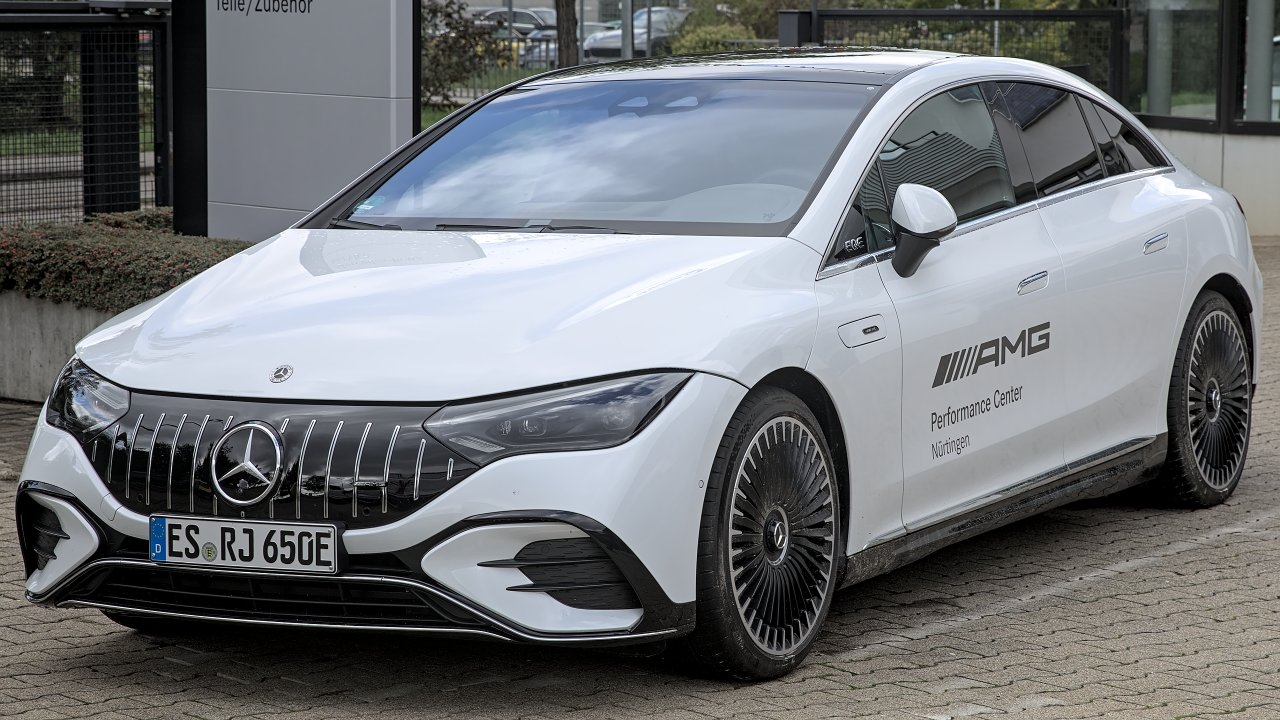
Mercedes spent much of last year retreating from the American electric-vehicle market, pulling its EQ models from showrooms just as rivals were doubling down. Now the company is reversing course, restarting production, reopening order books, and preparing a new wave of battery-powered cars that it insists will be more compelling and better priced. The abrupt pivot reveals not only how rough the first chapter of Mercedes EVs has been in the United States, but also how aggressively the brand now intends to fight its way back.
From abrupt pause to “hard reset” on strategy
When Mercedes paused shipments of its EQ electric cars to the United States, it was not a gentle slowdown but a hard stop that left dealers and customers in limbo. Reports at the time described how Mercedes stopped taking most EV orders in the U.S. and effectively pulled the plug on new EQE and EQS sales, a move that was framed as Mercedes Pauses US Bound EQ Electric Car Production Indefinitely rather than a minor production tweak. The company also temporarily halted the order bank for its electric EQS and EQE models, signaling that this was a deliberate reset rather than a supply hiccup.
That retreat set the stage for what insiders later described as a Hard Reset on the brand’s electric strategy, a Major Update that acknowledged the first wave of EQ products had not landed as planned. Mercedes-Benz finished 2025 in the U.S. with only a slight 1 percent uptick in overall results, and the electric side of the ledger was weak enough that some observers framed it as a Reset After a Rough Year for Mercedes. By the end of that rough year for Mercedes Benz, its electric cars had largely vanished from American showrooms, and the company was openly preparing a new approach.
Why Mercedes pulled back its EQ lineup
From my perspective, the decision to yank the EQ lineup from the U.S. was less about abandoning electric power and more about admitting that the first generation of products and pricing was misaligned with the market. The EQE and EQS arrived as expensive, complex flagships just as American buyers were becoming more price sensitive and more demanding about range and charging performance. When Mercedes Stops Taking Most EV Orders in the U.S. and pauses EV orders and production, it is effectively conceding that the existing mix of models, incentives, and positioning is not delivering the volumes or margins it needs.
The company’s own behavior supports that reading. Executives framed the pause as part of a broader Hard Reset in which Mercedes Strategy Gets a Major Update, with future EVs expected to share a new platform and a more cohesive technology package. The fact that Mercedes Pauses US Bound EQ Electric Car Production Indefinitely while it prepared new vehicles around the same MMA platform suggests that the brand wanted to clear the decks, avoid overproducing slow-selling models, and buy time to recalibrate everything from battery specs to interior tech. In other words, the pullback was painful, but it was also a calculated move to avoid doubling down on a flawed first draft.
Reopening the taps: EQ production restarts and orders return
The most striking sign that Mercedes is ready to fight again is that its EQ-branded EVs Are Finally Back in Production for the American market. After months of silence, the company has restarted production of EQ Branded models and is once again building U.S.-bound cars instead of diverting them elsewhere. Love them or not, the Mercedes Benz EQ vehicles are available to order once again, ending the limbo that began when the order banks were frozen and shipments were paused.
That restart is not happening in isolation. Mercedes has said that this year will be its largest product offensive ever, pairing the revived EQ lineup with a wave of new models that are meant to reset perceptions of what a Mercedes EV can be. The company is reopening EQ orders in the U.S. at the same time that it prepares to launch fresh metal, signaling that the pause was a prelude to a coordinated push rather than a quiet exit. For American buyers who watched Mercedes EVs disappear from lots, the message is clear: the brand is back, and it intends to compete.
Price cuts and a new value pitch
Restarting production alone would not be enough if the cars returned with the same sticker shock that helped sink demand the first time. Mercedes appears to understand that, which is why it has slashed prices dramatically for 2026 in a bid to make the EQ models more appealing. The EQE sedan now starts at $66,100, a figure that undercuts its earlier positioning and signals a willingness to sacrifice some margin to win back buyers who might otherwise drift to Tesla, BMW, or a wave of newer competitors.
I read that move as a recognition that luxury EV shoppers are no longer willing to pay a large premium simply for a three-pointed star on the grille. By cutting prices and pairing that with a broader product offensive, Mercedes is trying to reframe its electric cars as rational choices rather than niche statements. The company’s own Reset After a Rough Year for Mercedes narrative acknowledges that the first wave of EQ pricing did not resonate, and the new numbers are a concrete attempt to correct that. If the brand can sustain those prices while improving technology and range, it will have a far stronger story to tell in American showrooms.
The CLA 250+ and the next generation of Mercedes EV tech
The clearest expression of Mercedes’ second-chapter strategy is the upcoming CLA 250+ with EQ Technology, which is set to anchor the brand’s new compact electric lineup in the U.S. The CLA 250+ is positioned as a more attainable entry point, Starting at $47,250, yet it carries specifications that speak directly to the pain points that hurt the first EQ wave. Official figures list an EPA estimated electric range of 374 miles, Power of 268 hp, and Acceleration from 0 to 60 m in a bracket that should feel brisk in daily driving, all while undercutting the price of many larger luxury EVs.
Under the skin, Vehicles on this new platform use an 800-volt architecture that is designed to improve charging speeds and efficiency. Under that 800-volt system, the CLA and its siblings are expected to be DC fast charging compatible with 800-volt chargers, which should reduce time spent at public stations and make long-distance travel more practical. Mercedes has also signaled plans to expand this model family, suggesting that the CLA 250+ is not a one-off experiment but the first in a series of compact EVs built around the same core technology. In practical terms, that means American buyers will see a more coherent lineup of smaller, more efficient electric Mercedes models rather than a scattered collection of expensive flagships.
More from Fast Lane Only