The Mercury Breezeway window was a rear pane of glass that went down at the touch of a switch. Mercury first sold it on the 1957 Turnpike Cruiser, then let it fade away with that car. Six years later, it came back as the signature feature of the 1963 Monterey, and this time it stuck around until 1968.
Most drivers think of the back window as fixed glass. Mercury saw it as a vent. In fact, the idea was older than either car. Early coupes often had rear glass that opened, so the driver could talk to rumble-seat passengers or let in some air.
What made Mercury’s version different was the power motor, the slanted roof built around it, and a marketing push that turned a gadget into a styling theme.
The 1957 Mercury Turnpike Cruiser hardtop
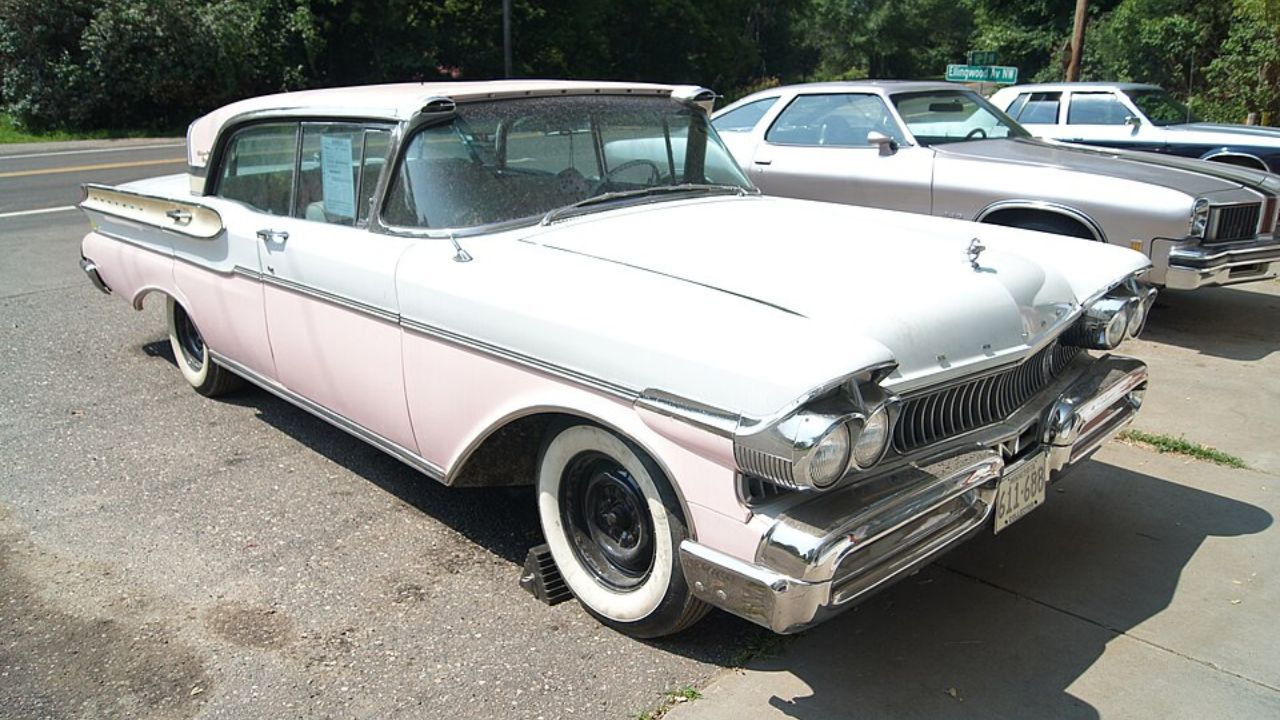
The Breezeway story starts in the show-car world. Mac’s Motor City Garage traces Mercury’s first working retractable rear glass of that era to the 1955 D-528 concept. That show car was later called the Beldone, and it still exists. Then Mercury put the idea into production on the Turnpike Cruiser, which RM Sotheby’s says began life as the XM-Turnpike Cruiser concept in 1956.
The road car was a showcase of gadgets. According to Over-Drive Magazine’s 1957 Mercury fact sheet, it carried a 368-cubic-inch V8 rated at 290 horsepower for 1957, an engine shared with Lincoln. It also had push-button “Keyboard Control” for the automatic and a “Seat-O-Matic” seat that moved when the ignition was switched off. Meanwhile, the rooftop air intakes covered a body seam, and each one hid a dummy antenna.
Above all, it had the power rear window, which Mercury already called the Breezeway. Even so, the car was expensive for a Mercury. The same fact sheet lists the 1957 two-door hardtop at $3,758, the four-door at $3,849 and the convertible at $4,103.
Why the Breezeway faded after 1958
Buyers didn’t rush in. Over-Drive counts 7,291 two-door hardtops, 8,305 four-door hardtops and just 1,265 convertibles for 1957. A convertible paced the Indianapolis 500 that year, and Mercury sold yellow replicas, but that publicity didn’t change the math.
As a result, Mac’s Motor City Garage notes that the Turnpike Cruiser sold slowly and that both the car and its window were soon dropped. RM Sotheby’s describes the model as offered only for 1957 and 1958.
However, the window didn’t vanish from the Ford family. Lincoln’s 1958 to 1960 Continental used retractable rear glass as standard on its sedans and convertibles. Mac’s explains that it was electric and worked from a switch in the driver’s armrest, although the Breezeway name wasn’t officially applied to it.
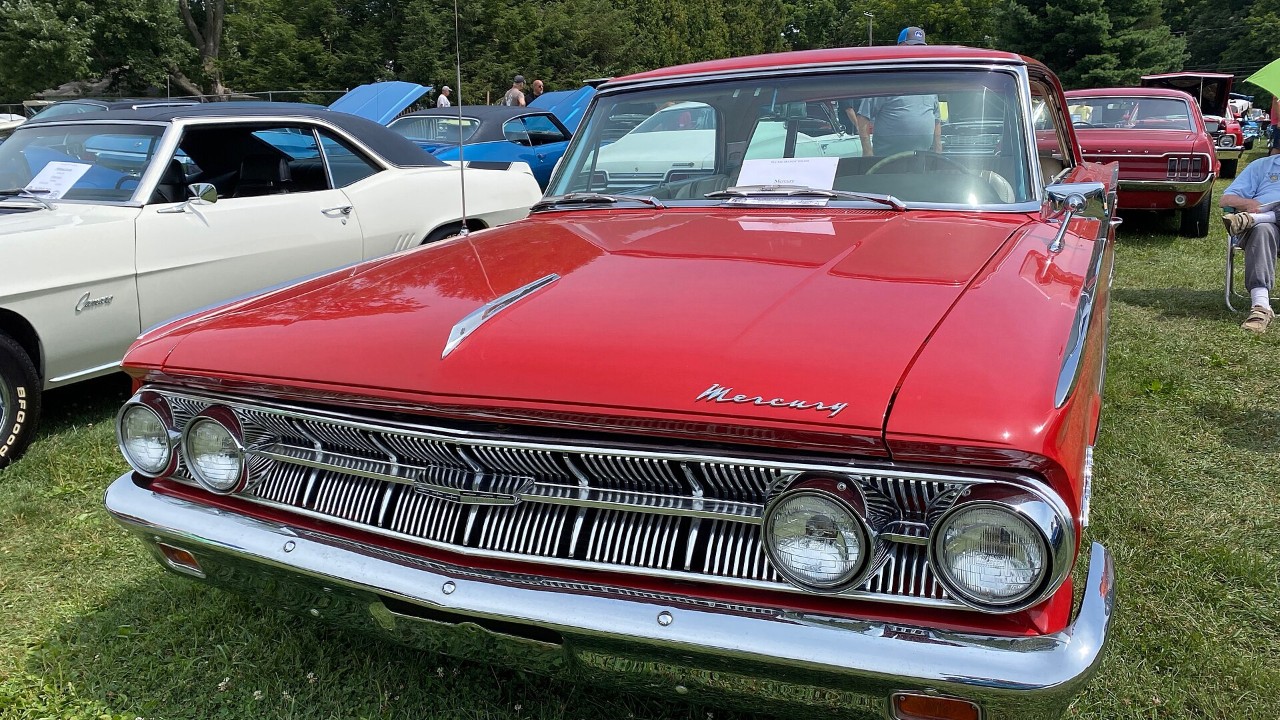
The 1963 Mercury Monterey Breezeway hardtop
For 1963, Mercury brought the Breezeway back and made it the face of the full-size line. Over-Drive Magazine’s 1963 Mercury fact sheet says the window was standard on non-convertible Monterey and S-55 models. It also notes that the power mechanism came from Mercury’s station wagons, where a motor already lowered the tailgate glass.
The roof was the clever part. Instead of sloping back over the rear seat, the rear glass leaned forward at the top. Mac’s credits this “Z-line” roof with making the feature work. It also counts eight Breezeway models in 1963, in two- and four-door form, with hardtop and pillared bodies.
The engine choices were stout, too. Over-Drive lists a 390-cubic-inch V8 with 250 horsepower as the standard 1963 engine, with a 300-horsepower four-barrel 390 as a step up. Later in the year, Mercury added 427 V8s.
The base two-door hardtop was one of the rarer 1963 bodies. Over-Drive counts 2,879 base Monterey two-door hardtops for 1963, compared with 10,693 Monterey Custom two-door hardtops. By contrast, the Custom four-door sedan was the big seller at 39,542.
How the Mercury Breezeway worked on the road
The point was airflow, not looks. With the glass lowered, Mac’s Motor City Garage says, the opening could exhaust cabin air efficiently. On the other hand, it notes that in some conditions it could also draw road fumes into the back seat.
Mercury also had a performance problem to solve. The Breezeway roof was upright and blunt, which didn’t help on fast NASCAR ovals. So, according to Over-Drive, Mercury added the Marauder fastback in mid-1963 with a sloping roof modeled on the Ford Galaxie hardtop. In other words, Mercury sold both shapes at once.
What finally killed the Breezeway
Sales started strong and then slid. Mac’s reports more than 92,000 Breezeway cars sold in 1963, falling to roughly 46,000 by 1965. That year, new sheet metal cut the Breezeway down to the four-door sedan alone.
For 1967, the full-size Mercury got a conventional sloping roof. After that, the Breezeway became a limited option on four-door sedans, and the glass dropped only about two inches. Mac’s puts 1968 sales of that option at fewer than 6,000 before Mercury dropped it for good.
The cause, in Mac’s words, was simple: “air conditioning.” Once buyers could close every window and cool the car, a rear vent lost its reason to exist.
The car that started it all now trades as a collector piece. At its Hershey auction in 2025, RM Sotheby’s sold a 1957 Mercury Turnpike Cruiser coupe from the Suzy Q Collection for $29,700.
More from Fast Lane Only