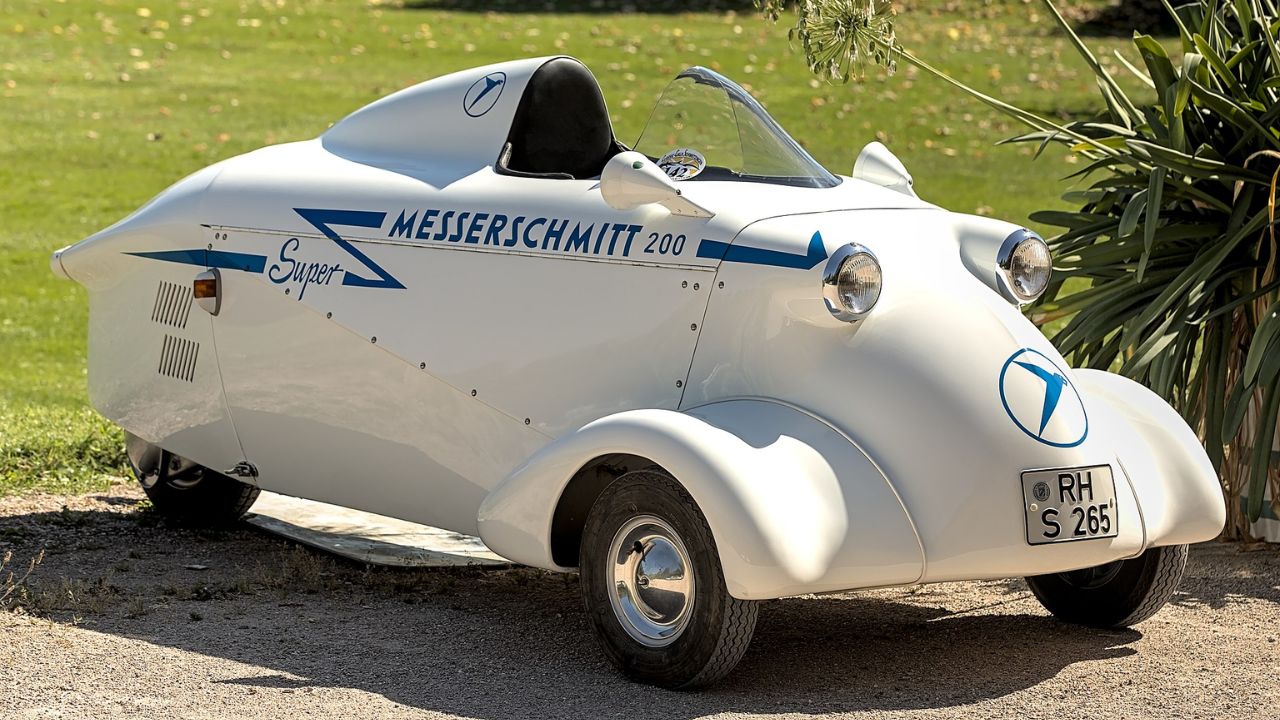
The Messerschmitt KR200 had four forward gears and no reverse gear at all. To back out of a parking space, the driver stopped the little two-stroke engine and started it again so it spun the other way. In theory, that turned all four forward gears into reverse gears.
It sounds like a garage legend, but it was a factory feature. The trick spared the car a reverse gear, and it fit a design that borrowed freely from motorcycles.
That kind of thinking ran through the whole car. Here is where the KR200 came from, how its reverse trick worked, and what one is worth today.
Why an aircraft maker built the Messerschmitt KR200
After World War II, Messerschmitt could not build aircraft for a time, so it looked for other work. According to The Motor Museum in Miniature’s history of the car, aircraft engineer Fritz Fend proposed small motor vehicles to the company in 1952. His first design, the KR175, grew out of the Flitzer, an invalid carriage he had built in 1948.
The KR175 had a real weakness. As the Southward Car Museum in New Zealand puts it, the KR175 had no reverse, so drivers simply pushed it backward. The museum in miniature says Fend’s team built about 10,000 KR175s in 1953 and 1954.
The KR200 replaced it in the spring of 1955. Instead of starting over, Fend kept the basic layout and fixed the problems. In particular, he gave the new car a way to back up without anyone getting out to push.
How the KR200 went backward
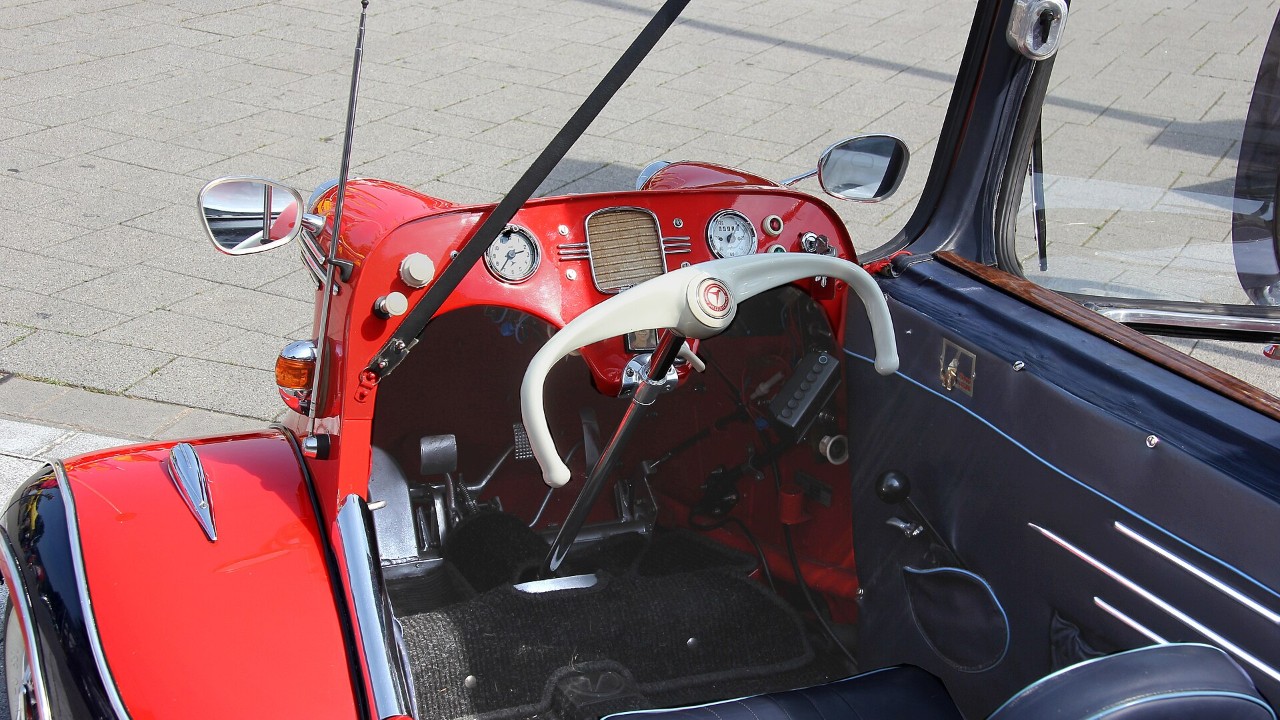
The answer lived in the ignition, not the gearbox. The KR200 used a motorcycle-style sequential gearbox with four forward speeds. However, its engine had a reversing starter on a dual-mode ignition, according to the museum in miniature.
The driver first stopped the engine. Next, the driver pushed the key further into the switch, and the starter fired the two-stroke so it ran backward. A simple two-stroke single can run in either direction, because it has no camshaft or valve timing to care which way the crank turns. Once the engine turned the other way, every gear in the box drove the rear wheel backward.
The museum in miniature notes that this “in theory gave the vehicle four reverse gears.” In practice, few owners would want to test fourth gear backward. Still, the Southward Car Museum sums up the method plainly: the KR200 reversed by reversing the engine’s direction.
Life in the cockpit
The engine itself was tiny. Southward lists a 191 cc Fichtel & Sachs single-cylinder two-stroke, while the museum in miniature puts output at around 10 horsepower, with a fan for cooling. Southward gives a top speed of 100 km/h, or about 62 mph.
The rest of the car felt more like an airplane than a sedan. Two people sat one behind the other, in tandem, under a Plexiglas bubble. The whole top, bubble included, lifted up and over so the driver could climb in. Steering came from a handlebar connected straight to the track rods with no reduction gearing, which made the car very quick to respond.
A popular story says the canopy came from a Messerschmitt fighter. However, the museum in miniature says there is “no truth” to the story that the canopy and wheels came from Me 109 parts. In addition, it quotes Fend’s own sales line: “if you have a head you can drive a Messerschmitt.”
Sales, records and the end of the line
The KR200 started strong. The museum in miniature says dealers sold 12,000 in 1955, the car’s best year, and it competed head-on with the BMW Isetta. In the United States, a 1956 KR200 cost $1,073 through the Frank Sennes Motor Corporation of Glendale, California.
The car also chased records. In August 1955, a modified single-seat KR200 ran a 24-hour attempt at Hockenheim and set a class record at 103 km/h. In total, according to the museum in miniature, that run set 22 international speed records.
Ownership changed soon after. Southward says Messerschmitt AG sold the microcar business to Fend in 1956. He then formed FMR with Valentin Knott, the brake and hub supplier, and the new company built the KR200 until 1964. By then, a stronger economy and the arrival of the Mini had cut demand for bubble cars.
What a Messerschmitt KR200 is worth now
Total production is harder to pin down than the first-year figure. Both museums put it at roughly 40,000 cars over about ten years. The museum in miniature also says the UK has around 500 Messerschmitts on the road and the second-largest owners’ club after Germany.
Prices have climbed well past that $1,073 sticker. The museum in miniature says well-kept examples have sold for up to €20,000. On the high end, a red 1956 KR200 bubble top with a 10-horsepower engine sold for $67,200, according to Hagerty’s past-sales records.
If you want to see one in person, the Southward Car Museum in New Zealand displays a 1960 KR200 built by FMR in Regensburg, Germany.
More from Fast Lane Only