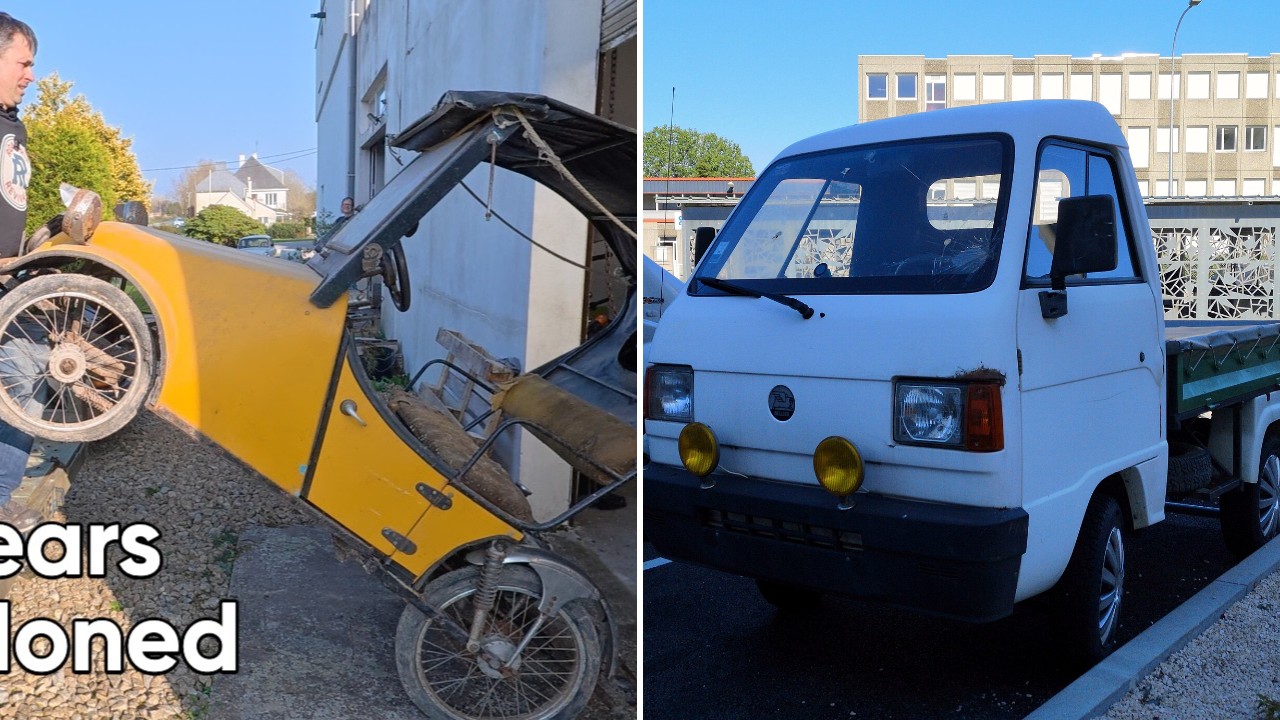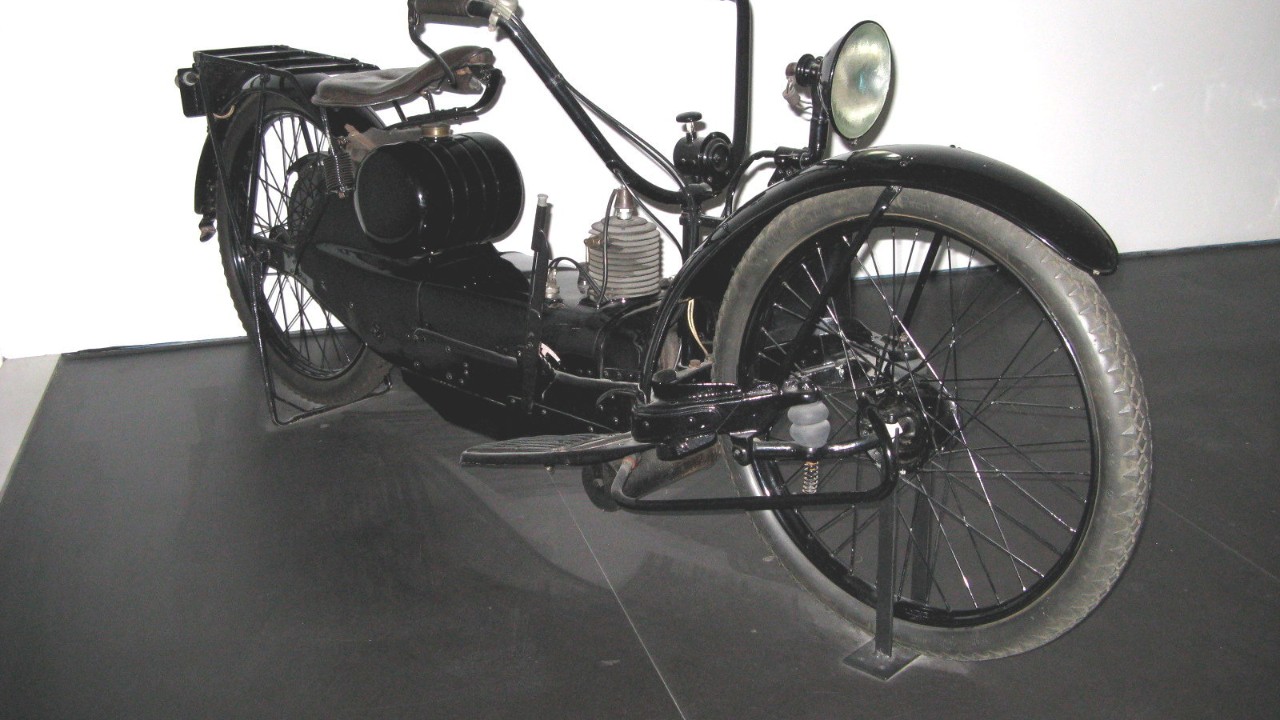
The Ner-A-Car looked like a motorcycle that had borrowed parts from an automobile. It had a low steel chassis, a friction drive and a front wheel that steered on a pivot inside its own hub. Britain’s Sheffield-Simplex built about 6,500 of them in the 1920s.
American engineer Carl Neracher designed it, and the name was a pun on his own. Say it out loud and you get “near a car,” which hinted at the idea. This was a two-wheeler with car-like parts and very steady manners.
Here’s how it worked, how it was built on both sides of the Atlantic, and where you can see one today.
A motorcycle built like a car
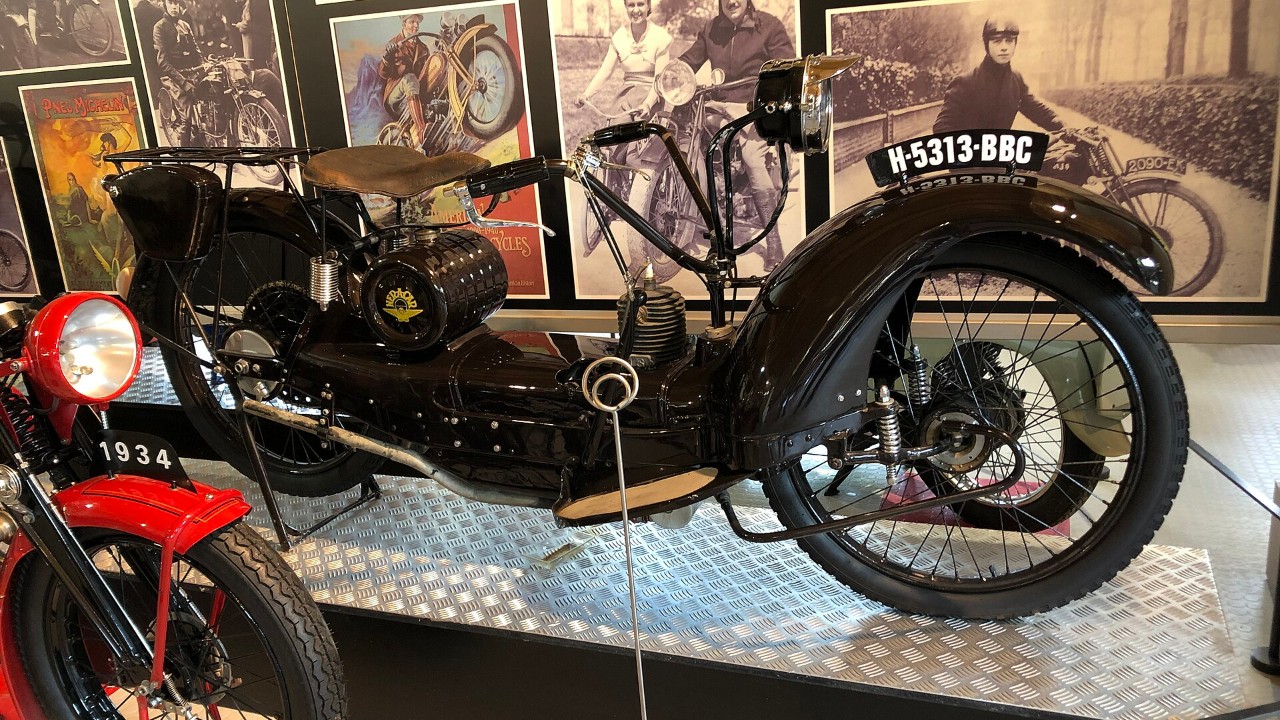
The design came from Syracuse, New York, according to Grace’s Guide to British Industrial History. Instead of tubes, the frame used pressed-steel channel sections. The National Motor Museum at Beaulieu describes it as a low-slung monocoque chassis.
That low frame mattered. It put the weight close to the ground and gave the rider a low seat. For example, the 1924 English Model B at the Lakeland Motor Museum has a 27-inch seat height, a 59-inch wheelbase and a weight of 190 pounds.
Neracher also borrowed earlier ideas. Silodrome traces its hub-center steering to Tooley’s Patent Bi-Car of 1904 and its pressed-steel frame to the Militaire Autocycle of 1911.
How Ner-A-Car hub-center steering worked
A normal motorcycle steers by turning the whole fork at a steering head above the front wheel. On the Ner-A-Car, by contrast, the steering pivot sat at the hub itself. Leading links carried that pivot, Grace’s Guide explains.
The front wheel also hung on coil springs rather than a conventional fork, RideApart notes. As a result, the machine was famously steady. Silodrome says riders showed off its stability by kneeling on the seat with their hands cuffed behind their backs.
The drivetrain was just as unusual. Power went through a friction drive and then a chain to the rear wheel, according to Grace’s Guide. RideApart compares the friction drive to a modern CVT. Meanwhile, both drum brakes sat in the rear hub.
Two factories, two countries
The design sold on both sides of the Atlantic. RideApart and the Lakeland Motor Museum both put US production at about 10,000. In Britain, Sheffield-Simplex took a license and built around 6,500, the same sources say.
The British machine was announced during TT week on the Isle of Man in 1921, Grace’s Guide reports. Sheffield-Simplex built it first at Tinsley, near Sheffield. Then in 1923, production moved to Kingston-upon-Thames in Surrey.
Engines also changed along the way. The early two-stroke displaced 221 cc, RideApart says. The 1923 Model B moved up to 285 cc, and the 1924 Model C brought a 350 cc side-valve Blackburne engine, a conventional clutch and a gearbox, according to Grace’s Guide.
The Cannonball Baker run
One long ride showed what the Ner-A-Car could do. In 1922, Erwin “Cannonball” Baker rode one from Staten Island, New York, to Los Angeles, Silodrome reports. He covered 3,364.4 miles in 174 hours and one minute.
Better still, the trip was cheap. Baker’s operating costs came to $15.70, the same source says. In fact, he liked the machine so much that he later opened his own Ner-A-Car dealership in Los Angeles.
Why the Ner-A-Car disappeared
Money was the problem in the end. First, The Times advertised the British machine at £57 10s in September 1923, Grace’s Guide notes. However, sales were “good but not great,” the same history says, and Sheffield-Simplex ran into financial trouble.
The end dates vary by source. The National Motor Museum puts British production between 1921 and 1927, while Silodrome gives 1921 to 1926. Either way, RideApart says Sheffield-Simplex eventually sold out to Hawker Engineering, which dropped the bike to focus on aircraft.
Survivors also turn up for sale. For instance, Silodrome notes that a 1921 example was listed for Mecum’s Las Vegas auction in January 2022. Meanwhile, at least two British museums hold one, including Lakeland.
The other is at Beaulieu. The National Motor Museum collection lists a 1921 Ner-A-Car with a 285 cc single-cylinder engine, a top speed of 35 mph and a new price of £70.
More from Fast Lane Only