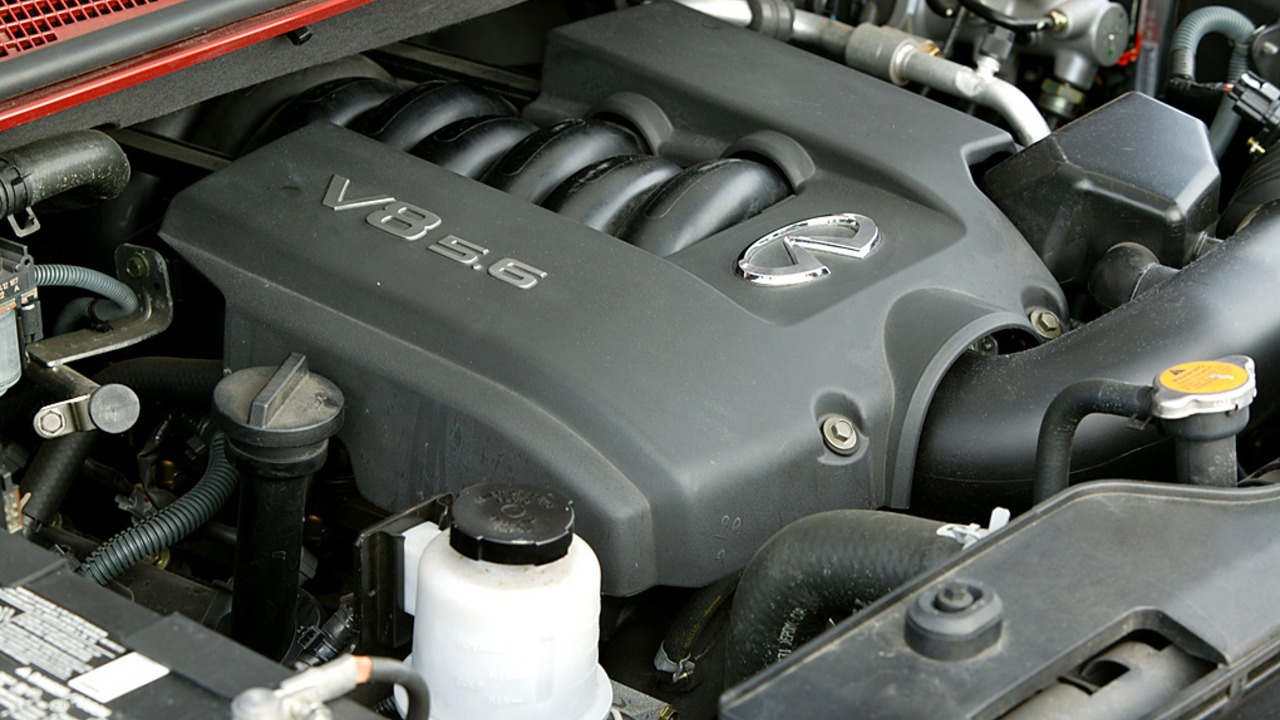
Nissan’s VK56 V8 is one of the rare modern engines that genuinely lives a double life, serving as a workhorse in full-size pickups and SUVs while also forming the basis for serious competition machinery. Built to tow, haul, and commute during the week yet capable of supporting four-figure horsepower builds on track, it has quietly become a favorite among engineers, racers, and engine swappers who want durability as much as drama.
That dual personality is not marketing spin. In showroom form the VK56 powers family haulers and job‑site trucks, while in heavily reworked trim it has run at Le Mans, in Australia’s touring car ranks, and in drag cars that cover the quarter mile in the six‑second range. The same basic block that moves an Armada or Titan can, with the right parts, anchor a 2,000 horsepower race program.
From work truck to “Japanese muscle” V8
The VK56 was conceived first as a utility engine, designed to move heavy vehicles with confidence rather than chase headline power numbers. In early Nissan Titan pickups, the VK56 delivered around 305 horsepower and 379 lb‑ft of torque, a combination that favored mid‑range pull and relaxed cruising over high‑rev theatrics. That focus on sustained torque and thermal stability meant the V8 could haul weight and cope with long periods under load without complaint, a trait that would later prove invaluable when tuners began pushing it far beyond factory output.
As Nissan refined the platform, the VK56 evolved into the Endurance family that now powers the Armada and TITAN. In current form, the 5.6-liter Endurance V8 produces a quoted 400 horsepower in both the Armada and TITAN, giving full‑size buyers a strong, naturally aspirated alternative in a market increasingly dominated by turbocharged six‑cylinders. Owners of recent trucks describe the 5.6L Endurance as a “freakn beast,” noting that its 400 horsepower and 413 Ibs of torque feel more than adequate for towing and highway passing while still returning acceptable fuel economy for a large gasoline V8.
The engineering that makes the VK56 so adaptable
Beneath its truck‑focused image, the VK56’s architecture is unusually sophisticated for a mass‑market pickup engine, which helps explain its success in racing. The VK56VD variant is a 5,552 cc (5.6 L, 338.8 cu in) 32-valve, DOHC, Direct Injection Gasoline (DIG) aluminum‑alloy V8, combining lightweight construction with modern combustion technology. Direct injection, variable valve timing, and carefully managed cooling allow the engine to run high cylinder pressures and temperatures, exactly the conditions encountered in endurance racing and high‑boost drag applications.
Builders who have torn down junkyard VK56 units routinely remark on the robustness of the block and rotating assembly. The 5.6-liter V8 is noted for very thick cylinder sleeves that add strength and resist distortion under extreme pressure, and Some Nissan enthusiasts even compare the VK56VD to more famous American performance V8s in terms of how much power the stock block can safely contain. In detailed technical walk‑throughs, engine specialists have shown that a largely stock VK56 bottom end can support close to 2,000 horsepower when paired with the right fueling and forced‑induction hardware, a figure that would be unthinkable for many other production truck engines.
How a pickup engine became a global race motor
The VK56’s leap from job sites to international circuits began when Nissan sought a production‑based V8 for top‑tier touring car competition. For Australia’s V8 Supercars Championship, Nissan chose the VK56 as the foundation and committed to being the only manufacturer in the series to use a production engine rather than a bespoke racing design. Company representatives emphasized that the brand, which had last raced in the Australian Touring Car Championship two decades earlier, would return with an engine derived from its showroom trucks, a point of pride that underscored confidence in the VK56’s basic design.
That same philosophy carried into other series. In Japan’s Super GT and at Le Mans, Nissan again turned to the VK56 architecture, adapting it for high‑revving, high‑output duty while retaining its core block dimensions. During the 2020 to 2024 rule cycle in one major prototype category, the governing body mandated a single engine supplier for the entire class, and a VK56‑based unit served as the spec powerplant. The fact that a design born in a half‑ton pickup could be trusted to power an entire grid of endurance racers for hours at a time speaks volumes about its cooling capacity, oiling system, and structural integrity.
Drag strips, drift circuits, and the 2,000 horsepower frontier
If touring car and endurance programs proved the VK56’s stamina, the drag racing community has demonstrated its ultimate headroom. A standout example is the Nissan VK World Record effort by Jon Rogers for, whose Nissan‑powered 240SX has become a benchmark for what this platform can achieve. With a 6.88 @ 201 M MPH pass, Jon pushed the Nissan VK56 V8 into the six‑second zone in quarter‑mile competition, a milestone that officially established the engine as a true powerhouse across platforms and set a new world record for a JDM‑based V8 combination.
Behind that number is a carefully developed package that still relies on the production block. The car uses a Nissan VK56 V8 boosted by a single large turbocharger, with tuners reporting output in the neighborhood of 2,000HP on methanol. Technical videos that dissect similar builds, sometimes nicknamed “Tokyote,” show that the stock casting, with its thick sleeves and generous main webbing, can handle this punishment when paired with upgraded internals and meticulous tuning. For many drag racers accustomed to LS and Coyote platforms, the VK56 has emerged as an underrated alternative that offers comparable performance with a distinct character and sound.
The swap culture turning VK56s into Sunday toys
As word of the VK56’s strength has spread, a growing number of enthusiasts have begun pulling these engines from wrecked Titans and Armadas and installing them into lighter, more agile chassis. Grassroots builders have documented projects that drop a 5.6 L Nissan V8 into cars like the Infiniti G35 coupe, pairing the engine with popular manual gearboxes such as the CD009 to create affordable, high‑torque track and drift machines. One series of builds chronicles the process from ripping out the original powerplant to test‑firing the VK56, with the creators openly comparing its potential to more established swap choices.
Professional shops have taken the idea further, Using a VK56 Nissan V8 as the basis for nitrous‑fed drift engines that combine low‑end grunt with high‑rpm aggression. AHM Performance, for example, reworked the originally off‑road‑focused truck engine with revised camshafts, intake, and valvetrain components to suit sustained sideways abuse, proving that the same core design can thrive in an environment that demands instant throttle response and repeated high‑load transitions. Between these dedicated builds and the growing catalog of aftermarket support, the VK56 has quietly become a go‑to option for drivers who want a vehicle that can tow a trailer to the track on Friday, then run laps or slide through clipping points on Sunday without changing the badge on the valve covers.
That versatility is what sets Nissan’s 5.6-liter V8 apart. It was designed to haul, to idle in traffic, and to survive years of daily use, yet its aluminum block, 32-valve DOHC layout, and Direct Injection Gasoline system have given tuners an unexpectedly capable canvas. Whether it is moving an Armada and TITAN family hauler, powering a Supercars entry, or pushing a JDM drag car to a 6.88 at 201 M MPH, the VK56 shows that a well‑engineered truck engine can be just as at home chasing lap times as it is pulling a trailer.
More from Fast Lane Only