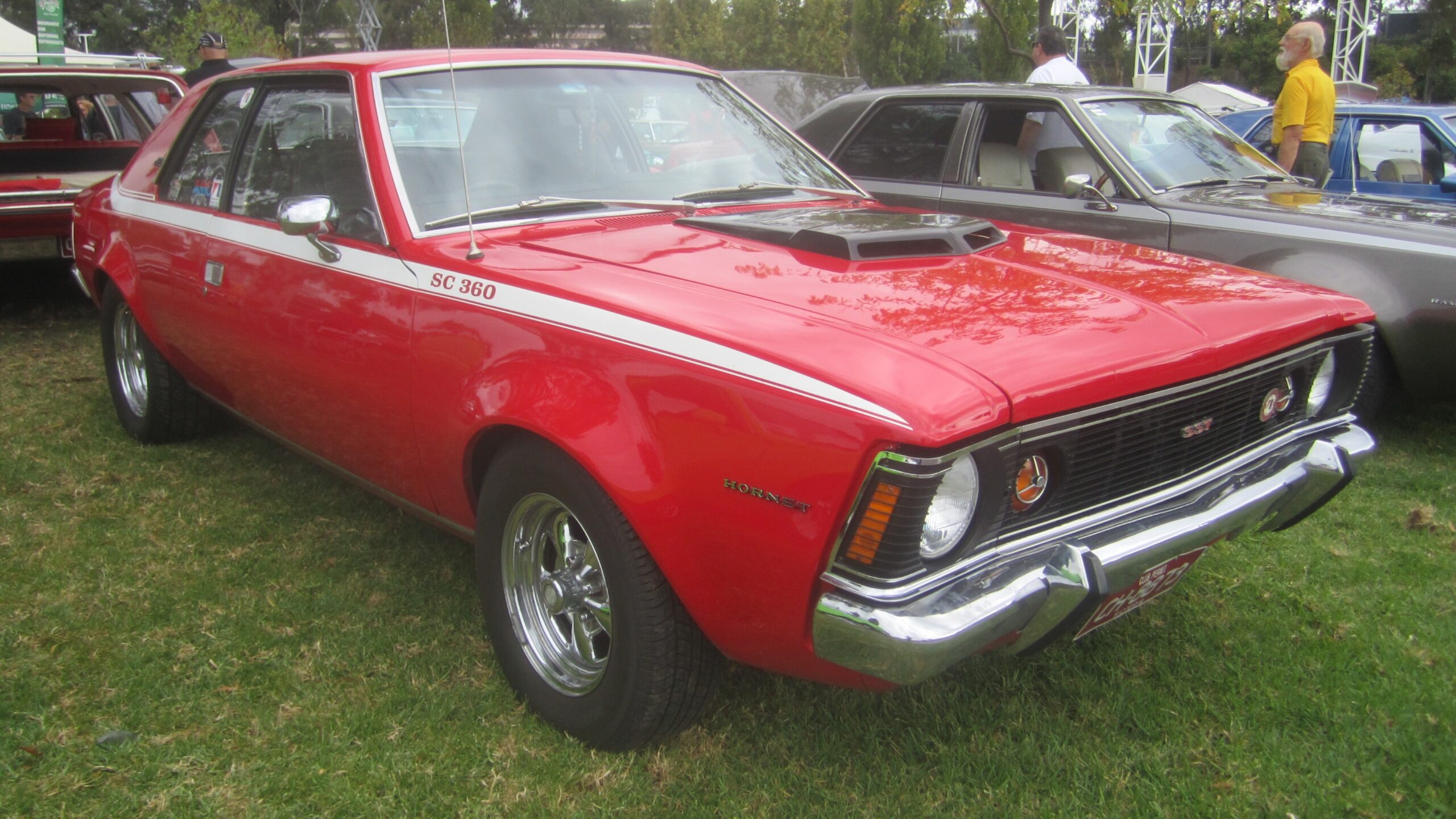
The AMC Hornet SC/360 arrived for 1971 as a compact coupe with a serious V8 and a mission to bring muscle car performance to a shrinking, insurance-conscious market. Built in small numbers and overshadowed by flashier rivals, it quietly delivered real speed and character just as the party was ending for big-block Detroit performance. Today it sits on the margins of muscle car memory, even though its numbers and road manners show it deserves a spot in the conversation.
Viewed against the backdrop of American Motors Corporation’s constant budget pressure and the tightening emissions and insurance rules of the early 1970s, the SC/360 looks less like a curiosity and more like a smart, if short-lived, response. It distilled the muscle car idea into a lighter, more efficient package without giving up the sound and feel enthusiasts wanted.
What happened
American Motors Corporation entered the 1970s as the smallest of Detroit’s major automakers, with limited cash and a reputation built more on practicality than raw performance. The Hornet compact, introduced for 1970, was meant to be a sensible, modern replacement for the Rambler American. It rode on a relatively simple unibody platform, offered four- and six-cylinder engines, and targeted buyers who valued economy and manageable size more than quarter-mile times.
Yet AMC had just experimented with a very different kind of image car. The 1969 and 1970 SC/Rambler had taken the humble Rambler American and turned it into a loud, graphics-heavy, drag strip special with a 390 cubic inch V8. That car won attention but also signaled the end of an era for full-bore compacts. Insurance surcharges on high-compression big blocks were climbing, and federal emissions rules were starting to bite. AMC needed a way to keep performance-minded buyers in the showroom without triggering the worst of those penalties.
The answer was the Hornet SC/360, a performance version of the Hornet two-door coupe built around AMC’s 360 cubic inch V8. Rather than chase the largest displacement or wildest horsepower ratings, the company chose a mid-size V8 that could be tuned for strong torque and acceptable fuel consumption. The SC/360 package combined that engine with chassis and appearance upgrades, then priced it within reach of younger buyers who were being priced out of bigger muscle cars.
In its standard form, the SC/360 used a two-barrel carburetor and a relatively mild state of tune aimed at regular fuel. Buyers who wanted more could specify a four-barrel carburetor and performance exhaust, which pushed output into territory that matched or exceeded many larger intermediates that were suddenly burdened by weight and emissions hardware. The lighter Hornet shell gave the SC/360 a favorable power-to-weight ratio, so real-world acceleration felt stronger than the raw numbers suggested.
AMC also gave the SC/360 visual cues that connected it to the outgoing muscle era. Early cars could be ordered with bold side stripes, a hood scoop, styled steel wheels, and a low stance that made the compact body look purposeful rather than purely economical. Inside, bucket seats, a floor shifter, and an available tachometer reinforced the idea that this was not just another commuter Hornet.
Production, however, stayed very limited. Contemporary accounts and later registries have long placed SC/360 output in the low thousands, with some estimates suggesting only a few hundred cars built with the hotter four-barrel configuration. The model lasted just a single model year before AMC shifted its performance focus to other projects and the Hornet line settled back into its core role as a practical compact. That short run, combined with AMC’s smaller dealer network, meant many enthusiasts never saw an SC/360 new, and fewer still had the chance to drive one.
As the decade moved on, the Hornet itself became part of a broader pattern. Several compact and mid-size sedans and coupes that once offered interesting performance editions faded into obscurity, a trend that has left cars like the SC/360 largely absent from mainstream muscle car lore. Modern roundups of forgotten 1970s sedans often group the Hornet with similarly overlooked models that once carried sporty trims but never achieved lasting fame.
Why it matters
The Hornet SC/360 matters first because of what it represented within AMC. The company did not have the resources to build a separate, exotic platform for a halo performance car. Instead, it took a mainstream compact and engineered a package that could compete with more expensive machinery while sharing most of its components with regular production Hornets. That strategy anticipated the way later manufacturers would create hot versions of everyday cars, from turbocharged hatchbacks to performance sedans that shared basic shells with fleet models.
From a performance standpoint, the SC/360 also marked a turning point. As muscle cars grew heavier and more constrained by emissions, the idea of a lighter car with a mid-size V8 and a relatively simple mechanical layout started to make more sense. The Hornet’s compact dimensions and straightforward suspension let the SC/360 feel agile on real roads, even if it lacked the sophisticated chassis tuning that would define later performance compacts. Enthusiasts who drove the car when new often remarked on its strong mid-range pull and willingness to rev, qualities that stemmed from the 360’s torque curve and the car’s modest curb weight.
In that context, the SC/360 can be seen as an early template for the idea that performance does not have to come from the largest available engine. While it still relied on a V8, it did so in a way that balanced power with size and cost. Later decades would see this philosophy expressed through smaller-displacement turbo engines and high-output fours and sixes, but the basic logic was similar. A well-tuned engine in a lighter body can deliver the thrills buyers want without the excess that regulators and insurers punish.
The car also illustrates how market timing can bury interesting ideas. By the time the SC/360 reached showrooms, public sentiment was already shifting. Concerns about fuel prices and safety were rising, and many buyers who might have chosen a performance compact a few years earlier were either moving into more practical transportation or being steered away from high-performance options by insurance agents. AMC’s limited marketing budget compounded the problem. Without a sustained advertising push or a major racing program built specifically around the SC/360, the model struggled to carve out a clear identity beyond the small circle of brand loyalists.
That obscurity has consequences for how automotive history is remembered. The muscle car story is often told through the most famous badges and the highest horsepower numbers, which naturally favors big-block Chevrolets, Fords, and Mopars. Smaller experiments from companies like AMC, even when they offered comparable real-world speed, tend to be compressed into a footnote. The SC/360 challenges that simplified narrative. It shows that innovation and enthusiasm were not confined to the largest players, and that some of the most interesting responses to changing conditions came from companies that had the least room for error.
For collectors and historians, the SC/360’s rarity and context add another layer of interest. Surviving examples provide a direct link to a moment when American performance was trying to reinvent itself under pressure. The car’s mix of bold styling, compact size, and V8 soundtrack captures a specific mood at the end of the classic muscle era, when optimism about speed met growing anxiety about regulation and cost. That tension is part of what makes the SC/360 feel relevant again as modern performance cars navigate their own transitions.
There is also a cultural angle. AMC has long attracted a devoted group of enthusiasts who value the company’s willingness to take risks with limited resources. The Hornet SC/360 fits neatly into that tradition. It was not the most powerful car of its time, and it did not dominate any particular racing series, yet it showed a kind of stubborn creativity. Faced with headwinds that might have pushed a more conservative company to abandon performance entirely, AMC tried to repackage it in a more efficient, compact form.
That approach resonates with current debates about how performance fits into a future shaped by tighter emissions rules and changing consumer expectations. The SC/360 does not offer a direct blueprint for modern engineers, but it does illustrate a mindset: accept the constraints, then look for ways to keep the experience engaging within them. In that sense, it stands as an early example of how passion for driving can survive even when the traditional formulas are under pressure.
What to watch next
Interest in cars like the Hornet SC/360 tends to move in cycles. As the most famous muscle cars climb beyond the reach of many enthusiasts, attention often shifts to overlooked models that offer similar character at a lower entry cost. The SC/360 sits squarely in that category. It combines rarity, a distinctive backstory, and genuine performance, all of which appeal to collectors who prefer something different from the usual high-profile choices.
One factor that will shape the SC/360’s future profile is how the broader market treats compact performance cars from the early 1970s. Several models from that period, once dismissed as transitional or compromised, have begun to gain respect as enthusiasts reassess their strengths. The Hornet’s clean lines, relatively light weight, and usable interior make it a practical classic, and the SC/360 package adds the kind of mechanical interest that often drives long-term appreciation.
Another angle involves the growing fascination with automotive underdogs. Stories about major manufacturers and their headline-grabbing muscle cars are well documented, but there is a rising appetite for narratives that spotlight the smaller players and their offbeat solutions. The SC/360 fits that mold perfectly. As more enthusiasts seek out cars with unique histories and limited production, the AMC badge, once a liability in the resale market, can become an asset for those who value distinction over mainstream recognition.
Preservation and restoration will also play a role. Because the SC/360 shared much of its structure and many components with regular Hornets, basic mechanical upkeep is more manageable than on some low-volume exotics. At the same time, original performance parts and cosmetic details specific to the SC/360 are scarce, which raises the stakes for accurate restorations. Cars that retain correct drivetrains, trim, and interior features are likely to attract particular attention as reference points for the model’s history.
There is a broader historical trend to watch as well. As collectors and writers continue to fill in the gaps of 1970s automotive history, models that once sat on the fringes are being pulled into a more complete picture. The Hornet SC/360 offers insight into how one company tried to reconcile performance with practicality at a difficult moment. Its story helps explain why some strategies succeeded and others faded, and it adds texture to an era that is often reduced to a simple before-and-after line around the first oil shock and emissions regulations.
More from Fast Lane Only