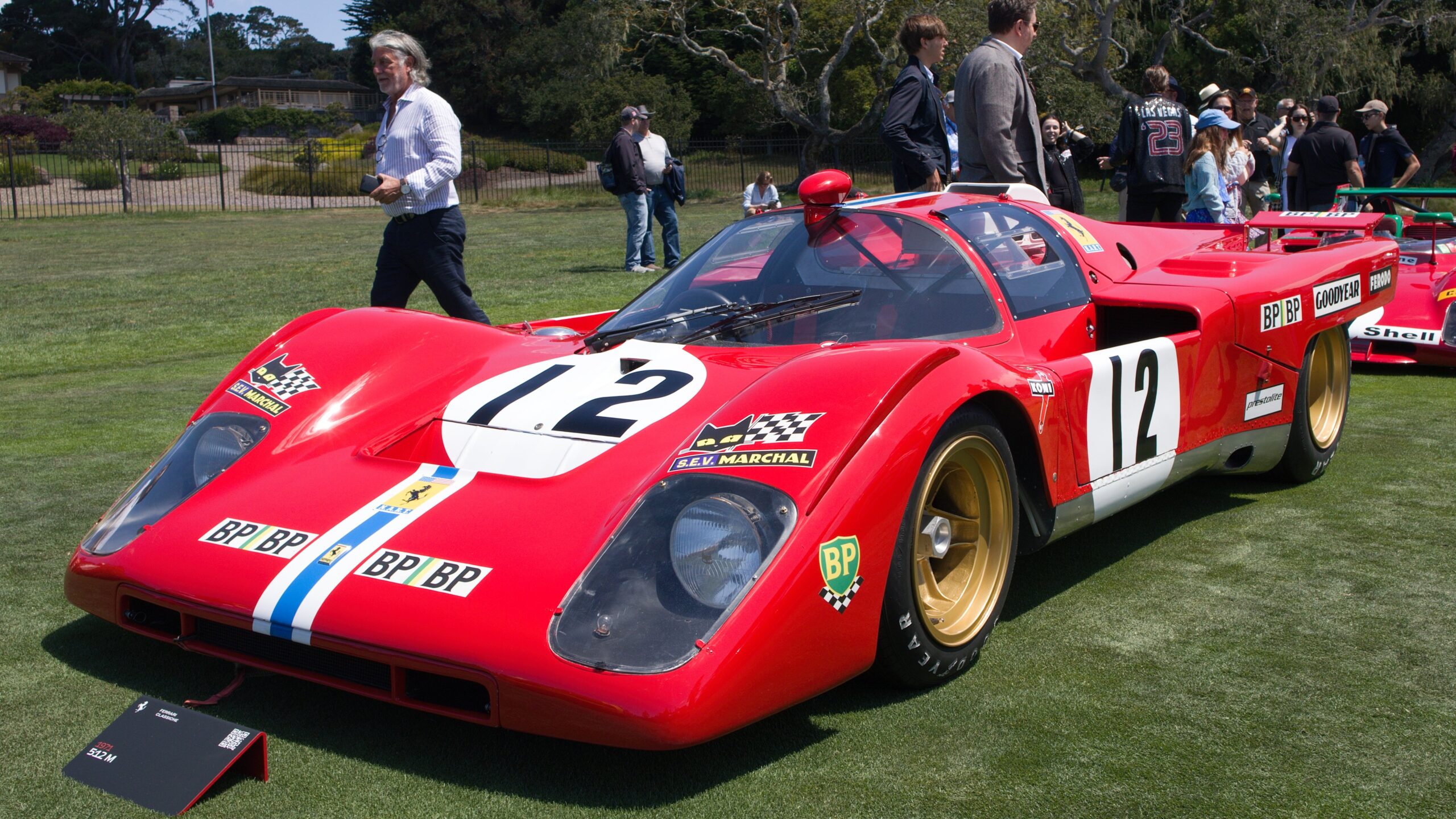
The Ferrari 512M arrived at the height of the World Sportscar Championship’s most intense era, conceived with a single purpose: to win races outright against the best from Porsche. Developed as an evolution of the earlier 512S, it sharpened the car into a lighter, cleaner, more focused machine that pushed Ferrari’s 5.0‑liter V12 to its limits. Yet despite its speed and drama, the 512M has lived in the shadow of both its rival, the Porsche 917, and Ferrari’s own road‑going legends.
Viewed today, the 512M captures a fleeting moment when endurance racing cars were brutally fast, visually outrageous, and still recognizably mechanical. It was not a styling exercise or a marketing halo car, but a weapon for the track, and its story helps explain why some of Ferrari’s purest racing creations remain relatively overlooked outside dedicated circles.
What happened
Ferrari’s 512 program began as a direct response to changes in sports car regulations that allowed large‑capacity prototypes to compete in the World Sportscar Championship. The 512S appeared first, carrying a 4,993 cc V12 and a steel spaceframe chassis wrapped in dramatic long‑tail and short‑tail bodywork. It was fast but heavy and aerodynamically troubled, and it struggled to match the pace and stability of the Porsche 917 over long distances.
Over the following months Ferrari refined the concept into the 512M, with the “M” standing for “Modificata.” The update involved far more than a cosmetic facelift. The body was reprofiled with a lower nose, cleaner tail, and a more integrated rear wing to tame high‑speed lift and improve stability on long straights. Extensive use of lighter materials and detail changes to the chassis cut weight compared with the original 512S, addressing one of the car’s key weaknesses against its German rival.
Under the rear bodywork sat a race‑bred 5.0‑liter V12 that delivered ferocious power and a soundtrack that defined Ferrari’s endurance racing era. In period trim, the engine produced well over 550 horsepower, revving past 8,000 rpm through a five‑speed gearbox and driving the rear wheels with a violence that only the bravest factory and privateer drivers could fully exploit. The 512M’s specification placed it squarely in the top tier of the World Sportscar Championship, competing for outright wins at events such as the 24 Hours of Le Mans, the 24 Hours of Daytona, and the 12 Hours of Sebring.
Ferrari’s factory focus, however, began shifting even as the 512M emerged. The company was heavily invested in Formula One and was already looking toward future sports car regulations that would favor three‑liter prototypes over the existing five‑liter monsters. As a result, the works team’s direct involvement with the 512M was relatively short, and much of the car’s racing life unfolded in the hands of private entrants. That limited window of factory support is one reason the model later slipped behind more celebrated Ferraris in the public imagination.
On track, the 512M proved that the underlying concept had real potential once properly honed. The modified aerodynamics reduced drag and improved top speed, while the lighter structure helped tire and brake life over long stints. Drivers praised the car’s more predictable high‑speed behavior compared with the 512S, a critical improvement on circuits with long straights and fast curves where the earlier car had felt nervous and prone to instability.
Despite those gains, the 512M faced a rival that had already matured. Porsche had invested heavily in the 917 program, working through its own early handling problems to create a dominant package. By the time the Ferrari 512M reached its best form, the 917 was already racking up major victories and establishing a myth that would later be amplified by film and popular culture. The Ferrari could fight, and at times match, its German opponent, but it entered the war late and with fewer resources behind it.
That imbalance shaped the 512M’s reputation. In pure performance terms, it was one of the most extreme Ferraris of its era, yet its race record did not translate into the kind of sustained dominance that tends to cement a car’s place in history. Consequently, it often appears in discussions of underrated Ferraris, admired by specialists yet unfamiliar to many casual enthusiasts who can easily name the 250 GTO or F40 but struggle to recall the 512M.
Why it matters
The 1970 Ferrari 512M matters because it represents a purer expression of Ferrari’s racing intent than many of the brand’s more famous road cars. It was not adapted from a grand tourer or styled to attract showroom traffic. Instead, it was built from the outset to chase overall victories in endurance racing, at a time when that discipline still rivaled Formula One for prestige and technical ambition. Understanding the 512M helps explain how Ferrari balanced its identity between road and race, and how that balance shifted over time.
In the broader context of motorsport history, the 512M stands at the end of an era. The five‑liter sports prototypes of the early 1970s were extraordinarily fast, with performance that in some respects outstripped contemporary Formula One machinery. Their speed, combined with relatively rudimentary safety standards, created a level of risk that regulators and manufacturers eventually judged unsustainable. When rules changed to favor smaller three‑liter cars, the 512M and its peers were rendered obsolete almost overnight, freezing them in time as artifacts of a wild, brief chapter in racing.
Because of that abrupt shift, the 512M never enjoyed the long competitive life that can turn a successful racing car into a legend. Its narrative is compressed into a narrow window, which makes it harder for casual fans to trace its impact. Yet the engineering lessons from the 512 program fed directly into Ferrari’s later sports prototypes and informed the company’s approach to aerodynamics, cooling, and high‑revving engines under sustained load. The car’s limited public profile does not reflect the depth of knowledge it generated inside the factory.
There is also a cultural dimension to why the 512M deserves more attention. The Porsche 917 has been immortalized in film and popular media, while Ferrari’s own endurance icons from other periods, such as the 330 P4 or the 250 Testa Rossa, have been celebrated through countless books, models, and restorations. The 512M, by contrast, occupies a middle ground. It lacks the romantic 1960s curves that many associate with classic Ferraris, and it never gained the pop‑culture exposure that can elevate a competition car into a household name.
Yet for those who value racing authenticity, the 512M offers something that even Ferrari’s most revered road cars cannot match. Its bodywork is dictated almost entirely by function, with a low, blunt nose, wide track, and huge rear haunches that communicate its purpose more directly than any badge. The cockpit is cramped and purposeful, framed by a roll structure and surrounded by mechanical noise. It is a machine that places the driver at the center of a complex, high‑risk environment, with little concession to comfort or style beyond what is needed to complete a long race at speed.
In that sense, the 512M helps clarify the difference between a fast Ferrari and a racing Ferrari. Modern supercars from the brand borrow design cues and marketing language from motorsport, but they are fundamentally road vehicles constrained by emissions rules, noise limits, and customer expectations. The 512M came from a period when Ferrari built cars that were almost entirely exempt from those pressures. It existed to satisfy regulations that prized speed and endurance above all else, which created a kind of engineering freedom that no longer exists in quite the same way.
The car’s relative obscurity also affects how enthusiasts and collectors think about Ferrari heritage. When attention concentrates on a small group of famous models, it can obscure the variety of approaches Ferrari has taken to racing and performance. The 512M shows that the company was willing to experiment with different chassis concepts, aerodynamic philosophies, and engine configurations within a short span of time, adjusting quickly to new rules and competitors. That adaptability is part of what kept Ferrari competitive across decades, and the 512M is a key piece of that story.
From a modern perspective, the 512M’s underappreciated status has another consequence. It slightly softens the glare that surrounds more iconic Ferraris, allowing a clearer look at how the company’s racing department actually operated. Without the weight of myth that clings to models like the 250 GTO, the 512M can be examined more objectively, as a tool designed for a specific task, with strengths, weaknesses, and compromises that reflect the realities of its time. That makes it valuable not only as an object of fascination, but as a case study in how top‑level racing programs evolve.
What to watch next
Interest in historic racing has grown steadily, and that trend has begun to lift lesser‑known competition cars into the spotlight. The 512M is well placed to benefit from that shift. As organizers expand grids for classic endurance events and high‑profile demonstrations, there is more room for cars that were once overshadowed by a handful of headline names. When a 512M appears at such events, its raw presence and sound often surprise spectators who expected something more familiar from Ferrari’s back catalog.
Collectors and restorers are also re‑evaluating models that combine clear racing pedigree with relatively small production numbers. The 512M fits that profile, which suggests that surviving examples are likely to attract increasing attention as enthusiasts seek alternatives to the most obvious blue‑chip Ferraris. That process can reshape how the market values different branches of Ferrari history, shifting some focus away from road‑car icons toward pure competition machines.
On the cultural side, the way Ferrari’s story is told in books, documentaries, and museum exhibits is gradually broadening. As more detailed histories of sports car racing reach wider audiences, the 512M’s role in the battle with Porsche gains context. Viewers who once saw the early 1970s as a one‑sided era of 917 dominance are now more likely to encounter the Ferrari response, including the technical upgrades that turned the 512S into the 512M and the tactical choices that shaped its limited factory campaign.
That shift in storytelling matters because it influences which cars future generations view as significant. If the 512M continues to appear in curated displays, historic race entries, and specialist coverage, its reputation will likely grow. As that happens, the model may move from “overlooked” status into a more widely recognized symbol of Ferrari’s commitment to racing at any cost, even in programs that did not deliver long strings of trophies.
There is also a broader lesson for how enthusiasts think about performance heritage. The 512M shows that some of the most interesting cars in a manufacturer’s history are not always the ones that won the most races or sold the most road‑going copies. Sometimes the most revealing machines are those that sat at the edge of a regulatory or technological shift, capturing a moment when priorities changed and old formulas were pushed to their limits one last time.
More from Fast Lane Only