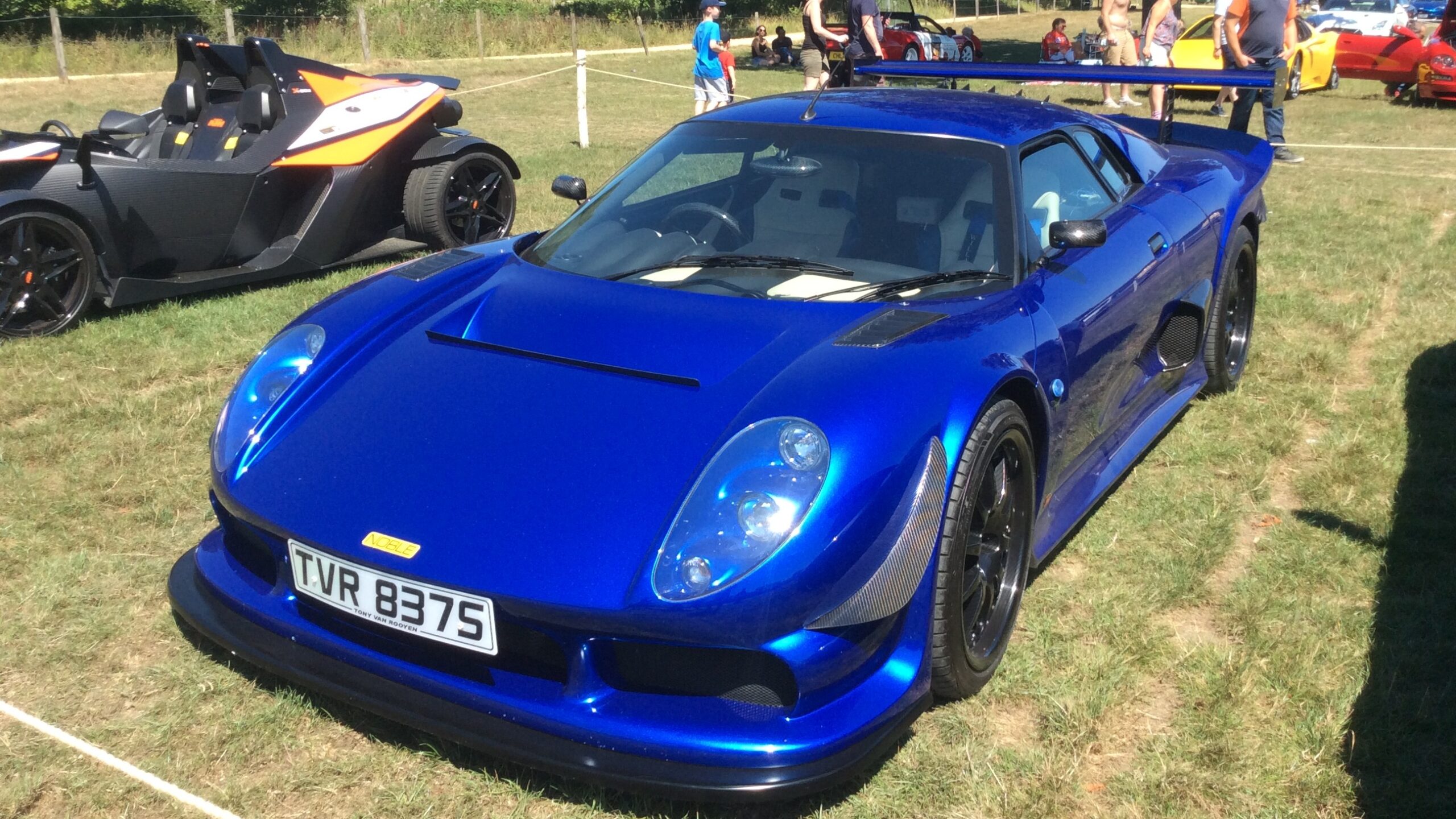
Among early-2000s analog supercars, the 2004 Noble M12 tends to sit in the shadows of more famous Italian and German badges. Yet this compact British coupe, built around a twin-turbocharged V6 and obsessive weight savings, delivered performance that could embarrass far pricier machinery of its era. For enthusiasts who care more about lap times and steering feel than badge prestige, the M12 deserves far more attention than it usually gets.
Viewed today, the car looks like a blueprint for the modern track-focused exotic: modest power on paper, very little mass, and a chassis tuned for driver feedback above everything else. Crucially, the Noble arrived before that formula became fashionable, which helps explain why it slipped past so many buyers at the time.
Compact supercar with race-car priorities
The 2004 Noble M12 was conceived as a purpose-built driver’s car rather than a luxury object. Its basic layout was a mid-mounted V6, rear-wheel drive, and a compact two-seat body that kept overall size and weight in check. Instead of chasing headline-grabbing horsepower figures, Noble focused on the relationship between power and mass, then tuned the suspension and aerodynamics to make sure every bit of that output could be used.
At the heart of the M12 sat a twin-turbocharged V6 derived from a production engine, tuned specifically for strong midrange torque and quick response rather than a peaky top-end rush. This engine was paired with a manual gearbox that reinforced the car’s analog character and gave the driver direct control over every shift. Together they delivered acceleration that, in period tests, put the M12 in the same league as contemporary supercars that carried much bigger engines and far more marketing muscle.
The bodywork was shaped with track performance in mind. Large side intakes fed the intercoolers and engine bay, while the front splitter, rear wing, and underbody were designed to add stability at speed rather than simply look aggressive. Inside, the cabin was intentionally simple, with supportive seats and a straightforward dashboard that prioritized clear instruments over ornamentation. Noise insulation was minimal, so the driver heard the turbos whistle and the V6 work, an experience that many modern cars filter out.
Engineering the twin-turbo V6
The twin-turbocharged V6 defined the M12’s character. Rather than building an exotic powerplant from scratch, Noble’s engineers started with a proven production engine and reworked it extensively. The result was a compact, relatively light unit that could handle significant boost pressure while remaining tractable in everyday driving. Twin turbochargers helped reduce lag, so the engine responded quickly when the driver rolled onto the throttle, something that mattered as much on a tight circuit as it did on a back road.
Cooling and reliability were central concerns. The mid-engine layout concentrated heat in a small area, so the car used carefully routed ducting and intercoolers to keep intake temperatures under control. Oil and coolant systems were upgraded to handle extended high-load running, which made the M12 suitable for track days without extensive modification. Exhaust routing and turbo placement were chosen not only for performance but also for service access, a practical consideration that many low-volume sports cars overlook.
Power delivery was tuned to complement the chassis. Instead of a sudden spike in boost, the engine built torque progressively, which allowed the rear tires to maintain grip as the driver fed in throttle. This approach reduced the likelihood of sudden oversteer on corner exit and made the car feel more predictable at the limit. The manual transmission’s ratios were chosen to keep the engine in its most responsive range, so each upshift dropped revs into a band where the turbos were already awake.
Serious performance in a small package
Performance figures for the 2004 Noble M12 put its capabilities into sharp focus. With a curb weight that undercut many rivals by several hundred pounds, the car did not need supercar-level horsepower to achieve supercar-level acceleration. Contemporary testing recorded extremely quick sprints to highway speeds and strong in-gear acceleration that reflected the engine’s torque-rich character rather than just its peak output.
On a circuit, the M12 truly distinguished itself. Its low weight, wide track, and carefully tuned suspension gave it high cornering limits and a neutral balance that encouraged committed driving. Steering feedback was a standout trait, with the front end communicating grip levels clearly enough that experienced drivers could place the car with confidence. Braking performance matched the chassis, with large discs and multi-piston calipers working in concert with sticky tires to deliver short stopping distances and consistent performance over multiple hard laps.
The M12’s lap times at various tracks compared favorably with more powerful cars from the same period. That outcome reflected the classic performance equation: less mass, strong but not excessive power, and a chassis that allowed the driver to exploit both. In an era when some supercars were becoming heavier and more insulated, the Noble took the opposite route and prioritized agility and feel.
GTO-3R: the sharpened evolution
The 2004 model year saw the M12 GTO-3R, a refined and sharpened evolution of the earlier versions. Power from the twin-turbo V6 was increased, and the car received suspension and aerodynamic tweaks that improved both stability and responsiveness. The GTO-3R also incorporated incremental updates to interior trim and ergonomics, which made it slightly more livable without diluting its focused nature.
Details such as wheel design, tire specification, and brake hardware reflected the GTO-3R’s track bias. Wider rubber improved mechanical grip, and revised damper and spring rates helped the car stay composed over curbing and mid-corner bumps. Owners who used their cars for regular circuit work reported that the GTO-3R felt more planted at speed and more precise on turn-in than earlier iterations.
A detailed look at a well-preserved example, described in a feature on a 2004 Noble M12, highlights how the GTO-3R combined its mechanical upgrades with subtle cosmetic changes. The car’s compact dimensions remained, but small adjustments to bodywork and stance gave it a more purposeful appearance. Inside, the layout still favored function over luxury, yet the materials and fit showed clear progress from the earliest cars.
Driving experience: raw, direct, and demanding
The way the Noble M12 drove is a major reason enthusiasts still speak of it with respect. Everything about the car pushed the driver into an active role. The steering was quick and unfiltered, the brake pedal firm, and the clutch and shifter required deliberate inputs. There were no electronic driver aids to mask mistakes or smooth over poor technique, which meant the car rewarded skill and punished carelessness.
On a twisting road, the M12 felt alert and eager to change direction. The mid-engine layout helped the car rotate into corners, while the rear tires dug in under power as the turbos came on song. Body roll was minimal, and the chassis communicated weight transfer with unusual clarity. Drivers who preferred a more relaxed, insulated experience often found the Noble too intense, but those who valued connection over comfort considered that intensity the whole point.
Noise, vibration, and harshness levels were high by modern standards. The engine and transmission sent a constant stream of mechanical information into the cabin, and road noise from the wide tires was always present. For many owners, those traits enhanced the sense of occasion. The car felt like a track machine that had been made barely civil enough for public roads rather than a road car that happened to be quick on a circuit.
Why such a capable car stayed under the radar
Given its performance, the Noble M12 might be expected to enjoy the same recognition as contemporary Ferraris or Porsches. Instead, it remained a niche choice. Several factors contributed to that relative obscurity. Production numbers were low, which limited visibility and meant few people saw the car in person. Distribution was also limited, particularly outside the United Kingdom, so potential buyers in large markets had fewer opportunities to test or purchase one.
Brand recognition played a major role. Noble was a young company without the decades of racing history or glamorous marketing associated with established supercar makers. For buyers who viewed an exotic car as a status symbol as much as a driving tool, that lack of heritage made the M12 a harder sell. The car’s minimalist interior and limited comfort features further narrowed its appeal to those who prioritized pure performance over daily usability.
Regulatory and homologation challenges also shaped its footprint. Meeting safety and emissions standards in multiple regions is expensive for a small manufacturer, and those costs can restrict how many cars reach certain markets. As a result, the M12 remained a rare sight on roads and at track days, which in turn kept it out of the mainstream conversation about early-2000s performance icons.
Collector interest and current perception
Over time, the Noble M12 has begun to attract more attention from enthusiasts who value analog driving experiences. The car represents a specific moment when supercars were fast enough to be thrilling yet simple enough that a skilled driver could understand and manage their limits without layers of electronics. That combination has become rarer as newer models add power, weight, and digital systems.
Collectors who seek something different from the usual Italian or German options are increasingly looking at low-volume British machines like the M12. Its rarity, combined with documented performance credentials, gives it a certain appeal as a future classic. Well-maintained examples, particularly the GTO-3R variant, are often treated as prized possessions rather than disposable track toys, which helps preserve their condition and long-term value.
At the same time, the car’s relative obscurity keeps prices from reaching the stratospheric levels associated with more famous badges. For drivers who want a genuine, track-capable exotic without paying a premium for brand image, that dynamic makes the Noble an intriguing proposition. The trade-off is that parts sourcing and specialist support can be more challenging than for mass-produced sports cars, which means ownership suits those willing to invest time and effort into maintenance.
How it stacks up against modern performance cars
Comparing the 2004 Noble M12 to modern performance cars reveals both how far technology has come and how focused the Noble already was. Many current supercars offer significantly more power, advanced dual-clutch transmissions, and sophisticated stability systems that allow astonishing speed with relatively little effort from the driver. They are also typically heavier, more complex, and far more insulated.
In raw acceleration, a present-day all-wheel-drive supercar with several hundred extra horsepower will often pull ahead, especially from a standing start. Even so, the Noble’s light weight and mechanical grip still make it competitive in real-world driving and on tighter circuits where agility matters more than sheer power. The level of feedback through the controls, something that modern electric power steering and heavy sound insulation often reduce, remains a strong point in the M12’s favor.
From a usability standpoint, the Noble cannot match the comfort, refinement, or safety tech of newer cars. Modern exotics offer advanced driver aids, adjustable suspension modes, and climate-controlled cabins that make long trips easy. The M12, by contrast, feels like a focused instrument that asks for commitment every time it is driven. For some enthusiasts, that trade-off is exactly what makes it special.
More from Fast Lane Only
- Unboxing the WWII Jeep in a Crate
- 15 rare Chevys collectors are quietly buying
- 10 underrated V8s still worth hunting down
- Police notice this before you even roll window down
*Research for this article included AI assistance, with all final content reviewed by human editors.