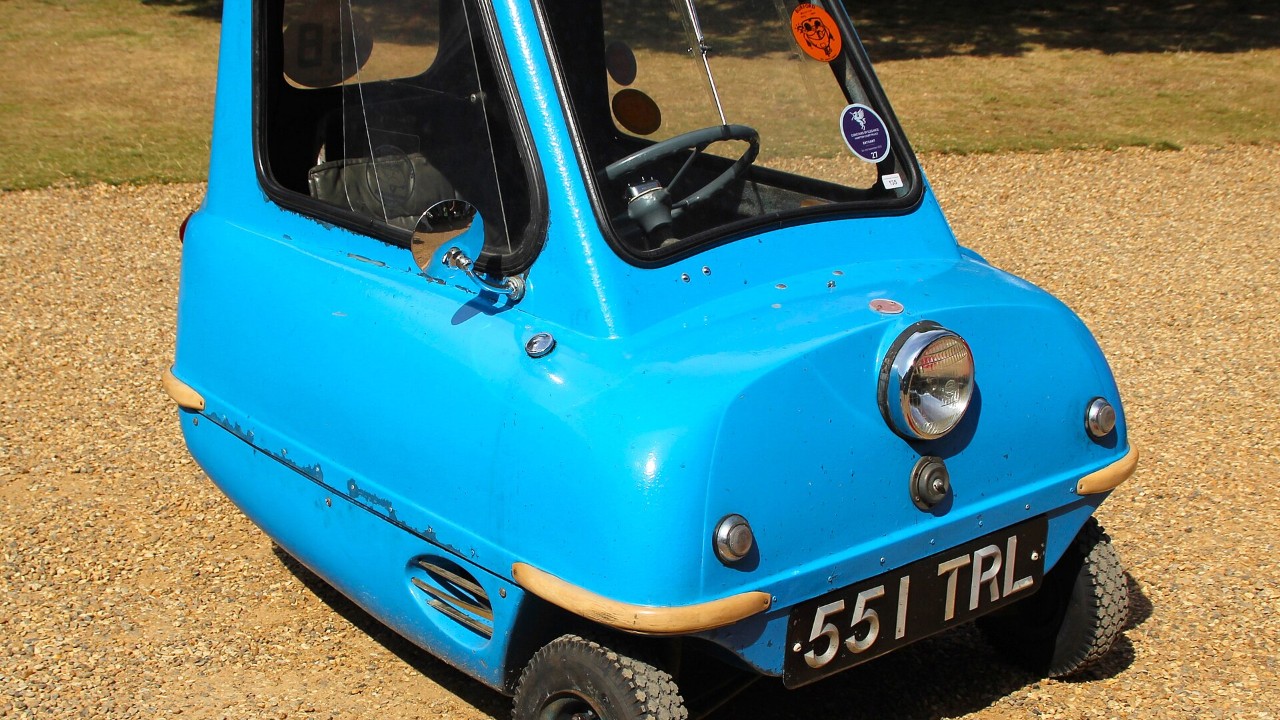
The Peel P50 has one door, one headlight and one windscreen wiper. According to the company that builds it today, Guinness World Records lists it as the smallest production car ever made. The original also has no reverse gear. Instead, the driver climbs out, grabs a handle on the back and swings the car around by hand.
That sounds like a joke, but it was a real answer to a real problem. In the early 1960s, a tiny firm on the Isle of Man set out to build the least car a person could commute in. The result weighed about 130 pounds and rode on three tiny wheels.
Here is where the little car came from, what powered it, how many were built and why one changed hands twice for six figures.
Where the Peel P50 came from
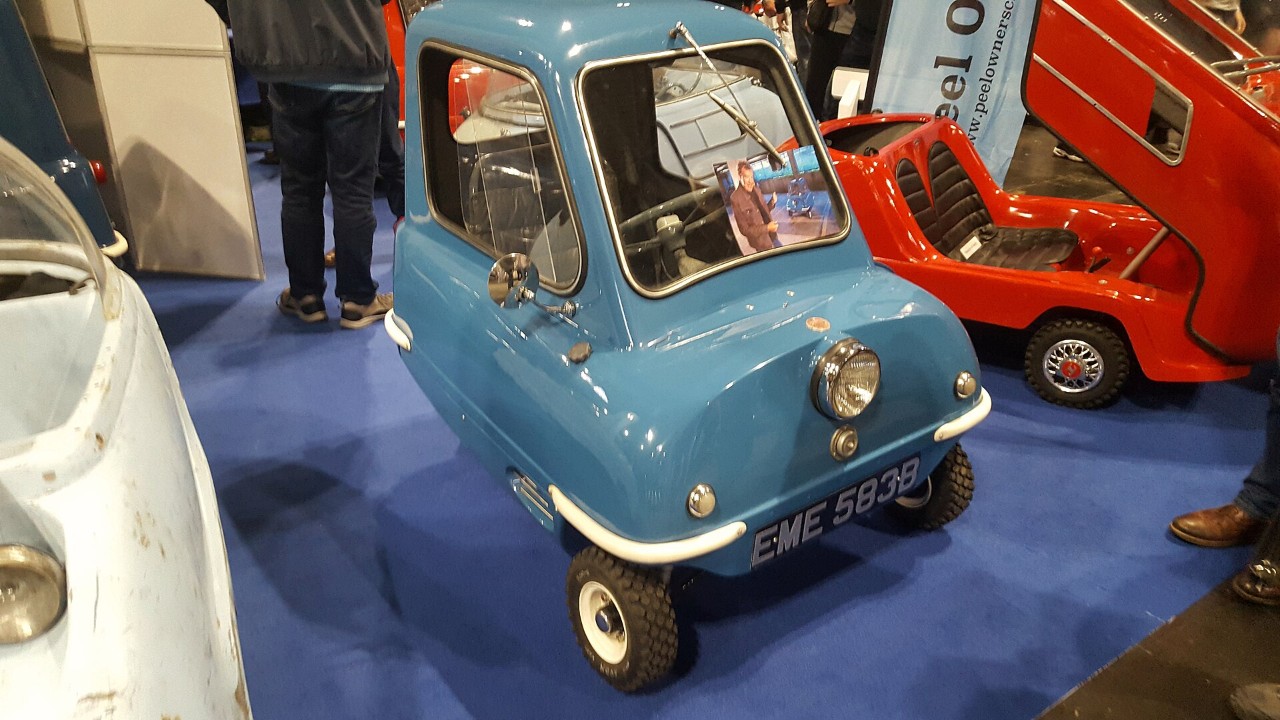
RM Sotheby’s lists the maker as Peel Engineering Co. of Peel, on the Isle of Man. According to the classic marketplace Car & Classic, Cyril Cannell founded the company in the late 1940s. Cannell saw the P50 as a commuter vehicle, CTV News reported in 2016.
The car started as an experiment in how small a car could get. In its 2013 catalog description, RM Sotheby’s says the first version was “originally nothing more than a fiberglass box on wheels.” In fact, it had no engine at all when Peel showed it at the 1962 Cycle and Motorcycle Show at Earls Court in London. However, the publicity was enough to turn the box into a product.
The production car changed one key detail. RM Sotheby’s notes that it “now had two wheels in the front and one driven wheel in the rear.” The auction house also claims Peel built the only cars ever to come from the Isle of Man, an island between England and Ireland.
A 49cc engine and a handle instead of reverse
Power came from a motorcycle-sized engine. RM Sotheby’s lists a 49cc two-stroke single-cylinder Zweirad-Union engine rated at 4.5 horsepower. By comparison, Car & Classic gives 4.2 horsepower at 6,600 rpm for the same DKW-family motor. Either way, a three-speed manual gearbox sent that power to the single rear wheel.
There was no reverse, so Peel fitted a handle at the rear. As the current Peel Engineering site puts it, the handle lets the owner move the car by hand. That was easy enough, because the company lists the P50 at just 59 kg, or 130 pounds. RM Sotheby’s joked in 2013 that “it is impossible to complain about the lack of a reverse gear” on a car you can simply pick up and turn.
The rest of the car was just as small. For example, Peel Engineering gives the length as 54 inches and the width as 39 inches. Meanwhile, the period advertising promised room for “one adult and a shopping bag,” according to the same site. The single door sits on the left side, and buyers could pick Daytona White, Dragon Red or Dark Blue.
How fast and how frugal the Peel P50 was
Nobody bought one for speed. Car & Classic puts the original top speed at 38 to 40 mph, while CTV News quoted up to 61 km/h. Car & Classic also notes that Peel never published any acceleration figures.
Fuel economy was the real selling point. RM Sotheby’s lists the P50 at 100 miles per gallon. The car was also sold as “almost cheaper than walking,” a line both RM Sotheby’s and CTV News repeat. Its price fit that pitch, too. RM Sotheby’s gives the price new as “a minimal cost of £199,” and Car & Classic puts the range at £199 to £299.
Safety, on the other hand, was close to nonexistent. Car & Classic says the original had no meaningful crash protection. Even so, it was road-legal under the British rules of the day.
How many were built, and how many survive
The production numbers depend on who you ask. The Peel Engineering site says the company “produced 50 P50s and only 27 are known to still exist.” RM Sotheby’s catalogs, however, say only 47 originals were made and 26 survive. Car & Classic gives a run of roughly 50 cars, built from 1962 to 1965.
Whatever the exact count, the survivors are now famous. Jeremy Clarkson introduced a P50 in the 10th series of Top Gear, RM Sotheby’s notes. Then, in the episode, he drove it through the BBC’s Television Centre, according to Peel Engineering. The company claims the segment ranks among the five most watched in the show’s history.
The Peel P50 returns, this time with reverse
The name came back decades later. Peel Engineering says co-owners Gary Hillman and Faizal Khan took the car to the BBC show Dragons’ Den in 2010 and won investment. Car & Classic dates the revival to 2011. Either way, the new cars are hand-built to order in the UK in petrol and electric versions.
The continuation cars fix the one quirk everyone remembers. According to Car & Classic’s buyer guide, they have a reverse gear, unlike the originals. The electric version uses a 2 kW motor with a top speed of 25 to 28 mph, the same guide says. In 2016, CTV News put the price of a replica at roughly US$25,000.
What an original sells for now
Original cars, however, cost far more. In 2013, RM Sotheby’s sold a red 1964 Peel P50, ID number D535, at the Bruce Weiner Microcar Museum sale in Madison, Georgia. It brought $120,750. The museum’s team had restored it with new Plexiglas windows and replated chrome.
The same car came back three years later. According to RM Sotheby’s results, chassis D535 sold for $176,000 at Amelia Island in 2016. As CTV News pointed out, that was nearly double the pre-sale estimate of about US$100,000 for a car that originally cost £199.
More from Fast Lane Only