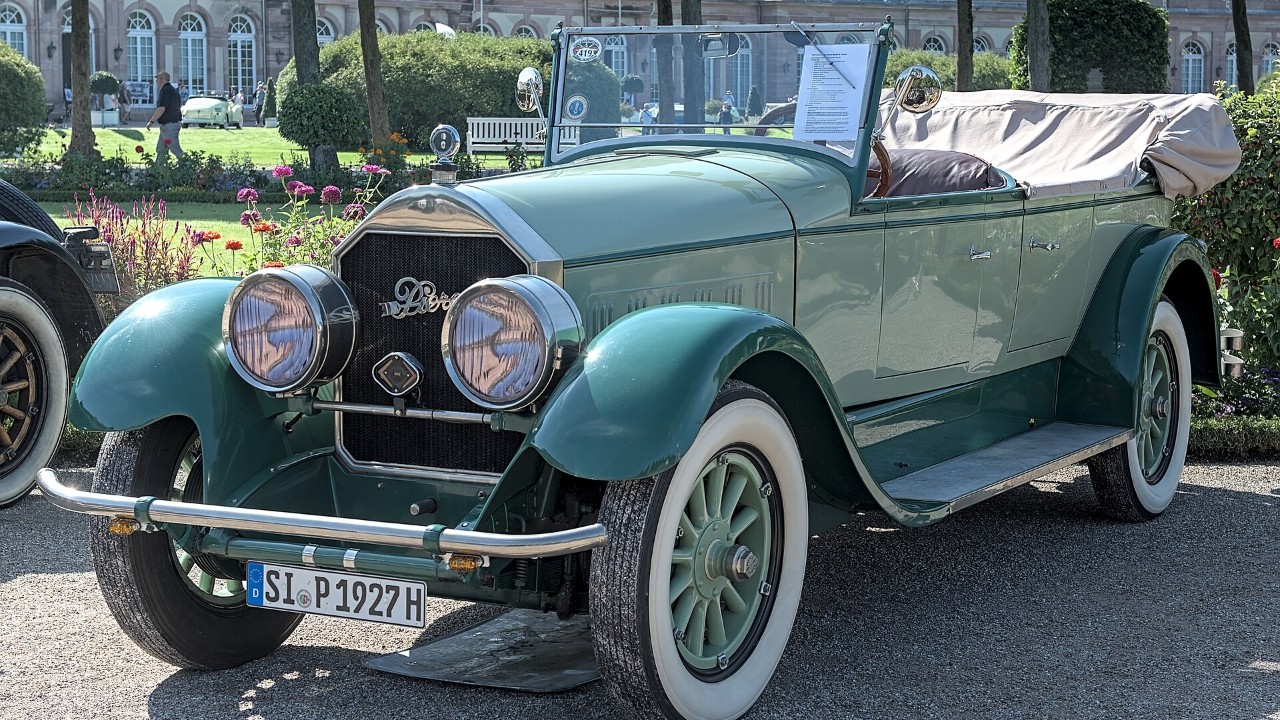
Pierce-Arrow headlights sit in the tops of the front fenders, and that one design choice became the Buffalo company’s trademark. The company introduced the fender lamps in 1913. Its designer, Herbert M. Dawley, patented the idea and wrote down exactly why he did it.
His reason was practical, not just stylish. In short, he believed lamps mounted out on the fenders lit more of the road, farther ahead and wider, and helped in turns.
That said, the story has a twist. For years, buyers in Pierce-Arrow’s own home state could not legally have the feature. Here is how the lamps came about, what the patent claimed, and what happened to cars that went without them.
What Pierce-Arrow was by 1913
Pierce-Arrow did not start with cars. George N. Pierce began as a partner in Heintz, Pierce and Munschauer, a Buffalo, New York, firm that made bird cages. After he bought out his partners in 1872, he renamed the company for himself and moved into bicycles. Then, in 1900, he built a steam car.
A gasoline car was running by that November, and the DeDion-engined Motorette followed in 1901. Next, the four-cylinder Great Arrow arrived in 1904. Pierce’s son Percy drove one in the first Glidden Tour in 1905 and won the reliability contest. The name “Arrow” stuck so firmly that the company became Pierce-Arrow in 1909.
By then, Pierce-Arrows sold for $3,050 to $7,200, according to an RM Sotheby’s catalogue history. As a result, the brand joined Packard and Peerless as the “Three Ps” of American luxury cars. The Collings Foundation adds that Pierce-Arrow had built its 12,000th car by 1915.
Herbert Dawley’s patent and the Pierce-Arrow headlights
The years 1911 and 1912 were largely carryovers. However, 1913 brought the fender-mounted headlamps, according to RM Sotheby’s. The Collings Foundation also gives 1913 as the year of introduction. In addition, it says the design came from inside the company and that Herbert M. Dawley held the patent.
Dawley worked with Pierce from 1912 until the end, and he also ran his own film production company. In his patent application, he wrote that the lamps “illuminate[d] the road for a greater distance and to a greater width.” He also claimed they gave “much better advantage in turning.” Those quotes come from RM Sotheby’s catalogue for a 1915 Model 66-A-3.
In other words, the case for the design was about light on the road. Dawley’s argument, as quoted, was that lamps set out on the fenders spread the beam wider and threw it farther. He also said they worked better when the car turned.
Dawley also shaped the bodies themselves. According to a separate RM Sotheby’s listing for a 1927 Series 80, he handled body design within Pierce-Arrow. That listing describes his 1913 patent as “the headlights faired into the tops of the front fenders.”
Not every buyer could have them
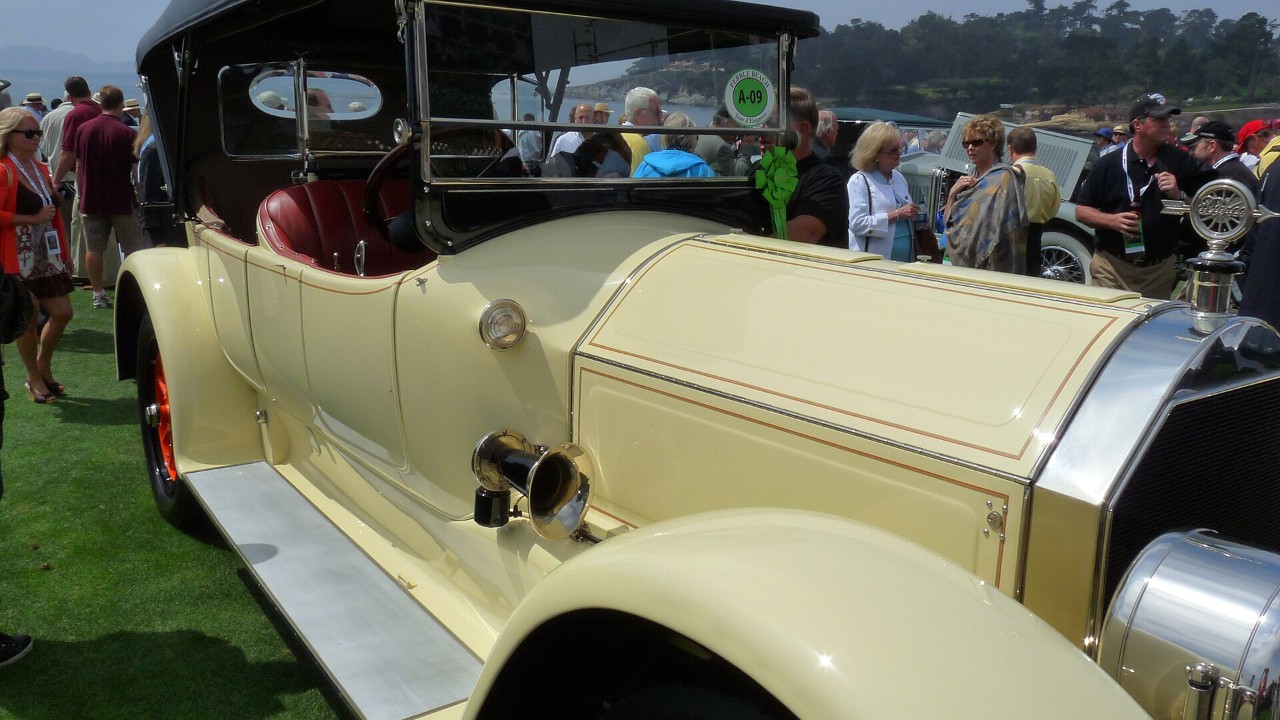
Pierce-Arrow never forced the look on anyone. Customers could order conventional lights instead, RM Sotheby’s notes, and some jurisdictions actually forbade the new type. Still, most buyers treated the fender lamps as a high-profile prestige feature.
The biggest exception was close to home. RM Sotheby’s says cars ordered in New York needed freestanding “New York” headlamps. That was because, for many years, the company’s famed fender lights were illegal in its home state. Conservative customers elsewhere also ordered the freestanding lamps by choice.
Meanwhile, the Collings Foundation says the drum headlamps stayed an option through 1932. In fact, the 1927 RM listing says the freestanding lamps are rarely seen on surviving cars.
How the fender lamps became a trademark
Over time, the Pierce-Arrow headlights turned into the brand’s signature. RM Sotheby’s calls them the feature “that would come to be Pierce-Arrow’s trademark.” It also says most later Pierce-Arrows came with the treatment. Similarly, the Collings Foundation calls the fender headlamp “the most famous Pierce-Arrow feature.”
The rest of the car was not always so forward-looking. For example, RM Sotheby’s points out that the company kept right-hand steering until 1920. By contrast, its engineering leaned on big, smooth sixes and cast aluminum bodies. Pierce-Arrow worked with its Buffalo neighbor, the Aluminum Company of America, on that casting work.
The cars around the lamps could be huge, too. The 1915 Model 66-A-3 that RM offered used an 824.7-cubic-inch T-head six on a 147.5-inch wheelbase. Even so, the catalogue says Dawley’s headlights are the first thing one notices. Later, according to the Collings Foundation, Pierce-Arrow merged with Studebaker in 1928.
What a car without them brought
Ironically, RM Sotheby’s calls a Pierce-Arrow without fender lamps an extremely rare sight today. The 1927 Series 80 Four-Passenger Touring that RM offered wore freestanding “New York” headlamps. It used a 70 bhp, 288.5-cubic-inch inline six with a four-speed manual and a 130-inch wheelbase.
Pierce-Arrow first offered the Model 80 in 1924 as a smaller, owner-driver companion to its bigger six. That 1927 touring car sold for $60,500 as Lot 131 at RM Sotheby’s Motor City sale in 2016.
More from Fast Lane Only
- Unboxing the WWII Jeep in a Crate
- 15 rare Chevys collectors are quietly buying
- 10 underrated V8s still worth hunting down
- Police notice this before you even roll window down
This article was created with the help of AI and was reviewed and edited by Fast Lane Only editors before publication.