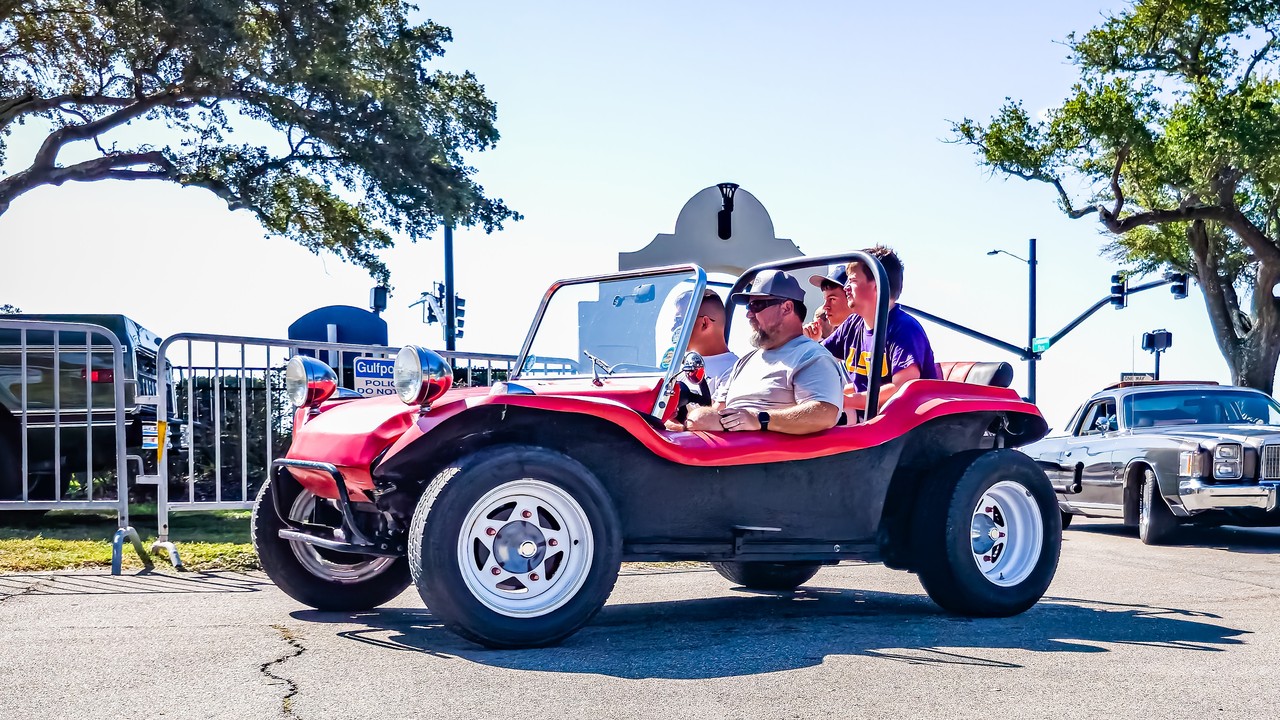
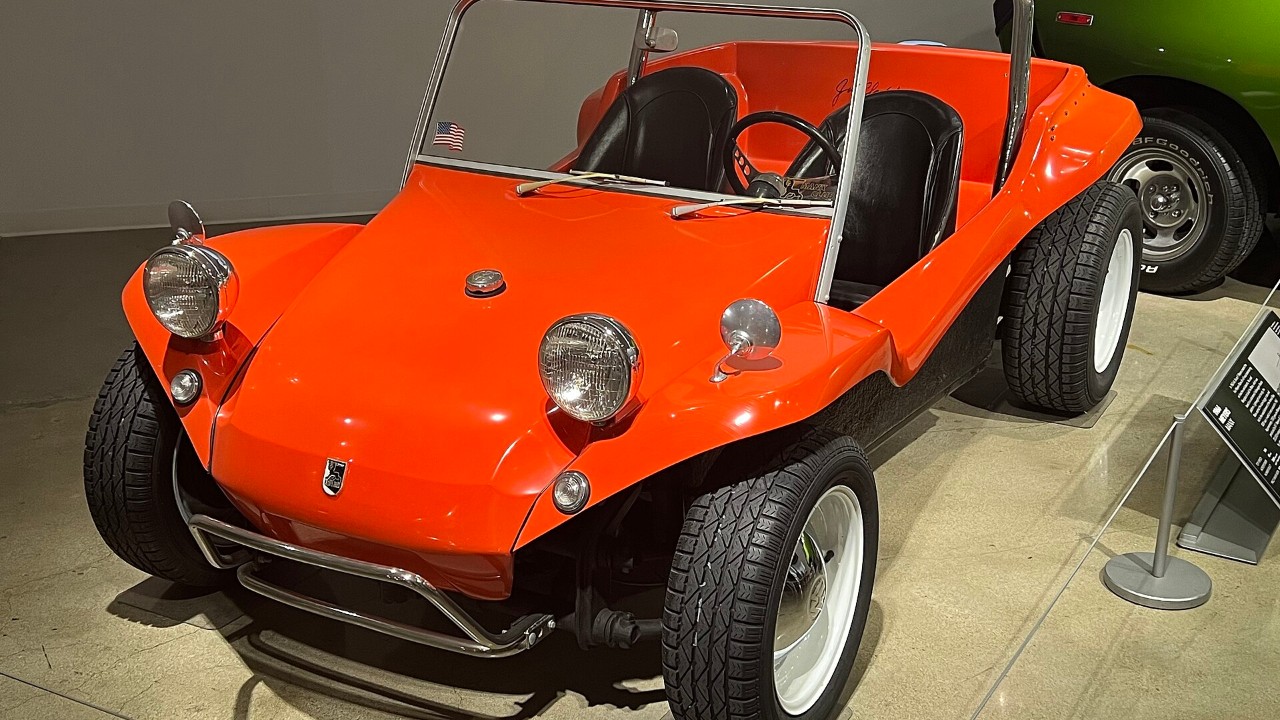
The Thomas Crown Affair dune buggy began life as a Meyers Manx, the fiberglass buggy that sat on a Volkswagen chassis. For the 1968 film, though, Con-Ferr Products of Burbank, California, built it up for Steve McQueen. The result, known as the Queen Manx, carried its biggest change out back: a Chevrolet Corvair flat-six in place of the usual VW four.
McQueen played Thomas Crown, a bored millionaire who masterminds a bank heist. Faye Dunaway played the insurance investigator sent after him. Their beach ride in the red buggy is a highlight of the film for car fans. It also shows a Southern California off-road toy in the hands of a Hollywood star.
The car itself then vanished for decades. It went to Hawaii, raced on dirt, lost its engine and sat in storage, before a long restoration brought it back to the way it looked on screen.
Why the Thomas Crown Affair dune buggy was a Manx
The script did not start with a buggy. According to Hagerty’s 2020 history of the car by Matt Stone, it originally called for a Jeep. McQueen preferred a Meyers Manx after he saw one on a 1966 cover of Hot Rod magazine.
That was a fresh idea at the time. Bruce Meyers built his first prototype in a rented garage in Newport Beach in 1963 and began selling Manx kits in 1964, according to Hagerty’s profile of Meyers and his company. Meyers found that the fiberglass body was stout enough to work as a monocoque chassis. He also cut more than a foot from the Volkswagen wheelbase.
The Manx then proved itself the hard way. In 1967, Meyers’ first prototype, known as Old Red, beat the Tijuana-to-La Paz motorcycle record by nearly five hours. Two months later, another Manx won the first Mexican 1000 rally. The original run eventually shipped nearly 7,000 kits, Hagerty reports.
What Con-Ferr changed to create the Queen Manx
McQueen took the project to Con-Ferr, an off-road accessory company in Burbank led by Pete Condos. The two men knew each other through off-road racing, according to Hagerty’s 2018 report on the car’s rediscovery. Condos also co-owned the National Off-Road Racing Association, which ran desert races in Las Vegas and Baja California.
McQueen asked for a buggy that was unique and more fun to drive. As a result, Con-Ferr gave it custom headlights, extended side pods, a low speedster windshield and custom upholstery. Fox News’ 2018 report adds chrome racks and bumpers and a Naugahyde-trimmed interior. The finished car soon became known simply as the Queen Manx.
The engine was the real headline. Instead of the Volkswagen flat-four, Con-Ferr fitted a larger, more powerful Chevrolet Corvair flat-six. Like the VW engine, it was air-cooled, so it suited the rear-engine layout. Stone puts the original at 2.7 liters. McQueen claimed it made about 230 horsepower. However, Stone calls that figure “pure fantasy” and estimates that a period Corvair six made perhaps 175 horsepower.
On the beach with Faye Dunaway
The buggy appears in the film’s quick-cut trailer, with McQueen at the wheel and Dunaway in the passenger seat. Fox News reports that the scene was shot on a Massachusetts beach. Years later, sand still trapped in the car traced it to Crane Beach.
The car also left a mark on the buggy business. According to Hagerty, Universal Fiberglass of Scarborough, Ontario, later made Hunter buggy bodies with similar headlights set into the hood, inspired by the film’s popularity.
Despite that, the Queen Manx never became as famous as McQueen’s Bullitt Mustang. For some enthusiasts, though, the red buggy matters just as much, because it shows McQueen’s own taste at work.
From United Artists to Hawaii dirt tracks
After filming on the East Coast, United Artists shipped the car to California and stored it. At the time, movie cars were not yet a serious collectible, Fox News notes. So the buggy sat as an old prop.
Then Jimmy Pflueger, a Hawaii businessman and Manx dealer, called the studio and made an offer. The car flew to Hawaii on a Pan Am flight. Pflueger’s mechanic, Lance Richards, then prepared it for dirt-track racing. The Corvair engine and its re-geared VW transaxle came out, and a 2,180cc Volkswagen race engine went in, according to both Hagerty and Fox News. By Pflueger’s account, the buggy won its first race and most of the races after that.
Someone later added turn signals and swapped the low windshield for a flat one. In 1997, the current owner traded a freshly restored 1966 Mini Cooper S and a shotgun for the car, Hagerty reports. He then put it into storage for about 20 years. That chain of owners, Stone notes, rules out the old legend that McQueen kept the buggy after filming.
Restored to Corvair power
The film’s 50th anniversary gave the restoration new momentum. Bruce Meyers saw the car in person and helped confirm it as the film car, according to Hagerty. Pete Condos also took part. Pflueger, who died in 2017, helped piece together the timeline before his death.
Fortunately, the custom dash and gas tank had survived, along with other parts that would have been hardest to replace. The car was fully taken apart for what Stone describes as a “platinum-level concours restoration.” The restorers refit the chassis with an original-spec Corvair six and a fresh VW transaxle, then replated the chrome. They also kept the original instruments and a 1967 registration sticker, the details that tie the Thomas Crown Affair dune buggy to the car McQueen drove on Crane Beach.
More from Fast Lane Only