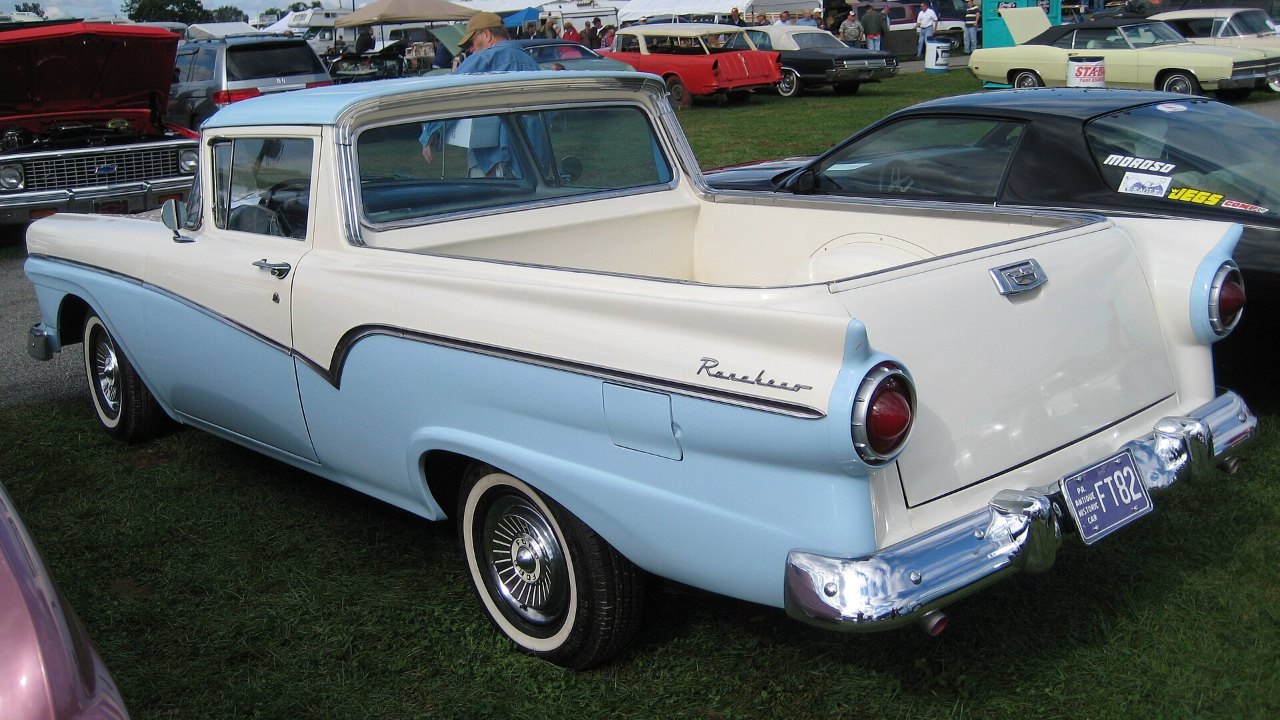
Ford put a pickup bed on a passenger-car body and sold it as the 1957 Ranchero. Chevrolet didn’t answer until the 1959 El Camino, two model years later. The Ranchero and El Camino went on to compete for years. Yet Ford got there first, and by a clear margin.
That head start gave Ford two full model years to sell the idea. Then Chevrolet arrived, and something unexpected happened to Ford’s sales.
How Ford built the first Ranchero
Ford introduced the Ranchero formally on December 6, 1956, about three months after the rest of the 1957 Ford car line went on sale. The idea wasn’t brand new to Ford. In fact, Ford’s Australian arm had been building coupe utilities, or “utes,” for decades before the Ranchero appeared.
The American version kept costs low by borrowing heavily. According to Mac’s Motor City Garage, the Ranchero shared its chassis and most of its sheet metal with the two-door Ranch Wagon. Hagerty adds that it rode on the same 116-inch wheelbase as the Ranch Wagon and the Courier sedan delivery. Ford’s sales line summed it up: “More than a Car, More than a Truck!”
What a 1957 Ranchero offered
Ford sold two versions in 1957. The base Ranchero cost $2,098, while the Ranchero Custom cost $2,149, as Mac’s reports. For that extra money, the Custom added an upgraded interior and twin sun visors. Buyers also got more paint colors and bright metal trim along the sides.
Under the hood, the standard engine was a 223-cubic-inch inline six with 114 horsepower. Buyers could also step up to V8 power. Mac’s lists a 190-horsepower, 272-cubic-inch Y-block for the base Ranchero and a 220-horsepower 292 for the Custom.
Sales started strong. Hagerty counts 21,696 Rancheros in the launch year, and Mac’s puts the figure at nearly 22,000. However, the second year was a different story. Hagerty reports that only 9,950 left the factory for 1958, fewer than half the 1957 total. As a result, Hagerty calls the 1958 the rarest Ranchero.
When the Ranchero and El Camino met
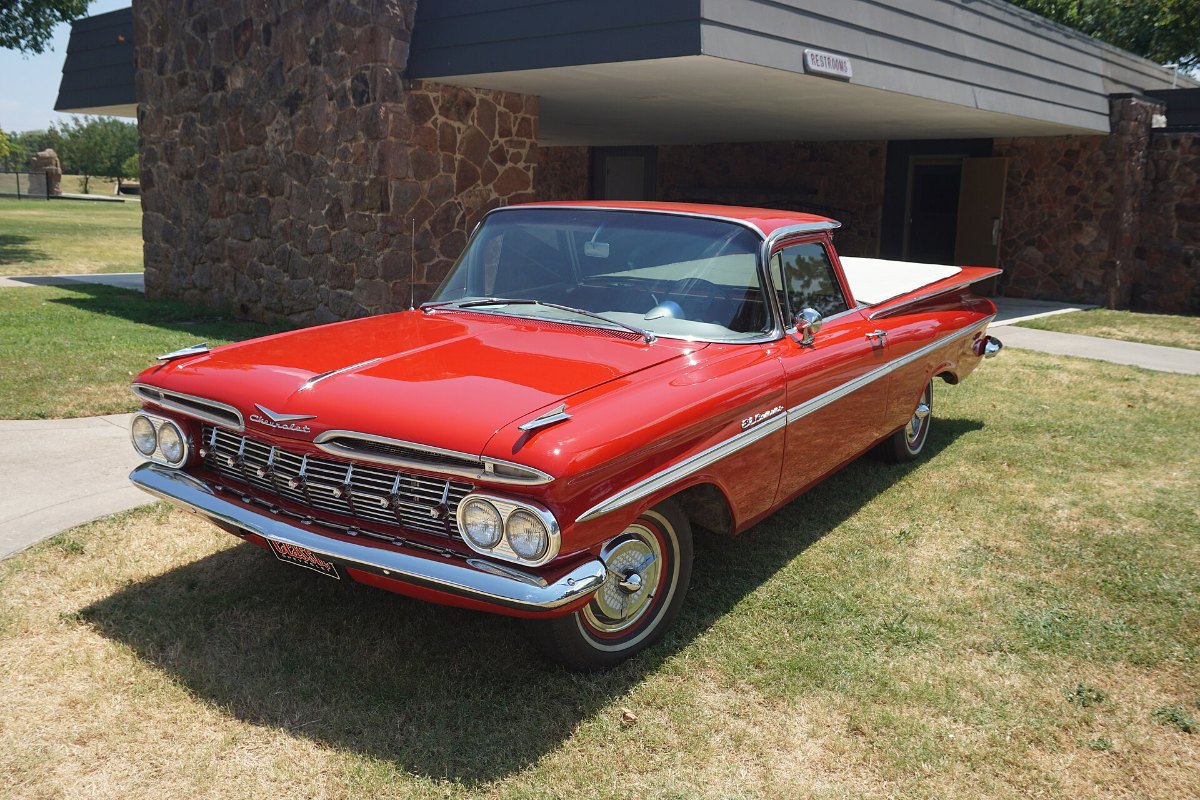
Chevrolet finally responded for 1959. Hagerty’s El Camino profile describes the car as Chevrolet’s answer to the Ranchero. It launched the same year as the full-size Chevrolet’s dramatic “gullwing” rear styling.
Like the Ranchero, the El Camino borrowed its drivetrains from the passenger cars. Hagerty says the choices ran from the “stove bolt” six to the 283 V8 and the big-block 348. So Chevrolet buyers could order anything from an economy six to a big-block. Today, Hagerty notes, cars with the 348 bring a premium.
Surprisingly, the new rival helped Ford. According to Hagerty’s history of all seven Ranchero generations, Ranchero sales rebounded 50 percent once the El Camino arrived. In other words, two car-pickups in the market drew more attention than one.
Seven generations of the Ranchero
After 1959, the two cars went separate ways. For 1960, Ford moved the Ranchero to the compact Falcon and its 109.5-inch wheelbase, according to Hagerty. That smaller Ranchero stayed in production through 1965.
Next came the move to midsize. Hagerty dates the third generation to 1966–67, when the Ranchero became a Fairlane on a 113-inch wheelbase. After that, Hagerty lists four more generations: 1968–69, 1970–71, 1972–76 and 1977–79. The fourth generation drew on both the Fairlane and the Torino. Finally, the Ranchero ended with the 1979 model year, according to Hagerty.
What happened to the first El Camino
Chevrolet’s first try, by contrast, lasted only two years. The CLASSIC.COM market page lists the first-generation El Camino for the 1959 and 1960 model years only. Then the second generation took over in 1964.
Today, the first El Caminos draw real money. CLASSIC.COM listed the average price of a first-generation El Camino at $63,818 when we checked on October 1, 2026. Meanwhile, the Ranchero’s production record speaks to its staying power. Hagerty counts 508,355 Rancheros sold over 22 years, with the best years being 1972, at 40,334, and 1973, at 45,741.
More from Fast Lane Only
- Unboxing the WWII Jeep in a Crate
- 15 rare Chevys collectors are quietly buying
- 10 underrated V8s still worth hunting down
- Police notice this before you even roll window down
This article was created with the help of AI and was reviewed and edited by Fast Lane Only editors before publication.