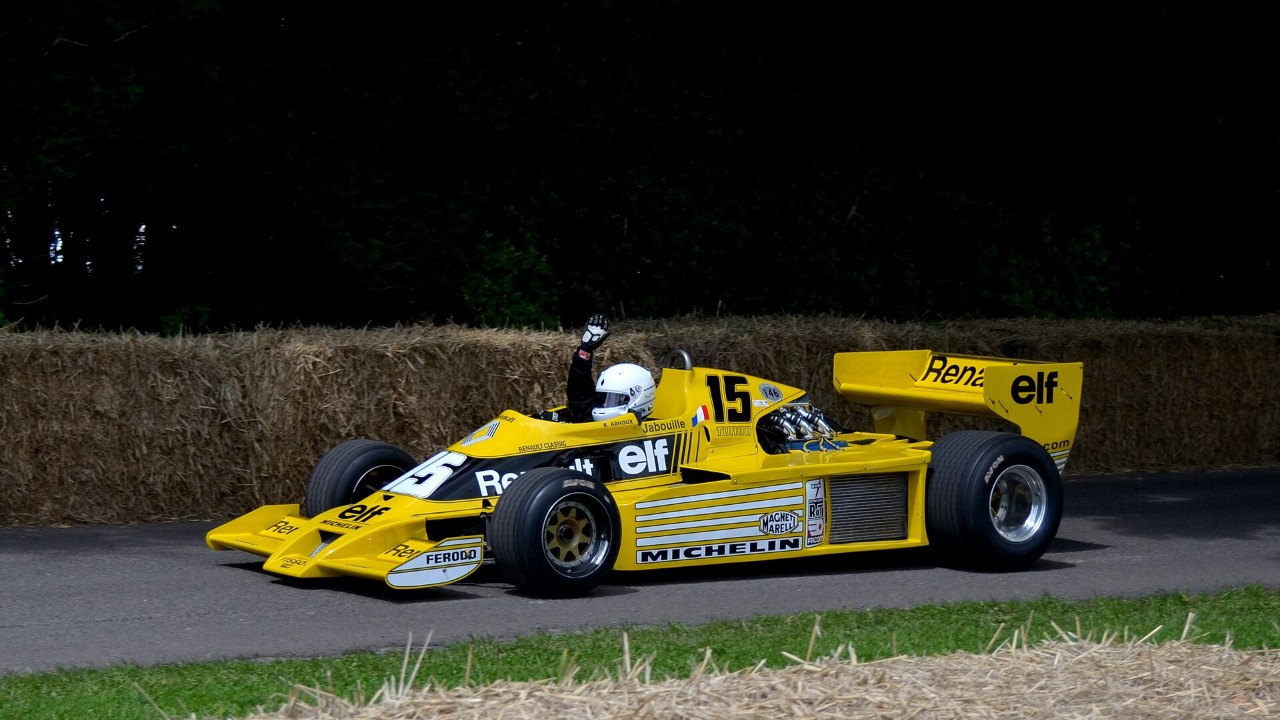
The Renault RS01 lined up for the British Grand Prix at Silverstone in July 1977 with an engine half the size of everyone else’s. It was a 1.5-liter V6 with a turbocharger, and no Formula 1 car had raced with one before. For more than a year, it mostly broke down in a cloud of smoke.
That smoke gave the car a nickname that stuck. Yet the same little engine went on to take Renault to pole positions and, in a later car, Grand Prix wins. The story starts not in Formula 1, but at Le Mans.
Here is how the Renault RS01 came to be, what made it so different, and how long it took to work.
An engine born at Le Mans
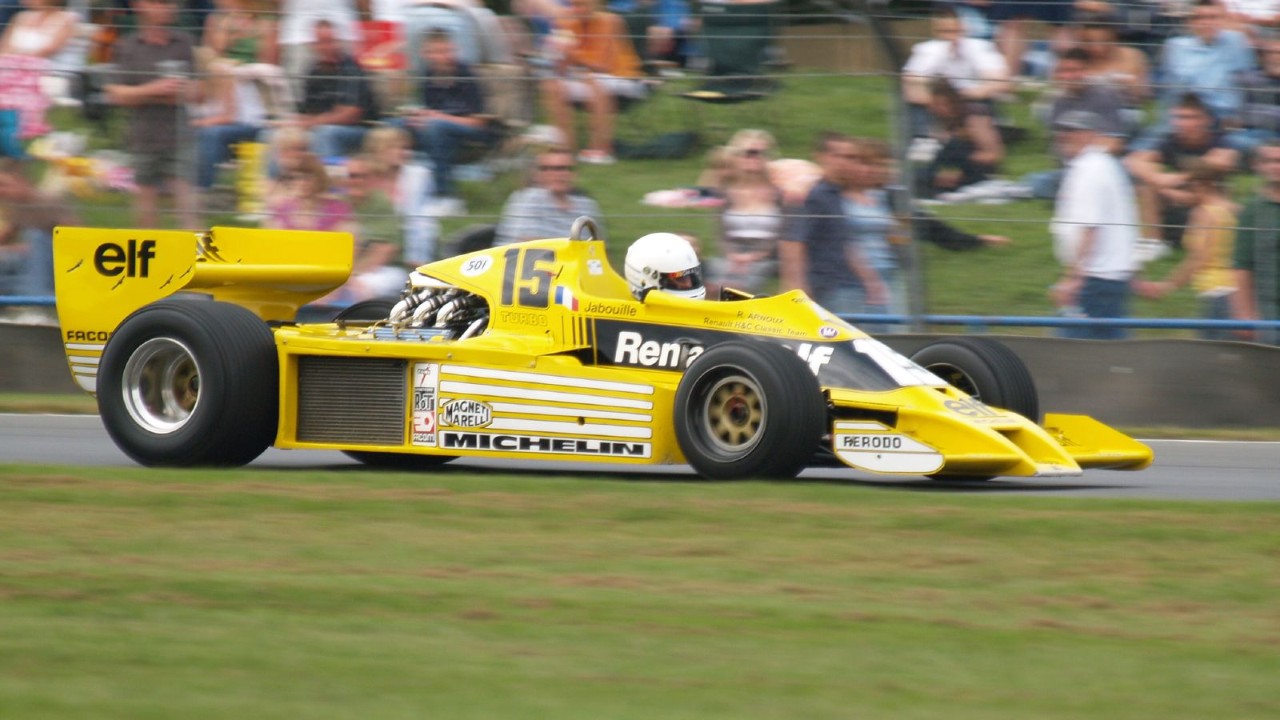
Renault tried turbocharging in endurance racing first. According to the Le Mans organizer’s history of the program, the company ran a turbocharged engine at the 1975 race in an Alpine A441. Marie-Claude Beaumont and Lella Lombardi drove it. However, that car did not finish.
Then the effort grew. In 1977, Jean-Pierre Jabouille and Derek Bell put a Renault-Alpine on pole at Le Mans and led until they retired on Sunday morning. About a month later, Renault’s V6 turbo made its Formula 1 debut at Silverstone.
In fact, the two programs shared the same basic engine. Renault’s own heritage site says it first ran in endurance form as a 2-liter unit, developed with its oil partner Elf. For Formula 1, the capacity came down below 1,500 cc. Meanwhile, the 2-liter version went on to power the Alpine A442B that won Le Mans in 1978.
Why the Renault RS01 was different
The rules made room for the idea. As Goodwood explains, Formula 1 allowed 3.0-liter engines without forced induction or 1.5-liter engines with it. By contrast, every other team chose the bigger, naturally aspirated route, with eight or twelve cylinders.
Renault went the other way. Goodwood describes the engine as a cast-iron 90-degree V6 with a single turbocharger mounted below it. André de Cortanze, meanwhile, designed the car itself. In addition, it ran on Michelin radial tires, the first non-crossply tires in Formula 1.
The numbers on Renault’s heritage page are modest by today’s standards. It lists 1,492 cc and 525 horsepower at 10,500 rpm. Top speed was around 300 km/h, depending on setup. Also, the car measured 4.50 meters long and 2.00 meters wide. Renault says it built four of them.
The Yellow Teapot years
The debut was short. Jabouille retired from the 1977 British Grand Prix, Goodwood notes. Renault then entered four more races that season. The RS01 retired from three of them and failed to qualify for the fourth.
Even so, the next year was not much kinder. Goodwood counts nine retirements in 1978. Engines failed often, and each failure sent smoke pouring out of the yellow car.
That, in turn, is where the name came from. On its heritage page, Renault itself says “the billowing smoke rising each time earned the RS01 Turbo the nickname ‘Yellow Teapot.’” Goodwood credits rival team boss Ken Tyrrell with reportedly coining a version of it, the “Yellow Kettle.” Either way, the nickname was not meant as a compliment.
The first points and the first pole
Patience paid off late in 1978. At Watkins Glen, Jabouille finished fourth in the United States Grand Prix. According to the Le Mans organizer’s history, that was the Renault V6’s first Formula 1 points finish. Goodwood adds that it came at the 15th round of the season.
The timing was neat, too. Only a few months earlier, Didier Pironi and Jean-Pierre Jaussaud had given Renault its first Le Mans win in the A442B. Jabouille, for his part, had been part of the turbo program since 1975, the organizer notes.
The real sign came the following spring. Goodwood says Jabouille took the first Formula 1 pole for a turbocharged car at the 1979 South African Grand Prix at Kyalami. By then, René Arnoux was driving a second RS01 for the team.
What the RS01 started
The RS01 did not win a Grand Prix itself. Instead, it led to the twin-turbo RS10. In that car, Jabouille won the French Grand Prix on home soil in 1979, as the Le Mans organizer recalls.
Renault’s own record keeps the RS01 at the start of the line. Its heritage page calls it the company’s first Formula 1 car. The same page counts 35 victories, 103 podiums, 51 pole positions and two drivers’ world championships, in 2005 and 2006.
More from Fast Lane Only