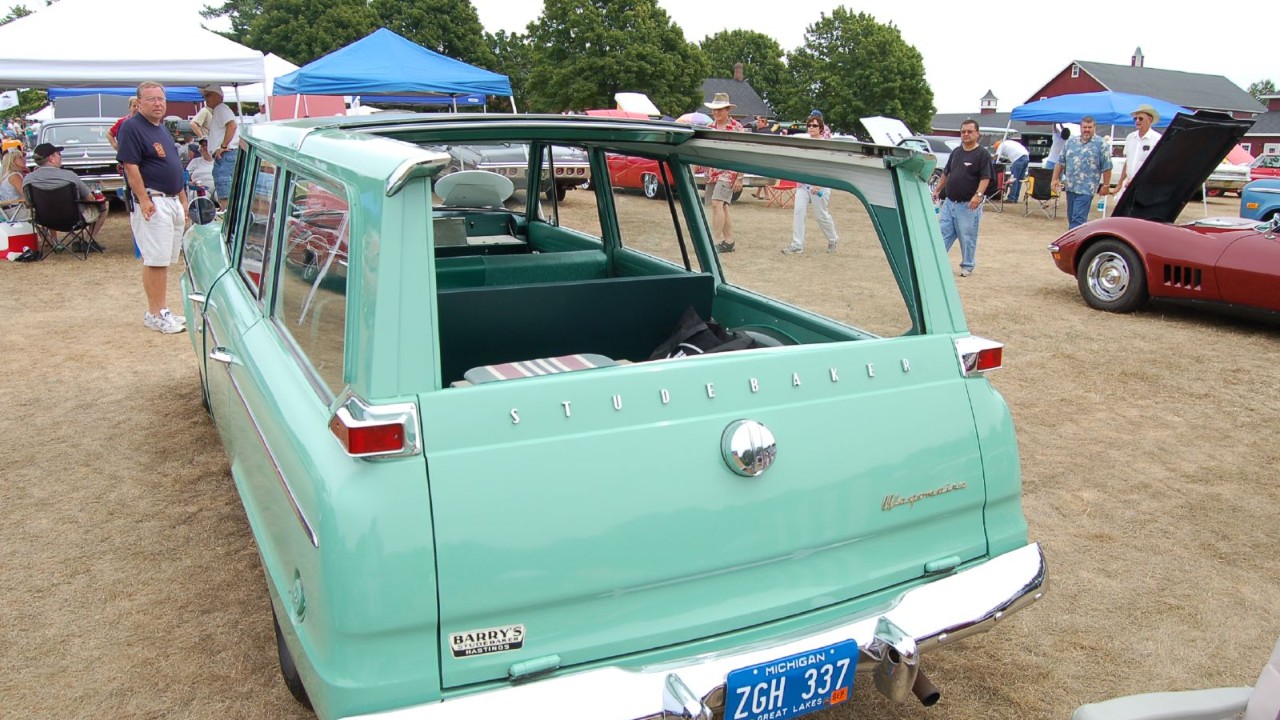
The Studebaker Wagonaire looked like an ordinary Lark station wagon from the curb. Then the owner pushed the rear section of the roof forward, and the cargo bay opened to the sky. Suddenly the wagon could carry tall loads standing upright. It was a clever answer from a small automaker that badly needed one.
Studebaker was the underdog of Detroit in the early 1960s. It built cars in South Bend, Indiana, without the budgets of GM, Ford or Chrysler. As a result, every new idea had to be cheap to make and easy to sell. The sliding roof checked both boxes, at least on paper.
What follows is the story of how that roof came to be, how it worked, why it leaked, and why the idea came back four decades later under a different badge.
Where the Studebaker Wagonaire idea came from
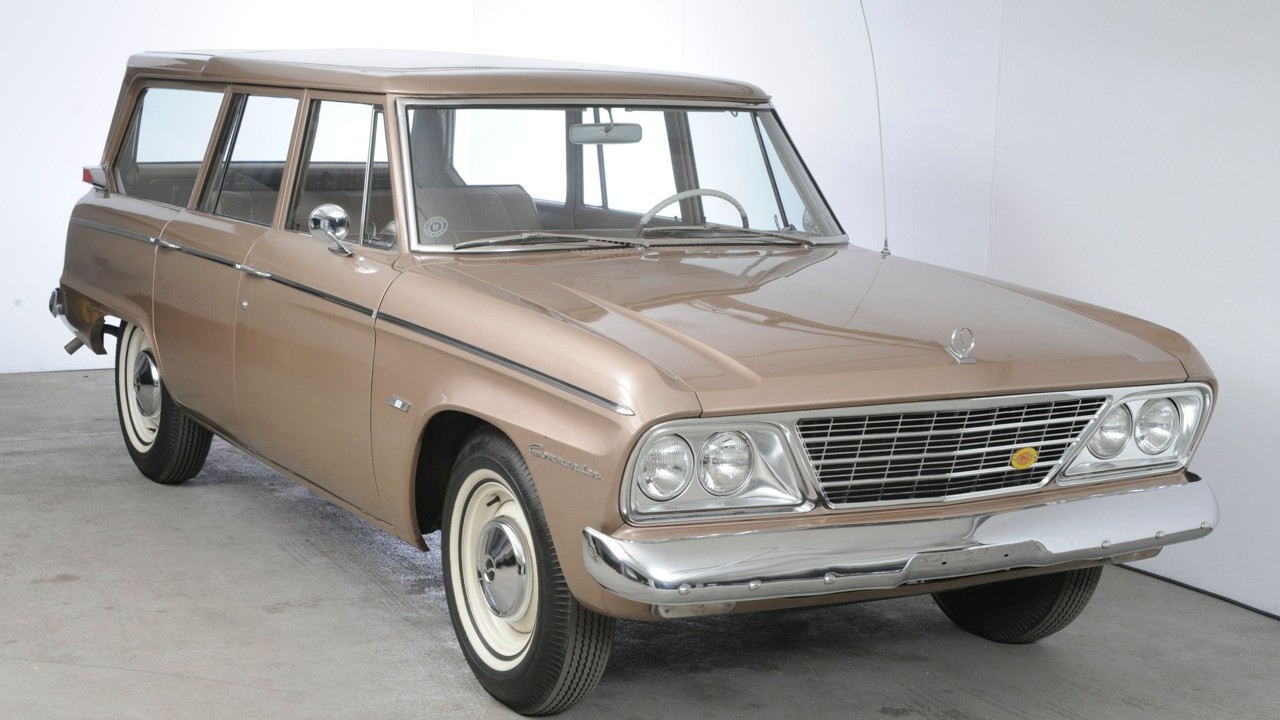
The roof traces back to industrial designer Brooks Stevens of Wisconsin. According to Mac’s Motor City Garage, Stevens built a set of 1959 experimental cars called the Scimitar for the Olin Corporation. One of them was a pillarless hardtop wagon called the All-Purpose Sedan, and its roof slid to open the cargo area.
Studebaker president Sherwood Egbert, a friend of Stevens, wanted low-cost ways to broaden the product line. So he turned to the designer, who had also restyled the Lark’s sheet metal for 1963. Curbside Classic adds that Egbert knew Stevens from his years at McCulloch. In 1962, Stevens built prototypes, including a wagon he called the Skyview.
The result went on sale as part of the 1963 Lark range. In fact, Curbside Classic notes that every Lark station wagon that year was a Wagonaire. Car and Driver puts the debut in September 1962.
How the sliding roof worked
The mechanism was simple, which was the whole point. A pair of tracks let the rear roof panel slide forward and tuck under the front section, above the headliner. The design also built in extra height so the panel had room to clear. Meanwhile, the tailgate window rolled down, so the back of the wagon opened from the floor to the open sky.
That combination is what made tall loads possible. For example, a buyer could stand a tall object upright in the cargo bay instead of laying it flat. Mac’s Motor City Garage also notes a folding step built into the inside of the tailgate, which helped people climb up to load the bay.
The rest of the car stayed familiar Lark. The four-door wagon rode on a 113-inch wheelbase, and buyers in 1963 could choose Standard, Regal or Daytona trim. Under the hood, Car and Driver lists a 170-cubic-inch six rated at 112 horsepower and a 259-cubic-inch V8 at 180 horsepower. On top of that, a 289-cubic-inch V8 rated at 225 horsepower was optional.
The leak problem
The open roof had a weakness that showed up almost at once. Mac’s Motor City Garage says the sliding panel was nearly impossible to seal against rain and snow. Instead of a perfect seal, Studebaker used drain tubes to carry water away from the cabin.
Those tubes were not always enough. One owner told Curbside Classic that the drains were never large enough and overflowed in heavy rain. On his own car, the seams were taped over. However, Studebaker did respond. Car and Driver reports that in January 1963 the company began offering a fixed-roof version as a delete option. According to Curbside Classic’s look at a period road test, that version cost $100 less.
What Motor Trend found
Motor Trend tested a 1963 Wagonaire with the 180-horsepower 259 V8 and a Borg-Warner three-speed automatic. The wagon ran from 0 to 60 mph in 15.6 seconds and topped out at 84 mph. By comparison, the testers noted that a full-size Chevrolet Bel Air six with Powerglide reached 95 mph.
Surprisingly, the test car did not leak during the rain it met. Still, the magazine found other faults. With the roof open, the moving wagon drew road dust and exhaust fumes in through the back. The steering was also slow, at a little more than 4.5 turns from lock to lock.
Sales, Canada and the end of the line
The Wagonaire’s best year was its first. Car and Driver says Studebaker built 11,915 of them in 1963, a figure that fell well short of what management had hoped. Mac’s Motor City Garage adds a fun footnote: Movietone News reportedly ran a fleet of 30 Daytona Wagonaires as mobile camera platforms.
Then Studebaker’s troubles caught up with it. The South Bend plant closed in December 1963, and production moved to Hamilton, Ontario. Studebaker dropped the Avanti and Gran Turismo Hawk at that point, but the Wagonaire stayed in the lineup for 1964, 1965 and 1966. According to Car and Driver, fewer than 20,000 were built in total through 1966.
The idea that came back
The sliding roof did not die with Studebaker. In 2004, General Motors revived the concept as the GMC Envoy XUV, which paired a retracting rear roof panel with a fold-down midgate. However, buyers again proved hard to win. Mac’s Motor City Garage notes that GM dropped the Envoy XUV in 2005 because of weak interest.
In our view, the Studebaker Wagonaire remains one of the cleverest wagons Detroit ever built, leaks and all. A restored 1963 Lark Daytona Wagonaire in Rose Mist, with the optional 289 V8 and power front disc brakes, drew Car and Driver’s attention when it came up on Bring a Trailer in 2024. Canadian Wagonaire production, the last of the line, ended on March 16, 1966.
More from Fast Lane Only