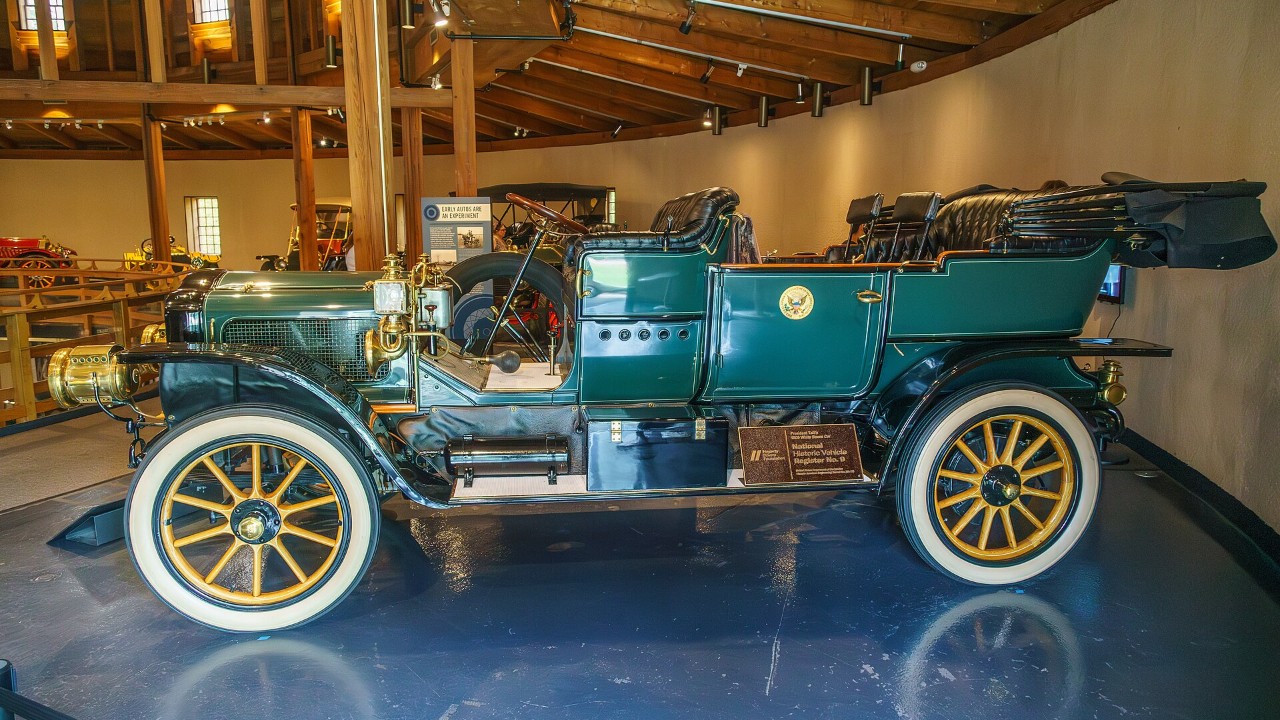
Taft’s White steamer was the car that pushed horses out of the White House. In 1909, William Howard Taft turned the executive stables into a garage. Then he filled it with four cars: two Pierce-Arrows, a Baker Electric and a steam-powered White.
That small fleet marked a real turn in presidential travel. Heritage Museums & Gardens, which displays the White today, calls Taft the first president officially transported by automobile rather than by horse and carriage. In other words, the carriage era at the White House ended with him.
Here is how the garage came together, what each car was, who drove them and where the president’s steam car sits today.
How Taft’s White steamer reached the White House
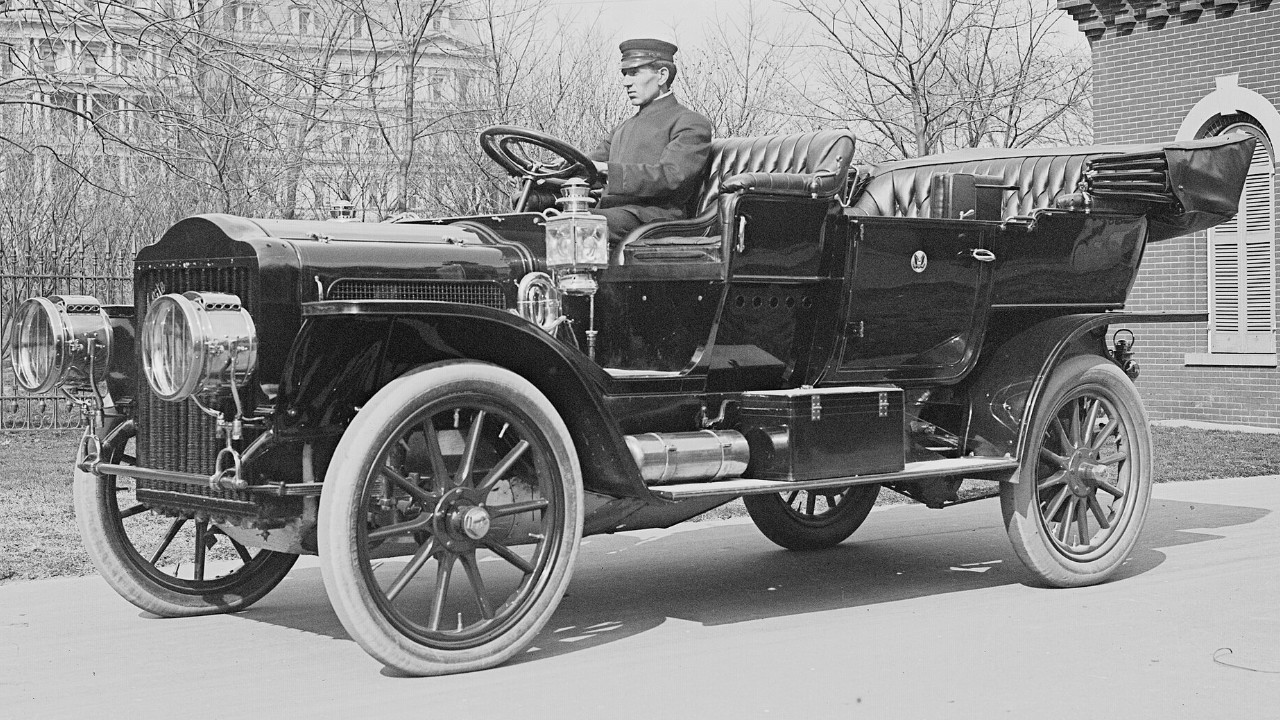
Money came first, and it took a fight. According to the White House Historical Association, Congress appropriated $12,000 in 1909 for the first White House motor cars “despite heated protests.” Hillary Mannion’s history of the episode, published in White House History in 2010, calls the incoming president “an automobile enthusiast.”
The steam car came from Cleveland, Ohio, Taft’s home state. Its maker, the White Motor Company, was a branch of the White Sewing Machine Company, the association notes. The car itself was a Model M, a seven-passenger touring car rated at 40 horsepower.
Meanwhile, the stables had to make room. The Henry Ford says Taft converted the mansion’s stables into a garage. By 1909, it held the White steam car, two gasoline Pierce-Arrows and a Baker electric.
Why a president chose steam
In 1909, the best fuel for a car was not yet settled, The Henry Ford explains. So Taft showed no preference among steam, gasoline and electric power. Instead, he bought all three, and he favored two Cleveland makers, White and Baker.
Even so, he had a clear favorite. “The President preferred the White steamer,” the museum writes. Heritage Museums & Gardens adds a livelier detail. The president, it says, would use bursts of steam to ward off pesky press photographers.
Heritage’s specification sheet explains the hardware. The car runs a two-cylinder, double-acting engine with a steam vapor recovery system. It displaces 120 cubic inches, or about 2 liters, and the museum rates it at 40 horsepower.
It was not a cheap machine, either. The museum lists its price new at $4,000. For comparison, it puts the average annual income in 1909 at just $544.
The Pierce-Arrows and the Baker Electric
Gasoline power came from Buffalo, New York. The White House Historical Association describes one Pierce-Arrow as a “six cylinder 48 horsepower suburban car.” Its main color was blue. Additionally, the association lists a 1909 Pierce-Arrow landaulet among the Taft-era cars.
The Baker, however, belonged to the first lady. Helen Taft chose it as her personal car, and she was “not content to be chauffeured around Washington,” The Henry Ford says. Instead, she drove it herself.
Three years later, Mrs. Taft traded the 1909 Baker for a new 1912 Baker Electric valued at $2,000. Records show she paid only $809.50, the museum notes. That 1912 car had a top speed of about 30 mph and a range near 50 miles.
It also outlasted the Tafts by years. Ellen Wilson, Edith Wilson, Florence Harding and Grace Coolidge all used it. The White House finally retired the Baker in 1928, and soon afterward it went to The Henry Ford.
The men behind the wheel
A president with four cars needed drivers. The White House Historical Association names two of them. George Robinson drove the big steam car, while Abe Long drove the Pierce-Arrow.
Long was still at the wheel three years later. In 1912, he was the chauffeur when Alice Roosevelt Longworth posed in the Taft Pierce-Arrow landaulet, according to the association.
Taft also gave the new industry a public voice. In 1910, he became the first president to attend an auto show, held in Washington. That May, he told visiting Virginia motorists, “I am a motorist myself and know what it means to travel over rough roads.”
What happened to the old stables
The horses’ building did not survive long. In July 1911, the Washington Times reported that crews would begin tearing down the White House stables “within the next few days.” Ghosts of DC reprinted that report in 2012.
According to the 1911 article, the stables went up during Ulysses S. Grant’s first term. After that, every president used them until Taft. The demolition contract went to T. Edward Clark for $59. By then, the stable’s only animal was Pauline, the president’s cow.
Where Taft’s steam car is now
Today, the White lives on Cape Cod. Heritage Museums & Gardens in Sandwich, Massachusetts, shows it in its J.K. Lilly III Automobile Gallery. The museum catalogs it as a 1909 White Steam Car Model M.
The car also holds a federal honor. In 2016, it became the ninth vehicle added to the National Register of Historic Vehicles, Heritage Museums & Gardens says. As a result, the steam car that once puffed at photographers is now a documented piece of national history.
More from Fast Lane Only